Thread Lift Cost: What to Check on a Quote
Thread lift quotes vary between clinics mainly because of thread type, treatment area, placement design, and what's included, not the thread count. Before comparing, check whether your concern is sagging or lost volume.

If you've collected face thread lift quotes from a few clinics, you've probably noticed they don't line up. One clinic lists a thread count and a total, another lists a different count and a very different total. It's tempting to set the numbers side by side and pick, but the thread count is only one line on the quote, and it's rarely the line that explains the gap.
The short answer? Quotes differ mainly because of four things written (or left out) next to the count: the type of thread, the area being treated, how the threads are placed, and what's included in the price. And there's an even earlier question: has the tissue in your lower face come down, or has volume gone missing? That decides whether a thread lift quote is the right quote to be comparing at all.
In this article, we'll walk through that first decision, what the research says about thread count, the four lines to check on every quote, and the side effects worth knowing before you book.
Sagging or Hollowing? Decide This Before Comparing Quotes
When your smile lines and the corners of your mouth start to look deeper, two different changes are often happening at once. The first is descent: the skin, along with the fat and fascia (a thin connective layer) beneath it, has shifted downward with gravity. The second is volume loss: fat in the inner cheek has shrunk, so the skin over it looks like there's more of it than there is support underneath.
These two problems call for different tools. Threads are designed to lift and hold tissue that has come down. Filling a space that has emptied out is a job for filler. A thread lift quote only makes sense to compare if descent is a meaningful part of what you're seeing.
Research tends to split the roles the same way. A prospective study that followed 11 Korean patients for 24 months describes thread lifting as a procedure aimed at gravitational tissue ptosis (sagging) and combined PDO threads with hyaluronic acid (HA) filler for lost volume. At 24 months, 9 of the 11 patients reported consistent satisfaction or improvement. Keep in mind it was a small pilot without a control group, and because filler and threads were used together, it can't tell you what threads alone would do. What it does show is how the two jobs are divided.
There's a simple way to get a rough sense of it at home:
- Lie down and look again: If your smile lines get noticeably shallower when you lie flat, descent is likely a bigger part of the picture.
- Hollow either way: If the area looks about as hollow lying down as it does sitting up, volume loss is likely playing a larger role.
- A mix of both: Many faces have some of each, so the final proportion is something your doctor should assess layer by layer in person.
Our doctors' view is straightforward. If the main issue is descent, a thread lift is the conversation to have, and placing threads while sagging is just starting is a bit like saving ahead: you're setting aside time before the tissue drops further. If the main issue is hollowing, adding more threads won't fill the space, and a filler plan should come first. Everyone's face is different, so individual results vary.
Do More Threads Mean More Lift?
Not necessarily, at least according to the one trial that tested it head to head. Count gets compared because it's usually the only number printed on the quote, so it feels like the obvious yardstick.
In a randomized controlled trial of 22 patients, researchers placed either 3 or 6 PDO threads per side of the face and measured the results with 3D stereophotogrammetry (three-dimensional photographic measurement) at 20 and 60 days, finding no significant differences between the two groups. The same study also reported that the initial improvements in both groups had diminished by the 60-day mark.
That doesn't mean fewer threads are better. The follow-up was short and only one type of thread was used, so it's not a reason to cut your count. What it does suggest is a direction: thread count alone doesn't decide the outcome. With the same number of threads, which thread goes in, at what layer, and in which direction becomes the real substance of the quote.
The fading by 60 days is worth taking seriously, too. It's a good reason to ask any clinic how long results typically last for someone like you, and when a repeat session would likely come up.
The Four Lines to Check on a Thread Lift Quote
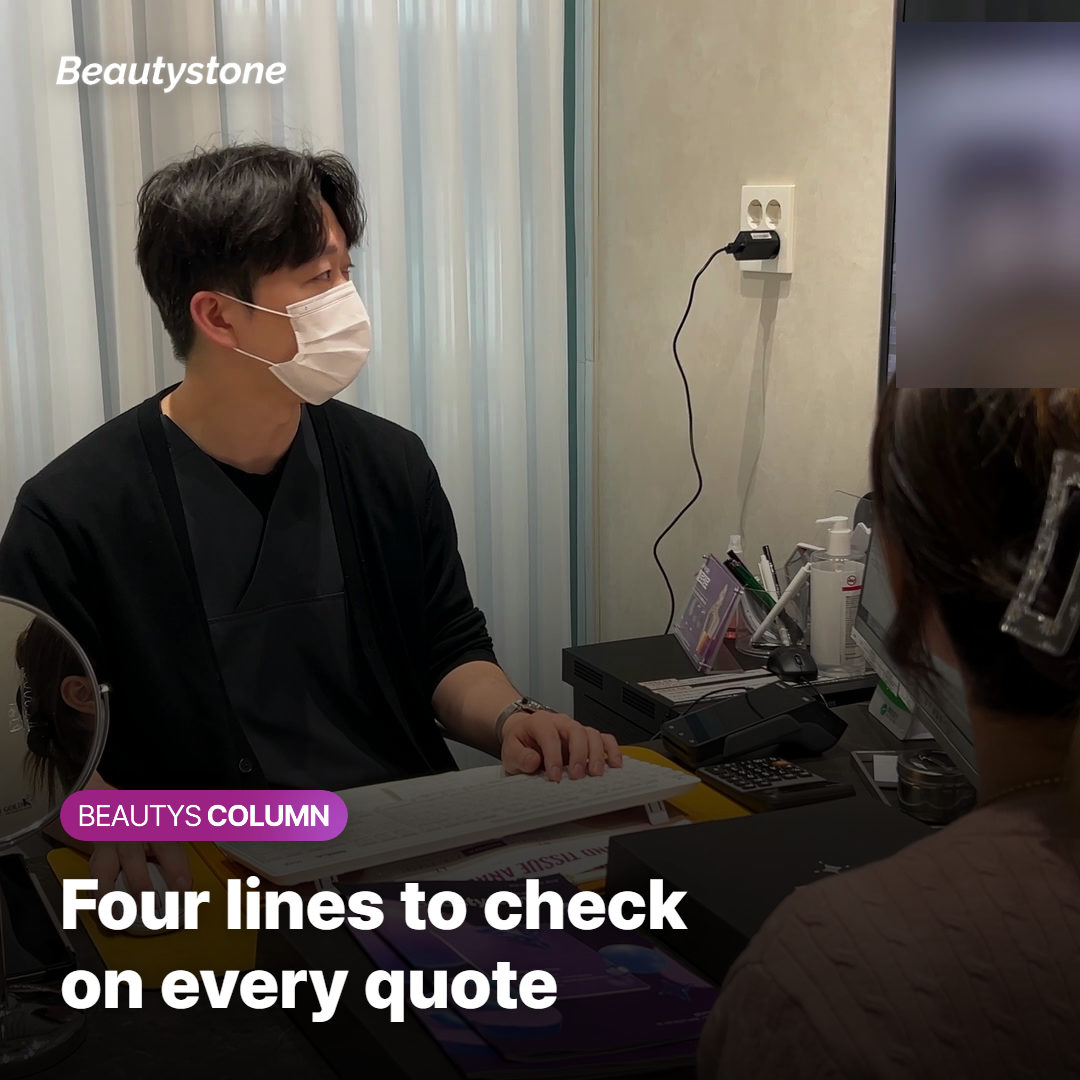
If these four lines are blank on a quote, there's no way to tell where the price difference is coming from. Try filling in the same boxes for every quote you've received:
| Line to check | Why the price differs | What to ask |
|---|---|---|
| Thread type | Barbed ("cog") threads and smooth threads do different jobs, so the same count isn't the same value | Which threads are you using, and how many of each? |
| Treatment area | Smile lines alone versus smile lines plus jawline and mouth corners changes how much is needed | Can you point to exactly which areas this quote covers? |
| Placement design | The direction and depth of each thread shape both the lift and the risk of dimpling | Which direction will the threads run, and at what depth? |
| What's included | Numbing, a follow-up check, and touch-ups are bundled differently from clinic to clinic | Are follow-up visits and touch-ups included? |
A barbed thread has tiny projections along its surface that catch on the surrounding tissue, which is what creates the lifting pull. Smooth threads don't grip in the same way. Because they aren't doing the same job, a quote that lists a thread count without naming the type isn't really comparable to one that does.
It's also worth asking whether the thread is absorbable. Most facial thread lifts today use dissolving materials like PDO (polydioxanone), and as we'll cover in the FAQ, absorbable threads have been linked to fewer reports of some complications.
At Beautystone, the price of a thread lift comes from our clinic's price list. Once the treatment area and the thread type are set during your consultation, we'll quote you based on that list. When all four lines are filled in, quotes from different clinics finally line up in the same units.
Side Effects and Risks: What's Normal and When to Call
A meta-analysis that pooled 26 studies on facial thread lifting reported how often each reaction came up across the research:
- Swelling: about 35%
- Skin dimpling: about 10%
- Paresthesia (altered sensation, such as tingling or numbness): about 6%
- Thread visibility or palpability (you can see or feel it): about 4%
- Infection: about 2%
- Extrusion (a thread working its way out): about 2%
Dimpling was reported more often in patients over 50, at 16% compared with 5.6% in younger patients. The studies used different threads and techniques, so treat these figures as general background rather than a prediction for your face.
Dimpling happens when the skin at a pull point gets drawn inward and forms a small dent, which is why it's closely tied to how the thread's direction and depth are planned. At Beautystone, threads are placed in a reverse direction so that dimpling does not form where the tissue is pulled. It's a placement approach aimed at lowering that risk, and like any technique, it can't rule out every reaction.
Here's how to tell the usual from the unusual:
- Usually normal: Swelling and a feeling of tightness that ease a little more each day over the first several days.
- Call the clinic that treated you: Redness and warmth that keep growing from one day to the next, any pus, numbness that doesn't fade, or a dent that's still there after several weeks.
Don't wait these out hoping they'll settle on their own. If spreading redness comes with a fever, seek medical care right away.

How to Get Quotes That Actually Line Up
If a thread lift turns out to suit your face, timing matters almost as much as the quote itself. Placing threads when sagging has only just started buys you time, while a face where hollowing dominates usually needs a plan for volume before any conversation about thread count.
A little preparation also makes the consultation far more useful:
- Bring the quotes you already have: Looking at the thread type and treatment area on each one together makes it easy to see where the prices split.
- Describe the area in one line: When you first message us on WhatsApp, note whether it's your smile lines or your jawline that bothers you, and whether it changes when you lie down. That one line helps us think about where threads might go and whether filler should be part of the plan.
- List recent treatments: If you've had a lifting treatment such as Ultherapy recently, share the date and the area treated so the sequence can be planned.
- Mention fixed dates: If you have a wedding, a trip, or a photo shoot coming up, say so early so there's time for swelling to settle.
Beautystone is a clinic in the Hongdae and Hapjeong area of Seoul, so if you're visiting from abroad, sharing your travel dates in that first message helps us suggest a realistic schedule.

The Bottom Line
- Decide first whether your concern is mostly descent (a thread lift question) or mostly hollowing (a filler question).
- In the one head-to-head trial, 3 versus 6 threads per side showed no significant difference, so count alone isn't a fair basis for comparison.
- Fill in the same four lines on every quote: thread type, treatment area, placement design, and what's included.
- Know the difference between swelling that eases day by day and the signs that mean you should call the clinic.
Like any procedure, a thread lift comes with trade-offs, and results can fade over time. Ultimately, the choice depends on your face, your goals, and your budget.
If you're considering a thread lift, a consultation is the clearest way to find out whether it fits what you're seeing in the mirror. You can reach Beautystone on WhatsApp to share your concern and the quotes you've collected.
Frequently Asked Questions
Q. Do absorbable and non-absorbable threads have different side effect rates?
A. In the same meta-analysis of 26 studies, absorbable threads were linked to fewer reports of paresthesia (3.1% versus 11.7%) and extrusion (1.6% versus 7.6%) than non-absorbable threads. Most facial thread lifts now use absorbable materials like PDO, so it's worth checking whether the thread named on your quote is a dissolving type.
Q. Does satisfaction with a thread lift hold up over time?
A. Not always at the same level. The meta-analysis found satisfaction was 98% immediately after treatment but 88% over the longer term, and the authors recommended explaining before treatment that results may not last. That's why it helps to ask about the typical interval for a repeat session and what it would involve.
Q. I had Ultherapy recently. Do I need to wait before a thread lift?
A. The order and spacing depend on which treatment you had and where. If you've had a lifting treatment recently, tell us the date and the area during your consultation so your doctor can plan the timing.
Q. I have a wedding or photo shoot coming up. When should I get a thread lift?
A. It's safer to count backward from the event and leave time for swelling and tightness to settle. If your date is already set, include it in your first WhatsApp message and we'll suggest a treatment day that works around it.