Sofwave vs. Shurink: How Deep Do They Go?
Sofwave and Shurink both get filed under "ultrasound lifting," but they don't reach the same depth under your skin — and that depth difference is the real reason their results look so different.

Sofwave vs. Shurink: Are They Really the Same Ultrasound Lift?
Ask two different clinics about ultrasound lifting and you'll probably hear both Sofwave and Shurink (Ultraformer MPT) come up in the same breath. That's not wrong, exactly — they're both non-surgical devices that use focused ultrasound to trigger new collagen. But if you've seen before-and-after photos of each, you've probably noticed the results don't quite match. One tends to leave skin looking smoother and firmer; the other tends to visibly pull a sagging jawline back up.
In this article, we'll cover exactly where each device's ultrasound energy lands under your skin, why that depth difference changes what kind of result you get, what the safety and recovery picture looks like for each, and how to figure out which one actually fits what's bothering you.
The short version: Sofwave concentrates its energy in one consistent layer of the mid-dermis, while Shurink uses interchangeable cartridges that can reach all the way down to the SMAS — the fibrous layer that structurally supports your face. That depth difference is the whole reason their results feel different, even though both get grouped under "ultrasound lifting."
How Deep Does Each Device's Energy Actually Reach?
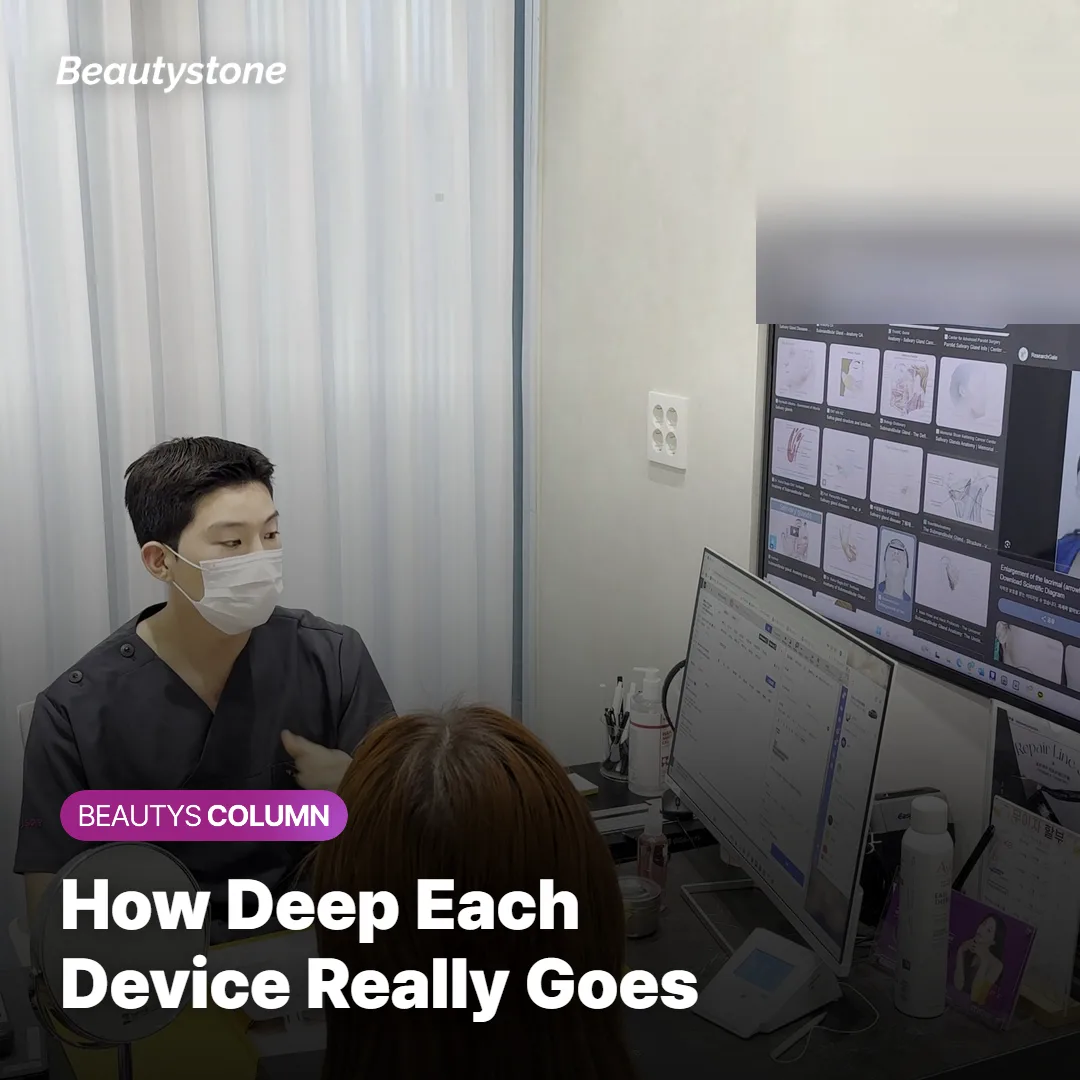
Skin isn't a single sheet — it's stacked layers, and where an ultrasound device drops its energy determines what kind of change you'll see. Just under the surface sits the epidermis, then the dermis (where collagen and elastin live), then a layer of fat, and beneath all of that, the SMAS — a fibrous sheet that acts like scaffolding for your face.
Sofwave is built around a single, fixed depth: roughly 1.5mm, which lands it squarely in the mid-dermis. It doesn't have interchangeable settings for going deeper, and that consistency is part of the design — it's a big reason treatment tends to feel predictable from session to session.
Shurink works differently. It uses swappable cartridges tuned to different depths — typically 1.5mm, 3.0mm, and 4.5mm — so a provider can choose a shallow cartridge for the dermis or a deep one that reaches the SMAS. One review of ultrasound-based lifting devices described exactly this kind of tiered approach, with focal depths adjusted from roughly 1.5mm up to 4.5mm depending on whether the dermis or the SMAS is the target (source).
- Sofwave: one fixed depth, around 1.5mm, mid-dermis only.
- Shurink: multiple cartridges, roughly 1.5mm/3.0mm/4.5mm, dermis through SMAS.
- Deepest reach: only Shurink's 4.5mm cartridge is designed to hit the SMAS layer.
- Why it matters: the layer that heats up is the layer that responds.
What Happens When You Target the Dermis vs. the SMAS Layer?
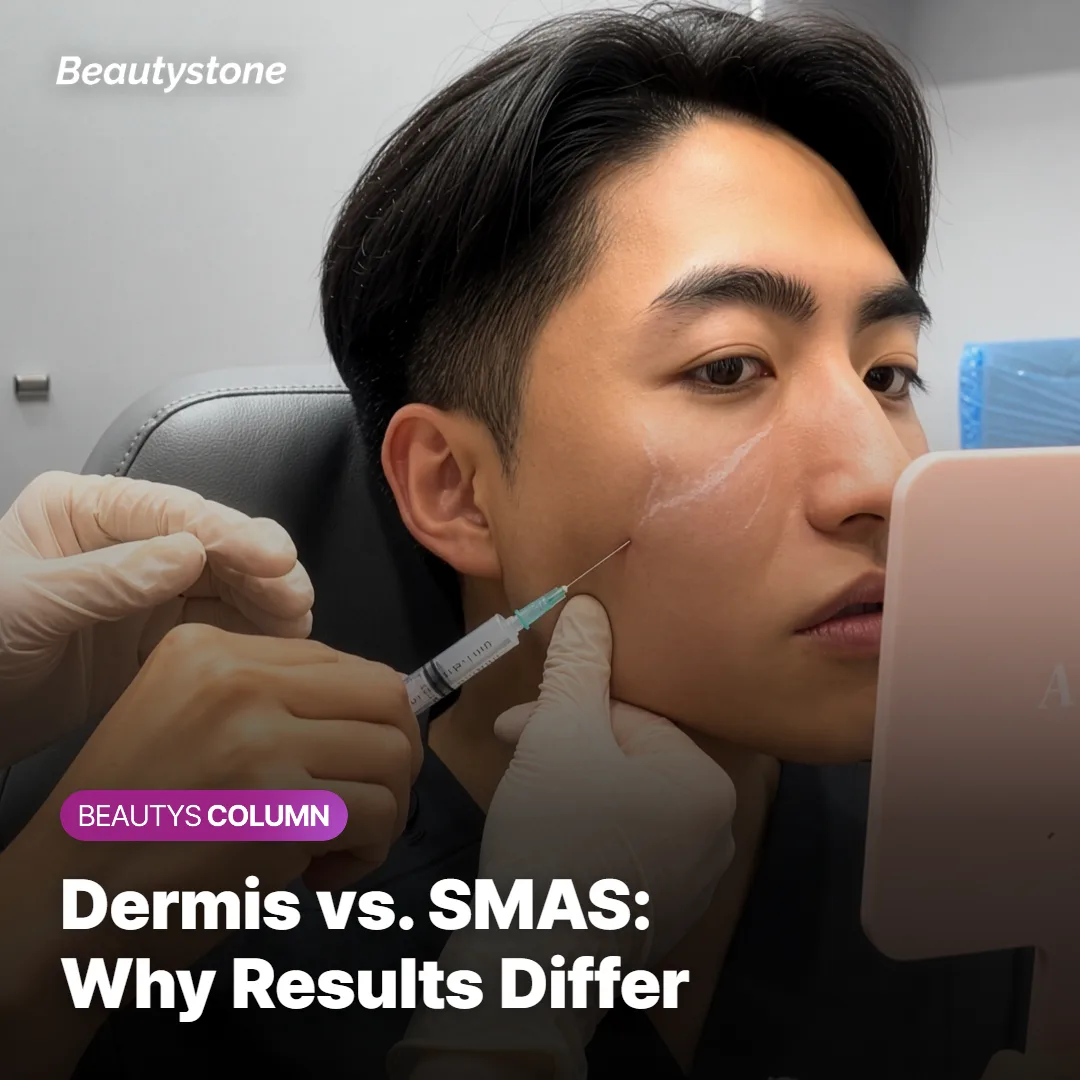
Answer first: heating the dermis tends to firm and smooth the skin itself, while heating the SMAS tends to physically lift sagging tissue. Same energy type, different outcome, because the two layers do very different jobs.
The dermis is where your skin's collagen and elastin actually live, so when Sofwave's thermal points land there, the response is mostly cosmetic — texture gets smoother, fine lines soften, and skin feels a bit more resilient. It reads as a surface-and-just-below-surface refinement rather than a structural one.
The SMAS is a different story. It's connective tissue that wraps around your facial muscles and helps hold your cheeks and jawline in position, more like scaffolding than skin. When Shurink's deep cartridge heats that layer, the tissue contracts and, over the following weeks, rebuilds with new collagen. One study on SMAS-targeted ultrasound described how that heat-induced collagen breakdown and remodeling is what drives the visible lifting effect (source).
| Factor | Sofwave | Shurink |
|---|---|---|
| Primary depth | ~1.5mm (mid-dermis) | 1.5mm–4.5mm (dermis to SMAS) |
| Target layer | Dermis only | Dermis + SMAS |
| Typical result | Smoother texture, firmer skin | Lifted, less sagging jawline/cheeks |
| During-treatment feel | Warm, tingly heat | Warmth plus a deeper pressure at depth |
| Downtime | Usually minimal | Usually mild, sometimes a bit more redness |
Put together, it's less about one device being "stronger" and more about which layer actually needs the help. If your skin's texture is the issue, going deeper doesn't necessarily do more for you — it just treats a layer that wasn't the problem in the first place.
What Results Can You Expect — And How Do They Differ?
Because both devices work by triggering new collagen, neither shows dramatic change on the day of treatment. Results build in gradually, usually becoming noticeable around four to eight weeks out and continuing to develop for a couple of months after that.
With Sofwave, that gradual change usually reads as smoother, tighter-looking skin — fewer fine lines, a bit more bounce to the texture. It's a refinement you might notice more in photos or under certain lighting than as one dramatic before-and-after.
With Shurink's deeper cartridges, people more often describe a visible shift in the jawline or cheek position — less droop along the jaw, a slightly more defined lower face. Because it's targeting a structural layer, the change tends to be a little more obvious to other people, not just to you.
How long either result lasts varies quite a bit from person to person — skin quality, age, and how your body maintains new collagen all play a role, so there's no single number that applies to everyone. Most people talk through a realistic re-treatment interval with their provider based on how their own skin responds the first time around.
Side Effects and Safety: What You Should Know
Both treatments are generally well tolerated, but they're still delivering heat to living tissue, so it's worth knowing what's typical. After either treatment, some redness, mild swelling, and tenderness in the treated area are common and usually settle within a day or two.
Shurink's deeper cartridges tend to produce a more noticeable sensation during treatment — people often describe it as a duller, deeper ache rather than a surface tingle — and recovery can include slightly more redness or a mildly bruised feeling for a couple of days. Sofwave's single, shallower depth tends to feel milder by comparison, though sensitivity really does vary from person to person.
Rare but more serious reactions can include prolonged swelling, bruising, or changes in skin texture with either device. If redness spreads well beyond the treated area, swelling gets worse instead of better, or you develop a fever, contact your provider right away rather than waiting to see if it resolves on its own.
Neither treatment is typically recommended if you're pregnant or breastfeeding, have active skin infections or inflammation at the treatment site, or have certain implants in the treatment area. Always walk your provider through your full medical history before booking, so they can flag anything that's relevant to you specifically.
How Much Does It Cost?
Pricing for both Sofwave and Shurink varies quite a bit depending on the clinic, how much of the face is treated, and how many sessions your provider recommends — Shurink's multi-depth cartridges in particular can shift the price depending on how many layers get treated in one visit. There isn't one number that applies across the board.
A consultation is really the most reliable way to get pricing that reflects your specific skin and goals, rather than a generic estimate — a provider can walk you through current offers at /en/promotion once they've seen what you actually need.
Which One Fits Your Skin — Sofwave or Shurink?
Once you know the depth difference, the decision usually comes down to what's actually bothering you day to day. A few starting points:
- Rough texture or early fine lines: Sofwave's dermis-focused approach tends to be the better match — it's built for refining skin, not repositioning it.
- Sagging along the jawline or cheeks: Shurink's deeper cartridges are designed for exactly this kind of structural lift.
- Both concerns at once: some providers combine a shallow pass with a deeper one, or space the two treatments out — worth raising at your consultation.
- Sensitive skin or downtime concerns: talk through intensity and cartridge depth with your provider, since that's what mostly determines how much sensation and redness you'll deal with.
None of this replaces an actual look at your skin, though. Two people who both describe their concern as "sagging" can have very different amounts of fat versus lost elasticity underneath, and that changes which approach makes more sense.
The Bottom Line
Sofwave and Shurink both fall under "ultrasound lifting," but they're not interchangeable — the depth each one reaches is the whole story. Sofwave stays in the mid-dermis and refines skin texture; Shurink can go deeper, all the way to the SMAS, to address structural sagging.
- Sofwave targets a single depth (~1.5mm) in the dermis — best for texture and early tightening.
- Shurink uses multiple cartridges (1.5mm–4.5mm) that can reach the SMAS — better suited to sagging jawlines and cheeks.
- Both build results gradually over weeks, not instantly, and neither result lasts forever.
- Like any procedure, both come with trade-offs, including temporary redness, swelling, and results that fade over time.
Ultimately, the choice depends on your skin, your goals, and your budget. If you're weighing Sofwave against Shurink, a consultation is the best way to find out which depth actually matches your concern. Beautystone is a dermatology clinic in Seoul's Hapjeong neighborhood — you can see current offers at /en/promotion.
Frequently Asked Questions
Q1. Is Sofwave or Shurink better for a sagging jawline?
Shurink tends to be the better fit for jawline or cheek sagging, since its deepest cartridge can reach the SMAS — the structural layer under the skin that Sofwave's fixed, shallower depth doesn't target. Sofwave is generally a stronger match for skin texture rather than structural sagging.
Q2. Does Shurink hurt more than Sofwave?
Many people describe Shurink's deeper cartridges as producing a more noticeable, duller ache compared to Sofwave's warmer, more surface-level sensation. It varies a lot from person to person, and your provider can adjust the energy or add numbing if either treatment feels like more than you're comfortable with.
Q3. How much does Sofwave or Shurink cost?
Pricing depends on the clinic, the area treated, and how many sessions or cartridge depths your provider recommends, so it's hard to quote one flat number. A consultation is the most reliable way to get pricing specific to your goals — you can also see current offers at /en/promotion.
Q4. Can Sofwave and Shurink be combined in one treatment plan?
Some providers do combine a dermis-focused pass with a deeper SMAS-targeted one, or space the two treatments out, especially if both texture and sagging are concerns. Whether that makes sense for you is really a conversation to have at a consultation, since it depends on your skin and goals.