Ultherapy, Thermage, Shurink: Korea vs US Cost
US averages vs Seoul list prices for Ultherapy, Thermage, and Shurink — do the math yourself.

If you have one tab open on a lifting quote from a clinic near you and another on a Seoul price menu, you are running the exact math this article is about. Here is the short answer first: the two markets do not just charge different amounts — they price in structurally different ways. US quotes are usually all-in, per treatment area. Seoul menus itemize by shot or line count, and a Korean-made device shares the menu with the imported ones. Once you see the structure, the numbers stop being confusing.
One thing to know up front, because it shapes everything below: Ultherapy and Thermage are FDA-cleared devices. Shurink is not FDA-cleared — it is a Korean device authorized by Korea's MFDS*, and the same machine is not distributed in US clinics. That is context for reading price menus, not a pitch; all three sit side by side on Seoul price lists, which is exactly why the comparison gets interesting.
MFDS*(Ministry of Food and Drug Safety): Korea's national regulator for medicines and medical devices — the Korean counterpart of the FDA.
What you'll learn

  · How Ultherapy, Thermage, and Shurink differ — energy type, depth, and US regulatory status
  · What published US price data reports, and what those figures do and do not include
  · How Seoul clinics structure lifting prices, and why the menus look so different
  · When you can fly home, and how to plan treatments inside a single trip
Ultherapy, Thermage, Shurink: what actually differs
All three get filed under "lifting," but they are different machines doing different jobs. Ultherapy delivers micro-focused ultrasound — the HIFU* approach — placing small points of heat at set depths under the skin to trigger a collagen response. Its manufacturer's official site states the system is FDA-cleared to lift the eyebrow, the skin on the neck and under the chin, and to improve lines on the décolleté. Thermage works differently: it uses monopolar radiofrequency to warm the deeper skin layers as a broader field rather than discrete points, and its maker announced FDA 510(k) clearance for the current Thermage FLX system in 2017. Shurink is also a HIFU device, but a Korean-made one — a staple of Seoul clinics, authorized by the MFDS, and not sold in the US.
HIFU*(high-intensity focused ultrasound): ultrasound energy focused on a small point under the skin, where it creates heat. Ultherapy and Shurink both use this approach.
| Ultherapy | Thermage | Shurink | |
|---|---|---|---|
| Energy type | Micro-focused ultrasound (HIFU) | Monopolar radiofrequency (RF) | HIFU |
| US regulatory status | FDA-cleared device | FDA-cleared device | Not FDA-cleared; MFDS-authorized in Korea |
| Onset of visible results | Gradual — manufacturer's gallery benchmarks results at 180 days | Gradual — maker cites measurable results over 2–6 months | Gradual over weeks to months, as commonly described; varies |
| How long results tend to last | Up to a year or more in the face, per manufacturer | 1–2 years depending on skin condition, per manufacturer | Often described as roughly 6–12 months; confirm at consultation |
| Downtime | Typically none — most resume normal activities same day | Little to none, per manufacturer | Typically none; short-lived redness or tenderness possible |
| Where you'll see it | US and Korean clinics | US and Korean clinics | Korean clinics |
Because the energy and depth profiles differ, one device is not an automatic substitute for another — which machine fits you depends on your skin and your goals, and individual results vary. Keep that in mind before letting price alone pick the device.
What published US price data shows
Start with a number nobody is trying to sell you. The American Society of Plastic Surgeons reports the 2023 average physician fee for noninvasive skin tightening — the category that includes Thermage and Ulthera — as $2,326. Two caveats belong next to that figure. It is a physician fee, not necessarily the all-in amount on an invoice, and it averages across devices and treatment areas. Consumer review platforms such as RealSelf have reported member-submitted averages for Ultherapy specifically in the mid-$2,000s, with wide ranges depending on the treatment area and the metro.
The structural point matters more than any single figure: US pricing is generally quoted per session or per area, with the provider's time and follow-up bundled into one number. You rarely see a per-shot line item on a US quote. Hold onto that, because it is the main thing that makes the two markets hard to compare at a glance.
How Seoul clinics price lifting — and why menus differ
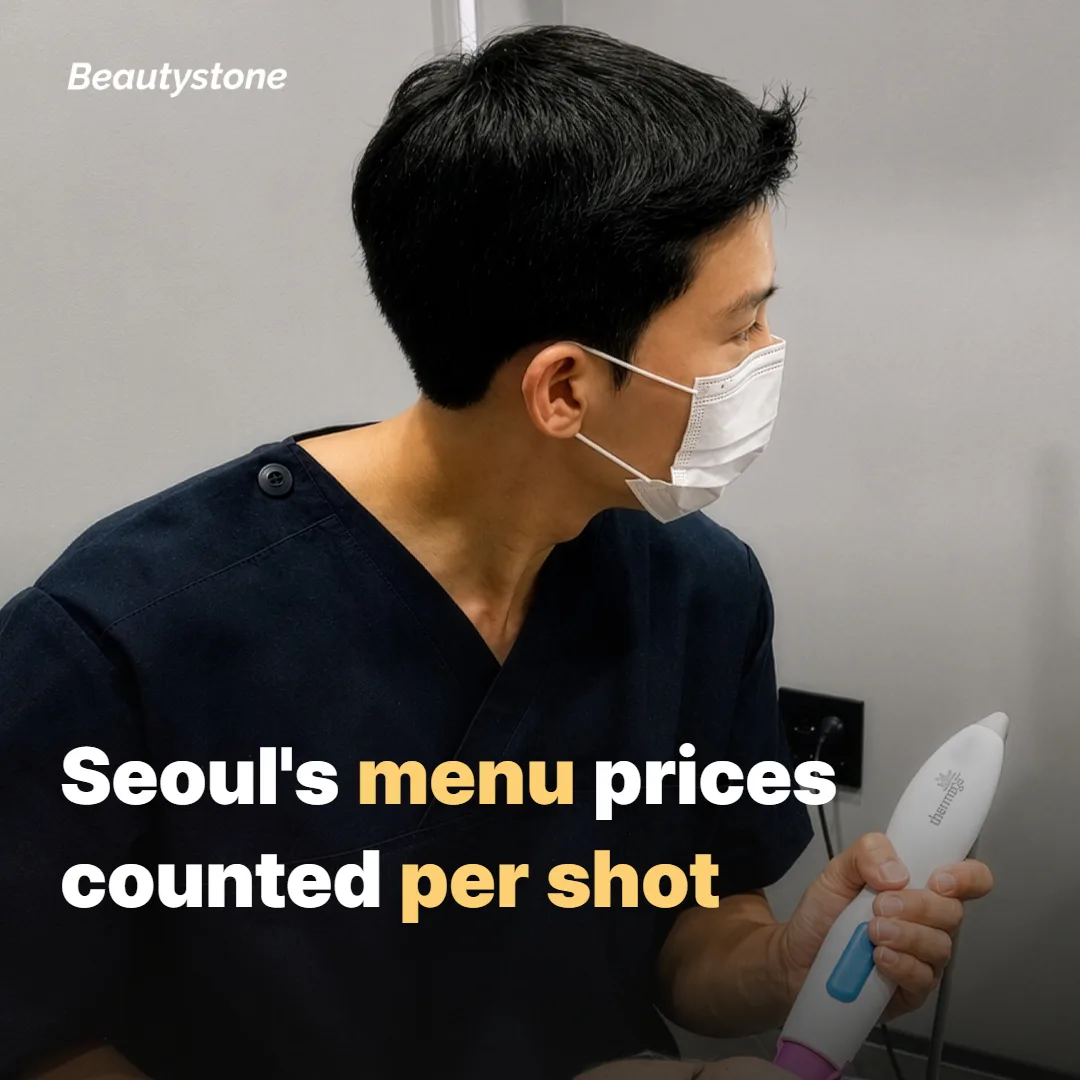
Seoul pricing reads like a menu because it mostly is one. Lifting treatments are commonly listed by shot or line count — Shurink 300 shots, Ultherapy 300 lines, Thermage 600 shots — with the count, not the session, as the unit. Prices are posted openly, promotions rotate often, and listed figures vary meaningfully between clinics and neighborhoods.
As a ballpark — not a quote — drawn from prices as listed on clinic menus and Korean price-aggregator platforms: clinics in Seoul commonly list Shurink sessions from a few hundred thousand won (very roughly $150–400 at recent exchange rates, rounded), Ultherapy full-face packages often in the 1.5–3 million won range (roughly $1,100–2,200 on the same basis), and Thermage FLX 600-shot sessions often around 2–3.5 million won (roughly $1,500–2,600). Every one of those numbers moves with the clinic, the shot count, the promotion, and the won–dollar rate, so treat them as a snapshot, not a promise.
Why the structure differs is not mysterious. Seoul has an unusually dense concentration of dermatology clinics competing on openly posted prices; a domestic device industry — Shurink is Korean-made — gives clinics a machine that shares the menu with imported ones; and high patient volume spreads equipment costs across more sessions. None of that tells you what you personally should pay. It explains why the two markets quote so differently — and it means the useful move is to put the ASPS average next to a Seoul menu price and run your own math, with your own treatment plan in the equation.
Why Beautystone in Hapjeong, Seoul
Beautystone is a small dermatology clinic a short walk from Hapjeong Station in Seoul, on the Hongdae side of the river. The working rule here is to look at your skin before recommending a device — the same "lifting" request can point to different machines, or to fewer shots than a package default. Consultations run one-on-one, and if you are visiting from abroad, say so at the start: planning around a flight date changes what is sensible to book.

Flying home after HIFU or RF: planning one trip
Here is the part most cost pages skip. HIFU and RF lifting treatments are non-invasive — no incisions — and most people go back to normal activities the same day. Redness and tenderness typically settle within hours to a few days, though some swelling or tingling can linger longer for some people; recovery genuinely varies. There is generally no medical restriction on flying after these treatments, but a long-haul flight the same evening is an unforced error. Build in a buffer day or two, and have the clinic look at your skin once more before you fly out.
The face in the mirror on day two is not the result, either. Collagen remodeling builds gradually — Thermage's manufacturer says measurable results appear over the two to six months after a session, and Ultherapy's official gallery benchmarks results at 180 days. Durations run per device — up to a year or more in the face for Ultherapy, one to two years for Thermage, per their manufacturers; Shurink is often described as roughly 6–12 months, a consultation question rather than a schedule. So expect the payoff to peak months after you fly home, and price in whether you would repeat the treatment — and the trip — when it fades.
If you are packaging one trip — the reason most people run this math at all — resist stacking everything into 48 hours. Overlapping tenderness from two energy-based treatments makes it harder to tell which one your skin is reacting to, and harder for any provider to advise you remotely afterward. Sequence what matters most first, space the rest, and ask at consultation what is realistic inside your travel window.
Now the honest total, as promised at the top: add round-trip airfare and four or five nights of lodging to the Seoul menu price, plus the value of your time off, and compare that full-trip figure to a local quote at home. That is the only comparison that means anything — for some plans the math works, for others it will not, and no slogan can decide that for you.
To make "for some plans" concrete:
- The math tends to work for people already coming to Korea — family, work, a vacation on the calendar — or folding several goals into one trip, so airfare is not charged entirely to the procedure.
- It tends not to work for a flight booked solely for one lifting session, a schedule with no buffer days, or a plan where unpaid time off erases the paper difference.
Practical notes for the same spreadsheet: major international credit cards are widely accepted in Seoul, and clinics used to international visitors often take English inquiries by email or messaging apps — both vary by clinic, so confirm when booking. Payment and installment options vary too — ask what's accepted before you fly.
One limitation to plan for rather than discover: if a side effect turns up after you are back in the US, the clinic that treated you in Seoul cannot physically examine you. Follow-up would fall to a local provider, possibly at your own cost — so know who you would call before you book. Worsening pain, blistering, or skin changes that spread are reasons to see a local provider promptly or seek urgent care. If you are weighing all of this, a consultation with a qualified provider — in either country — is the right next step.

Frequently asked questions
Q. Is Ultherapy cheaper in Korea than in the US?
A. The published numbers are different, but "cheaper" depends on your whole trip. Put the ASPS-reported US average next to a Seoul clinic's listed price, then add airfare, lodging, and time off. Exchange rates, treatment areas, and shot counts all move the total, so run the math for your own plan rather than relying on any blanket claim.
Q. Can I fly home the day after Ultherapy or Thermage?
A. Usually, yes — these are non-invasive treatments, and most people resume normal activities right away. Recovery still varies from person to person, so a one-to-two-day buffer before a long-haul flight is a sensible cushion, and it is worth asking the clinic to check your skin before you leave.
Q. Is Shurink the same thing as Ultherapy?
A. No. Both use focused ultrasound (HIFU), but they are separate devices from different manufacturers. Ultherapy is an FDA-cleared device available in both countries; Shurink is authorized by Korea's MFDS, widely used in Korean clinics, and not sold in the US. Which one suits you is a consultation question, not a brand question.
Q. What happens if I have a problem after I get home?
A. You would need a local provider — the Seoul clinic can review photos or messages, but it cannot examine you in person. Most reactions to HIFU and RF are mild and short-lived, but plan for the exception: know which dermatologist you would call at home, and seek urgent care for anything severe or spreading. This article is general information, not medical advice — treatment decisions belong in a consultation.