5 Lifting Myths That Send 40s Skin to the Wrong Machine
Depth wins, RF is HIFU-lite, the priciest device is best — the five beliefs that quietly steer first-timers toward the wrong first lift, corrected one by one.

Wi Young-jin
Chief Director & CEO, Myeongdong
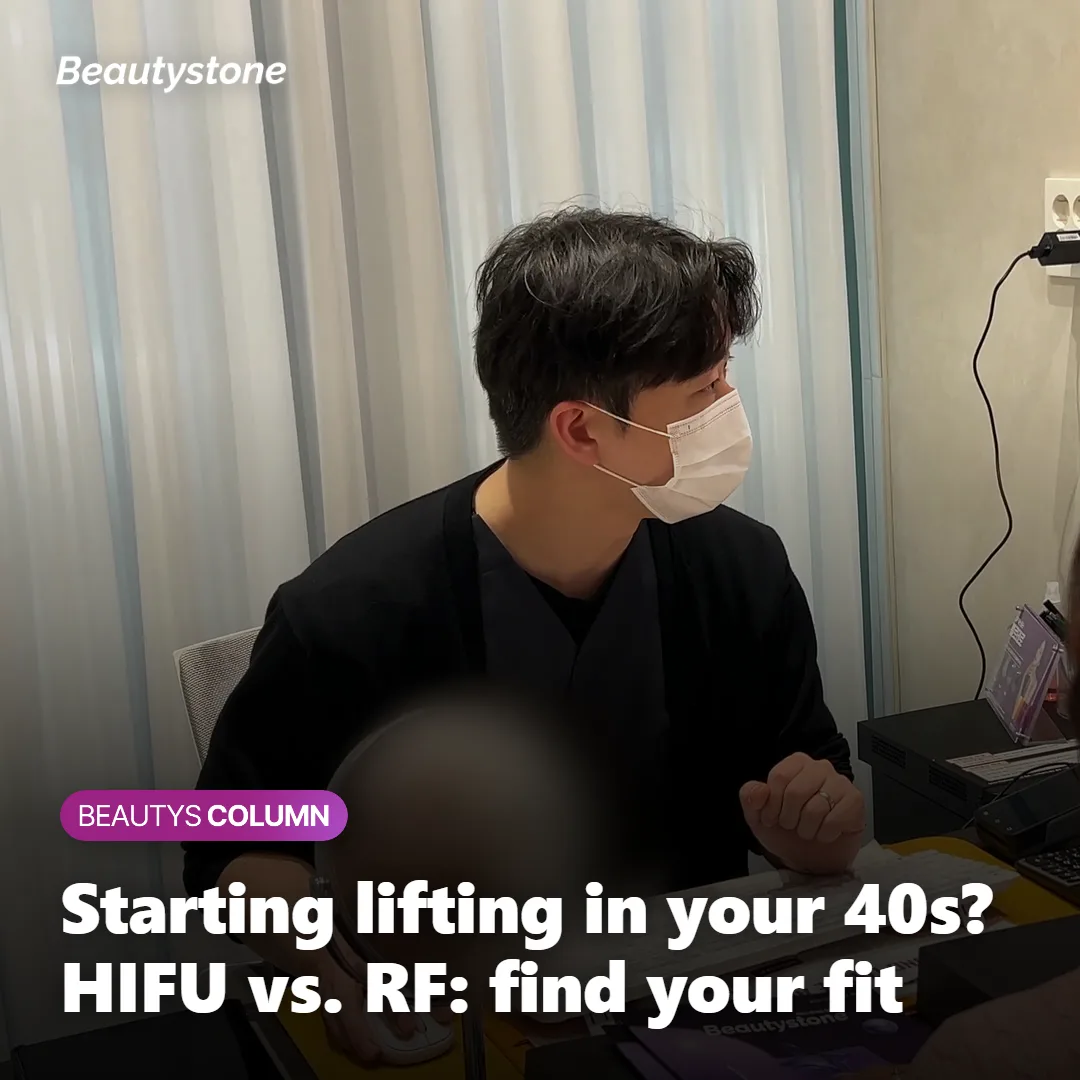
Start researching lifting in your 40s and two names surface almost instantly: HIFU and RF. What surfaces alongside them is a pile of confident-sounding advice — most of it half true. The wrong belief here doesn't just cost money; it can send perfectly good skin to the wrong machine and leave you underwhelmed after a treatment that was never designed for your concern.
So instead of another 'what is HIFU, what is RF' explainer, let's clear the five myths that most often push first-timers toward the wrong first treatment. Bust these, and the choice between HIFU and RF gets a lot simpler.
Myth 1: The Deeper Machine Always Wins
It's the assumption almost everyone carries into a first lifting consultation: HIFU reaches deeper than RF, so HIFU must be the better pick. Depth is real, but it isn't a quality score. It's a targeting decision, and the right target depends entirely on what's actually changing in your skin.
HIFU stands for High-Intensity Focused Ultrasound. It sends ultrasound energy through the skin — no needles, no incisions — to a tightly focused point well below the surface. The heat generated there nudges your body's own collagen-repair process into action, firming and lifting the treated area gradually over the following weeks and months. What sets it apart is exactly that reach: devices like Ultherapy and Shurink (Ultraformer MPT) can target the SMAS layer, the same structural layer surgeons work with during a facelift. Research suggests focused ultrasound can trigger a meaningful collagen response in deeper tissue that surface-level treatments simply can't get to.
RF, short for radiofrequency, works on a different level — literally. Instead of ultrasound it uses electrical energy to generate heat inside the dermis, the layer that houses your collagen and elastin. That controlled warmth causes an immediate, mild tightening (collagen contraction) and stimulates new collagen over time. It sits at the mid-dermis, shallower than HIFU's SMAS focus, which is why it shines at texture, surface firmness, and fine lines rather than deep structural lift.
So neither instrument is simply 'stronger.' They're built for different jobs. Here's the same information side by side:
| HIFU | RF Lifting | |
|---|---|---|
| Energy type | Focused ultrasound | Radiofrequency |
| Primary target | SMAS layer (~4.5 mm) and dermis | Dermis (~1.5–3 mm) |
| Main effect | Deep structural remodeling, lift | Dermal tightening, texture improvement |
| Downtime | Minimal (redness 1–2 days) | Minimal (redness 1–3 days) |
| Results timeline | 1–3 months; peaks at 3–6 months | 1–3 months, gradual improvement |
| Typical frequency | 1–2 sessions per year | 1–2 sessions per year |
Read the chart as a map of intent, not a ranking. Ask what your skin needs first — a structural lift or a quality upgrade — and the depth question mostly answers itself. Individual results vary based on skin condition, device, and provider technique, so a consultation is the most reliable way to gauge realistic expectations for your skin specifically.
Myth 2: RF Is Just a Weaker HIFU
Because RF works closer to the surface, it often gets filed away as 'HIFU lite' — the same idea, dialed down. That framing quietly steers people away from the treatment that might actually fit them best.
RF isn't a diluted lift. It's a different mechanism aimed at a different problem. By warming the dermis broadly, it improves the qualities that make skin look fresh rather than merely taut: dullness, fine lines, early crepiness, and the overall softening of tone and texture that hasn't yet become true sagging. If your reflection reads as 'tired' more than 'drooping,' that's RF's territory.
It also tends to be the more fitting starting point earlier in the decade. In your early 40s, before structural sagging has fully set in, RF is often described as a maintenance-and-prevention move rather than a rescue — and skin can feel more resilient and supple as dermal collagen responds. A few situations where RF earns the first slot:
- Skin quality is the goal: dullness, fine lines, and early crepiness respond to RF's dermal-level warming, and skin can feel smoother and subtly firmer overall.
- Comfort is a factor: treatments like Thermage FLX are generally considered comfortable with numbing cream applied beforehand, and many people find RF more tolerable than HIFU — though in most cases both are manageable.
- Skin is finer or more delicate: for a naturally thinner skin structure, the shallower RF energy may line up more precisely with where improvement is actually needed.
Devices you'll run into in this category include Thermage FLX, which uses monopolar radiofrequency across a broad surface area, plus Oligio and Oligio X, which take a similar monopolar approach with a different energy-delivery system. None of them is trying to be a smaller HIFU — they're doing their own work.
Myth 3: A Softening Jawline Will Respond to Any Machine
Here's where picking the wrong first treatment actually costs you. When the change you see is structural — a jawline starting to soften, early jowling, a sense that gravity is winning rather than a surface-texture issue — a dermal-level treatment won't reach the layer that's loosening. This is the scenario where depth genuinely matters.
If your skin has real structural looseness rather than a texture change, HIFU's SMAS-depth targeting typically delivers a more noticeable lift. It's also the stronger call when restoring definition along the jawline or reducing the look of early jowls is your main goal, because that's contour work, not surface work. The clearest signs HIFU deserves the first slot:
- Moderate laxity is present: structural looseness, not just texture, tends to respond to HIFU's deeper focus with a more noticeable lift.
- Facial contour is the priority: jawline definition and early-jowl softening are structural goals, and people chasing them often find HIFU a stronger first choice.
- You're patient with results: HIFU builds gradually, and if you're comfortable waiting for a peak around 3 to 6 months, the cumulative result can be meaningful.
- Skin has more volume or thickness: deeper subcutaneous tissue can respond well to HIFU's deeper energy focus in ways RF may not match as effectively.
The devices you're likely to see for this are Ultherapy and Shurink (Ultraformer MPT). One caveat applies to everyone, though: individual results vary, and most people need more than one session to see the full benefit — so pairing the right depth with realistic expectations matters as much as the machine itself.
Myth 4: Non-Invasive Means No Downtime and No Waiting
Two hopes tend to travel together: that a non-invasive treatment has zero side effects, and that the lift will greet you in the mirror the next morning. Both are worth resetting before you book.
First, the timeline. Neither HIFU nor RF is a same-day transformation. Improvement usually appears over 1 to 3 months, with HIFU peaking around 3 to 6 months and RF improving gradually along the way. Expecting an overnight change is the fastest route to disappointment — and to booking a second treatment you didn't need yet.
Second, the side effects. Both are non-invasive with a relatively low risk profile, but 'low' isn't 'none,' and honest expectations are part of a smart first decision:
- Redness and warmth: both treatments can leave skin flushed for a few hours to a couple of days, and it typically resolves on its own.
- Swelling: mild puffiness around the treated area is normal, especially with HIFU reaching deeper layers, and it usually settles within a few days.
- Tenderness: some people feel brief soreness after HIFU, generally gone within a day or two.
- Numbness or tingling: occasionally reported after HIFU near bony or nerve-adjacent tissue, and it tends to resolve within a few weeks.
- Bruising: more likely with HIFU than RF, particularly around the jawline and cheekbones.
Outcomes themselves vary too, depending heavily on technique, device calibration, and provider experience — not everyone sees the same degree of improvement. Redness and swelling usually settle within a few days; if they worsen, spread, or come with fever or blistering, seek medical care right away. And as with any procedure, talk through your health history and skin concerns with a licensed provider before moving forward.
Myth 5: The Priciest Device Buys the Best Result
The last myth is a budgeting trap: pick the most expensive machine and you've bought the best outcome. Price reflects a lot of things, but it doesn't purchase a guarantee — and the numbers don't behave the way most people assume.
Pricing for HIFU and RF varies with several factors, and there's no single figure that holds across clinics or plans. What actually moves the number:
- Device brand and model: premium devices like Ultherapy or Thermage FLX usually sit at a higher price point than alternatives, reflecting licensing and upkeep costs.
- Shot count and treatment area: HIFU is often priced by shot count and cartridge depth, so higher-shot full-face sessions cost more; RF is commonly priced by area or full-face session.
- Provider expertise and clinic type: a clinic with experienced staff and individualized protocols may price differently from a volume-based center.
- Number of sessions in your plan: most providers suggest 1 to 2 sessions per year per modality, and some plans combine both HIFU and RF.
Notice that outcome quality tracks with technique, calibration, and provider experience far more than with a sticker price. That's why the most reliable way to know what a plan costs — and whether it fits your skin — is a consultation, not a price comparison. Start from your skin's primary concern: structural laxity or early jowling leans toward HIFU, while skin quality and early softening without real sagging leans toward RF, and neither fully replaces the other.
Beautystone is a dermatology clinic in Seoul's Hapjeong area, and if you're weighing your first lifting treatment, a consultation is the best way to find out which approach fits you. You can see current offers at /en/promotion.
Frequently Asked Questions
Can I do HIFU and RF in the same treatment plan?
Yes — some plans combine both, since they address different concerns rather than compete. A common cadence is 1 to 2 sessions per year for each modality, with HIFU handling structural lift and RF handling texture and surface firmness. A consultation is the best way to see whether pairing them fits your skin.
How soon can I get back to normal after a session?
Both treatments have minimal downtime. You can expect redness for roughly 1 to 2 days after HIFU and 1 to 3 days after RF, sometimes with mild swelling or brief tenderness that settles within a few days. Neither requires significant recovery, so most people carry on with their usual routine.
Will one session be enough to see the lift?
Often not. Most people need more than one session to see the full benefit, and the effect builds gradually — improvement over 1 to 3 months, with HIFU peaking around 3 to 6 months. Realistic expectations matter as much as the treatment choice, and individual results vary.
Does a more expensive device guarantee a better outcome?
No. Results depend significantly on technique, device calibration, and provider experience, and not everyone sees the same degree of improvement. A premium device like Ultherapy or Thermage FLX often costs more because of licensing and upkeep, but the price tag doesn't buy a guarantee — the provider's hands matter more.