
Botox Timeline: What Day 3, Week 2 and Month 4 Really Mean
Botox does not switch on at once, and the day you should judge it changes with the wrinkle and the muscle underneath it.


What you'll learn

  · Movement usually begins to soften within 3 to 5 days, with the full effect visible around two weeks after treatment.
  · The date you can fairly judge the result is not fixed: it moves with the type of wrinkle and the muscle being treated.
  · Duration follows the muscle, roughly 4 to 6 months on expression lines and longer on the jaw muscle, calves or sweating.
  · Bruising is uncommon and fades on its own; asymmetry is the reaction that deserves a call rather than a wait.
Here is the direct answer. Botox does not act on the day it is injected. Movement usually starts to soften within three to five days, and the full effect is normally visible around two weeks. Checking the mirror on day two is checking too early.
I am Dr. Kim Daniel Ha-won at Beautystone, a skin clinic in Seoul. The harder question rarely gets answered: the fair date to judge your result is not the same for every area, because it shifts with the wrinkle and the muscle underneath it. Individual results vary.
Day 3 to Week 2: What Should Be Happening
Botulinum toxin temporarily eases the muscle contractions that fold your skin — it quiets the signal telling that muscle to crease. Nothing about that is instant, because what you see is movement fading rather than skin being filled.
The session is short. Numbing cream goes on first, the injections take roughly ten to twenty minutes, and most people find it milder than expected. What follows is a curve: a first hint of softening around days three to five, then the effect settling near the two-week mark.
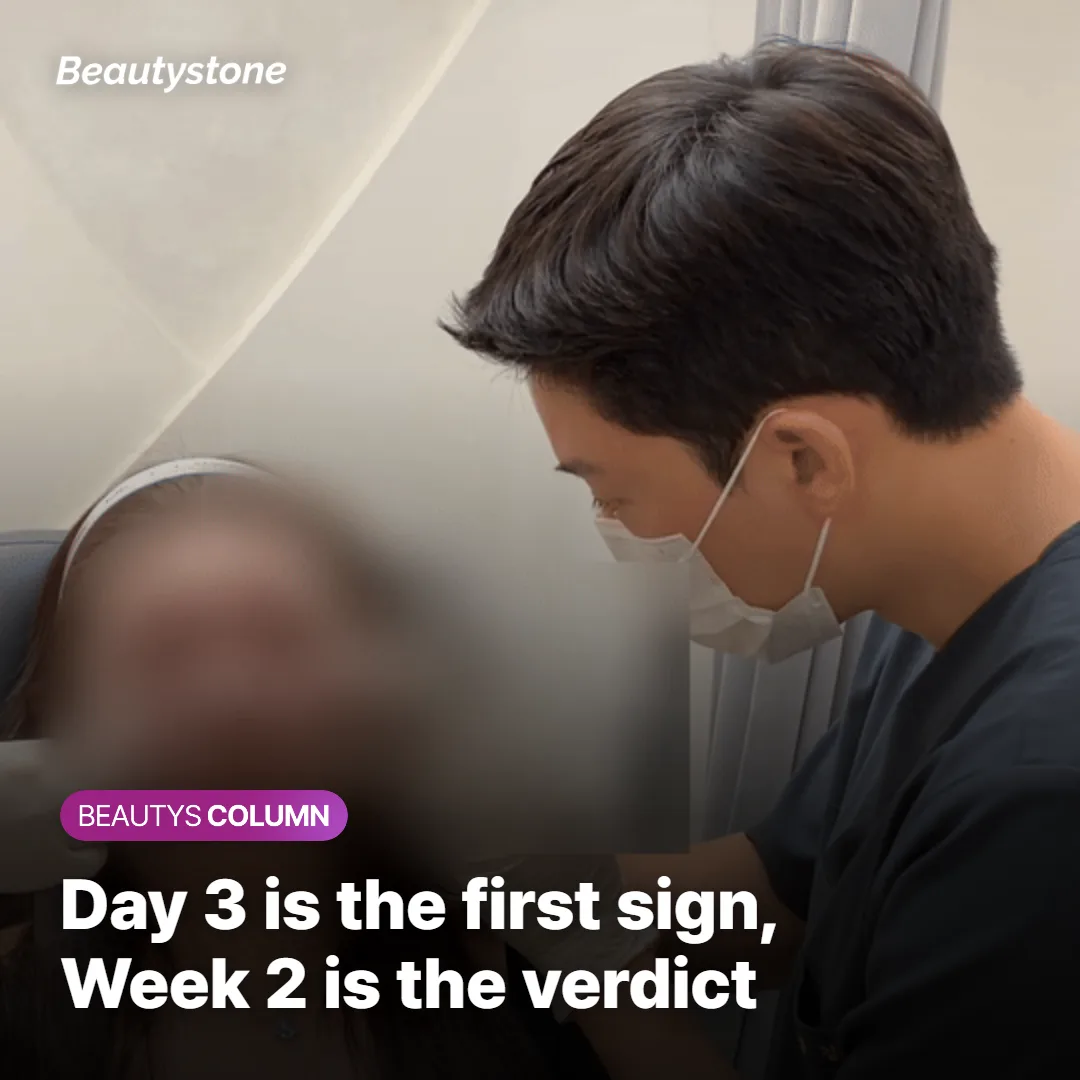
So stop judging daily and pick two dates: around day five to confirm something is moving, then two weeks for the actual result. On the day itself, skip intense exercise, saunas and alcohol, and avoid rubbing the injection points for two to three days.
Why Your Judgment Date Is Not Everyone Else's
This is the part that gets flattened into a single number online. When a result should be assessed depends on the wrinkle and on the muscle being treated, and both differ from face to face.
Dynamic wrinkles — those made by repeated expression on the forehead, between the brows and around the eyes — are what Botox addresses most directly. Static lines that stay visible at rest are a different problem, and often need filler or a combined approach rather than more units.
Muscle matters just as much. Thickness and position vary between people even in the same area, which is why dose and injection points decide the outcome. A thicker, harder-working muscle settles on a different schedule than a fine expression line, so two areas treated at once give you two verdict dates.
How Long It Lasts Follows the Muscle You Treated
Duration is the second place a single number misleads. On expression lines the average is roughly four to six months, but the same injection in a heavier muscle behaves differently.
| Area treated | What it is for | Average duration |
|---|---|---|
| Forehead, glabella, crow's feet | Softening dynamic wrinkles from facial expression | 4 to 6 months |
| Masseter, jawline | Contour refinement through masseter reduction | 6 to 8 months |
| Calves | Reducing calf muscle bulk for a slimmer line | 6 to 12 months |
| Excessive sweating | Reducing sweat for daily comfort | 6 to 12 months |

Read that table as a range, not a promise. Individual results vary, and how hard you use a muscle daily is part of the arithmetic.
Swelling, Bruising, Asymmetry: What's Normal and What Isn't
Separate the ordinary from the reportable, because the two get mixed together and the anxiety usually lands on the wrong one.
- Ordinary: a short-lived reaction at the injection points that settles on its own
- Ordinary: bruising, uncommon but possible, usually fading within one to two weeks
- Ordinary: a sharper pinch in sensitive spots such as between the brows or the eyes
- Report it: asymmetry, a drooping side, or eyebrows at visibly different heights
- Report it: anything that keeps getting worse rather than settling

Asymmetry is the disappointment I hear about most, and its usual origin is a muscle thickness difference between the sides being overlooked before the needle went in. If a side is drooping, contact the clinic that treated you rather than waiting four months out, and seek urgent care if symptoms escalate quickly.
Botox is not for everyone. Anyone pregnant, breastfeeding or living with a neuromuscular condition should not have it, and that belongs in the consultation before any talk of price.
Timing the Next Session, and What to Ask Beforehand
The interval is not a subscription. My working principle: if the result held well, we stretch the gap; if movement came back early, we look at dose and placement before shortening it. That needs a record of what was done last time.
- Which product was used, and that it is a product approved by the MFDS
- How many units went in, and into which areas
- What you saw at day five and at two weeks, ideally with a photograph
- How long the effect held before movement returned
- Whether both sides were dosed identically or adjusted for muscle thickness
Price differences between clinics come down to the product used, the number of units injected and the experience of the injector — which is why the questions worth asking are which product and how many units, not the headline figure. At Beautystone those numbers stay on file.
One note for anyone travelling: plan for follow-up where you live, because an asymmetry appearing two weeks later needs someone who can see your face in person.
Frequently Asked Questions
How long does the reaction at the injection points last?
The marks left by the needle are short-lived and settle on their own. Bruising is uncommon but possible, and when it appears it usually fades within one to two weeks. Avoid rubbing or pressing the area for two to three days. Anything that keeps worsening is worth a call rather than a wait.
Can I judge my Botox result after one week?
One week is early. Softening usually begins around days three to five and the full effect is normally visible near two weeks. The fair judgment date also shifts with the wrinkle and the muscle treated, so a heavier muscle may need longer than an expression line. Individual results vary.
Does Botox last the same length of time everywhere?
No, and it is the most common surprise. Expression lines average roughly four to six months. Masseter treatment for the jawline usually runs longer, and calf treatment or treatment for excessive sweating longer still. Two areas in one visit fade on different schedules.
Should I rebook the moment the effect wears off?
Not automatically. Look at how long it actually held. If it held well the interval can usually stretch; if movement returned early, the dose and injection points deserve a review before you repeat the same session.