Is Ultherapy Prime Painful? What to Say First
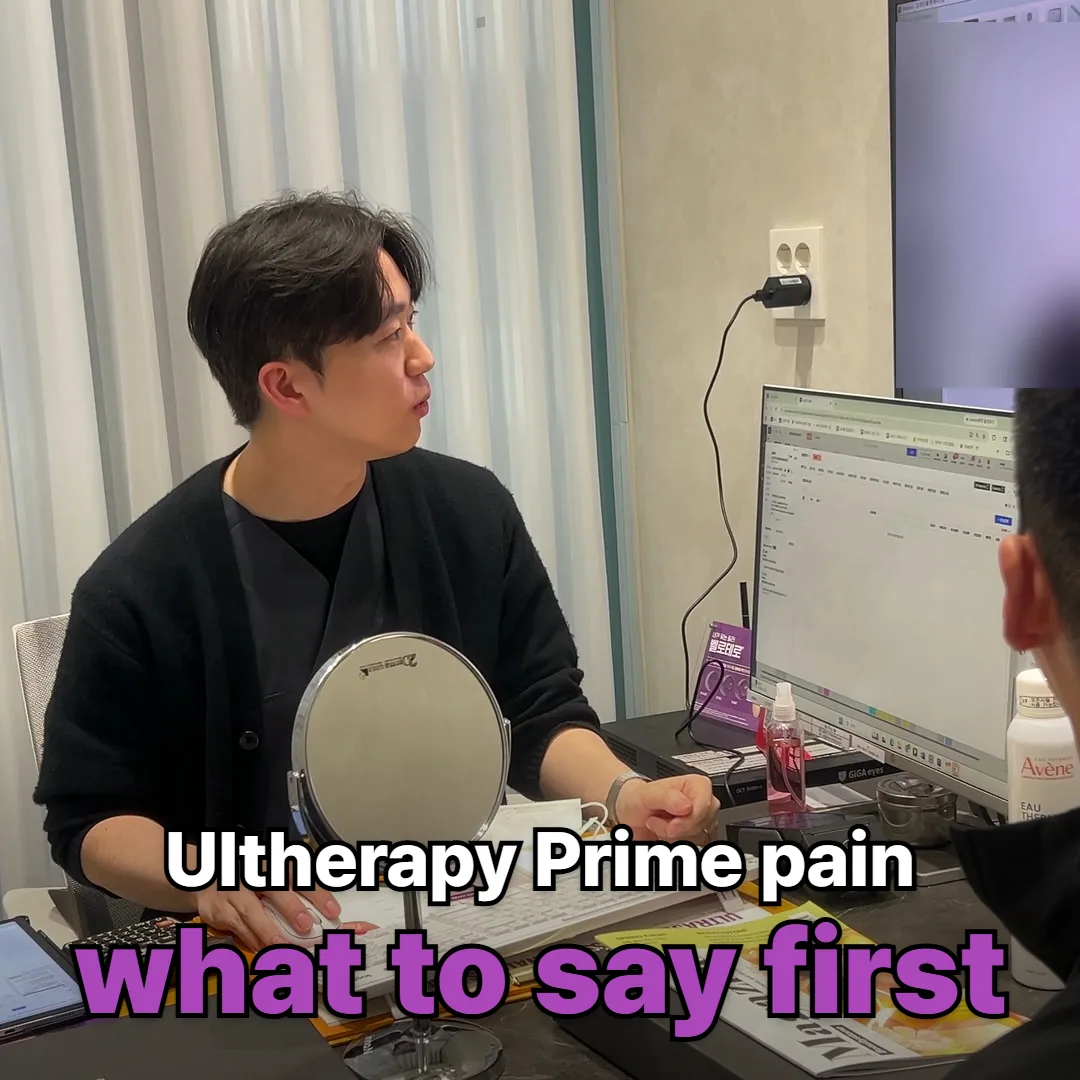
Ultherapy Prime tends to feel sharpest near bone and at deeper lines. Sharing the spot, a 0 to 10 score, and the numbing you've tried helps set the plan.

Wi Young-jin
Chief Director, Myeongdong
Ultherapy Prime can hurt, though one small study put it near the middle of the scale. In a group of 30 Asian adults who had Prime on the lower face and neck, the average score right after the session was 4.5 out of 10. Because the feeling shifts with where each line lands and how deep it goes, what you tell the doctor about your last treatment lets the numbing be planned before the first pass.
In this article, we'll cover the three details worth bringing to your consultation, why certain spots feel sharper than others, how your answers turn into a numbing plan, what the Prime pain studies can and can't tell you, and which changes afterward need a call. If you've never had a lifting treatment, how a numbing shot at the dentist felt is a fair stand-in.
What Should You Share About Past Pain Before Ultherapy Prime?
Start by pointing to the exact spot that hurt most last time. Whether it was the back corner of the jaw or the top of the cheekbone changes where extra numbing goes. Saying "it was really painful" is hard to plan around, while a place paired with a number gives the doctor something to work with.
These are the three details that help most:
- The area: the jaw corner, the cheekbone, the forehead, or somewhere else
- A rough score from 0 to 10 for that area, if you remember it
- The numbing you had then, and what still felt uncomfortable
If cream alone felt like too little last time, that's a reason to discuss adding an injection from the start this time. Have you ever felt faint or broken into a cold sweat while getting a shot? Mention that too. When a local anesthetic injection is added, your position and the pace can be set up for it in advance.
Switching the numbing method doesn't rewrite the treatment. How many lines go in, and at which depth, still follows the plan made when your face was assessed.
Why Do Some Spots Feel Sharper During Ultherapy Prime?
Spots with bone close under the skin, like the jaw corner and the top of the cheekbone, tend to send a sharper signal. A 2026 literature review that mapped nerves layer by layer found the skin, the SMAS, and the thin membrane around bone crowded with sensory nerves, while the fat lying between those layers has far fewer. The SMAS is the thin sheet that covers the facial muscles and holds up the fat and skin above it.
Depth matters as well. The 3.0 mm line is aimed at the lower part of the dermis, and in thinner skin it can sit close to where the fat begins. The 4.5 mm line targets the SMAS beneath the fat. Energy that lands in the deep dermis or the SMAS tends to feel heavier than energy that stays in fat, so a padded spot like the middle of the cheek often feels duller at the same setting.
The review's authors suggested that feeling those pulses could reflect energy reaching a nerve-rich layer. That's a hypothesis that still needs testing, and the paper was a literature review rather than a clinical trial. A higher score shouldn't be taken as proof the treatment is working better. What counts is whether the depths and placement suit your face.
How Is Your Ultherapy Prime Numbing Plan Put Together?
Numbing cream goes on soon after you arrive, and treatment starts once it's had time to absorb. Whether to add local injections depends on how much bony area is in the plan and how sensitive you are, and that's decided during the visit. Sedation, where you sleep through treatment, is an option for long sessions over a wide area, so it isn't part of every plan.
Here's how the details you share get used at each step:
| When | What happens | What to tell the clinic |
|---|---|---|
| When you book | Your preferred numbing is noted | If you want sedation, who will take you home |
| When you arrive | Numbing cream is spread over the area | Whether a numbing cream has ever stung you |
| Just before treatment | Local injections are decided for the most painful spots | The spot that hurt most last time |
| During treatment | Lines are split up with short breaks | Your score from 0 to 10 in that moment |
If you're planning on sedation, say so when you book. That way enough time can be set aside on the day.
What Is the Ultherapy Prime Pain Level on a 0 to 10 Scale?
It sits around the middle. In a 2025 case series, 30 Asian adults who had Prime on the lower face and neck scored their pain at an average of 4.5 right after treatment. Numbing cream had been on their skin for at least 30 minutes, and oral pain relievers were given when needed.
That paper also reported 6.15 for the earlier device, a figure combined from two older studies. Keep in mind these come from separate studies that handled pain relief differently, so they can't be lined up as a direct comparison. With only 30 people, the Prime figure is a reference point, not a prediction for your face.
The scale earns its keep during the session. Give a number, and the doctor can slow the pace, split the remaining lines, or add numbing on the spot. People score pain a little differently, which makes the number most useful for comparing your own sessions over time. If picking a number feels awkward, short phrases do the job: "I'm fine," "I need a pause," or "I can't keep going." You can also just raise a hand.
Ultherapy Prime Side Effects: Which Signs Shouldn't Wait?
Feeling sore when you press the area, or a tight pull when you chew, is common afterward. A 2025 review that pooled published studies found swelling, redness, and pain after the procedure were the reactions seen most often, and they were usually temporary. They tend to settle as the swelling goes down, and food that needs less chewing makes meals easier in the meantime. Looking in the mirror at about the same time each day helps you tell whether swelling and soreness are fading together.
The changes below are rarely reported, but they're not ones to wait out. Take a photo and contact the clinic right away if you notice:
- Pain that grows stronger each day instead of easing
- Blisters or fluid leaking along the treated lines
- Skin that breaks down or turns noticeably darker
- Tingling that won't fade, or numbness covering a wider area over time
- One side of your face lagging when you smile or close your mouth
Even if tingling seems to be fading, let the clinic that treated you know so it can be checked. For blisters or open spots, case reports list wound care as the first step in management. If symptoms are severe, get an in-person exam rather than relying on a message.
Planning Ultherapy Prime Around Your Korea Trip
You don't need to delay a flight because of Ultherapy Prime, as long as you didn't have sedation that day. Swelling generally stays hard to spot in photos when the plan is around 300 shots or fewer. If your plan is larger, mention the days you'll be sightseeing so the appointment can be scheduled with those in mind.
It also helps to know what one visit can do. Some treatments, like filler, change shape the same day. With Ultherapy Prime, change tends to come gradually, edging your face back toward its earlier shape instead of transforming it at once. Results differ from person to person.
After you fly home, photos of anything that concerns you can be sent to the clinic through the consultation button on this site. If a reaction is severe or spreading, get seen by a doctor near you before anything else.
The Bottom Line: Bring Your Pain Notes to the Consultation
The one detail to carry with you is depth at the spot that hurt. At the consultation, try asking: "If my plan puts 4.5 mm lines along my jaw corner, how far will the numbing extend there?" The answer shows both where the sharper moments are likely and whether the plan was built around your face.
When you reach out, include:
- The area that hurt most in a past lifting treatment, and its score
- The numbing you've tried and what bothered you about it
- The names of any medicines you take every day
- If you're thinking about sedation, whether someone can come with you
If you still have a treatment record that lists depths by area, bring it and mark where it hurt. And if fear of pain is what's kept you putting this off, it's fine to say that up front. Beautystone is a clinic in the Hapjeong area of Seoul.
References
- Sensory nerves in each facial layer and why ultrasound lifting hurts — Aesthetic Plast Surg, 2026
- First experience with Ultherapy Prime in 30 Asian patients, including pain ratings — Plast Reconstr Surg Glob Open, 2025
- One Bangkok clinic's patient survey comparing Prime with the original device — J Cosmet Dermatol, 2025
- Ultrasound tightening from the forehead to the side of the neck, a prospective study — J Am Acad Dermatol, 2010
- Adverse events after imaging-guided ultrasound lifting, from studies and device reports — Dermatol Surg, 2025
- Reports of blisters, ulcers, and other serious reactions after ultrasound lifting — Lasers Surg Med, 2018
Frequently Asked Questions
Q. Is Ultherapy Prime painful enough to need more than numbing cream?
A. Ultherapy Prime is sometimes done with numbing cream alone when the area is small and doesn't cross much bone, and a 2010 face and neck study also prepared the skin with a topical anesthetic before treatment. The options are ① numbing cream on the skin, ② a local anesthetic injection placed into painful spots, and ③ sedation for a long session over a wide area. That choice is made during your visit, depending on the areas planned and how sensitive you are.
Q. Is Ultherapy Prime less painful than the original Ultherapy?
A. Ultherapy Prime was reported as less painful than the original device in a survey from one clinic in Bangkok. It asked 231 people who'd had both devices and 92 who had Prime as their first treatment, and both groups said Prime left them with less pain, redness, and swelling. Patients knew which device they had and the answers came from a single clinic, so the result may not apply to everyone.
Q. I've never had a lifting treatment. How do I describe my pain tolerance?
A. If you've never had a lifting treatment, describe how a numbing shot at the dentist went, or how you handled other injections. It also helps to say whether you've ever felt faint during a shot, since that changes how an injection would be set up. From there, cream is the starting point and more numbing is added as needed.
Q. Can I ask to stop in the middle of Ultherapy Prime if it hurts too much?
A. Yes, you can ask to stop Ultherapy Prime at any point by raising a hand or saying so. The session pauses, and the remaining lines can be split up or more numbing added before continuing. Giving a number from 0 to 10 tells the doctor where to slow down.
Q. Can I drive myself home after Ultherapy Prime with sedation?
A. No, after Ultherapy Prime with sedation you shouldn't drive yourself home, and someone needs to come and take you. You may feel sluggish for a while after waking, so it's worth keeping the rest of that day free of important plans.
Q. Why does one side of my jaw hurt more than the other during Ultherapy Prime?
A. One side of the jaw hurting more during Ultherapy Prime isn't unusual, because the left and right halves of a face are rarely identical. A small difference in bone shape or fat thickness can make the same depth feel sharper on one side. If pain on one side keeps building after treatment, or a blister appears, contact the clinic right away.
Q. Should I take a pain reliever before Ultherapy Prime?
A. Ask at the consultation before taking a pain reliever ahead of Ultherapy Prime, rather than deciding on your own. It needs to be checked against any medicine you take daily. In the Prime case series, oral pain relievers were given only when needed, alongside numbing cream.
Q. Does Ultherapy Prime hurt the same every time?
A. Ultherapy Prime doesn't necessarily hurt the same each time, because the feeling shifts with the areas treated, the depths used, and the numbing chosen. That's why your previous score is useful: it gives the doctor a baseline to plan against. Comparing your own numbers across sessions tells you more than comparing them with someone else's.