Titanium Lifting Cost: 4 Numbers on Your Quote
Shot count and kJ show how much laser energy was used, not how much lift you'll get. Here's how to line up two titanium lifting quotes on the same basis.

Wi Young-jin
Chief Director, Myeongdong
A bigger kJ number on a titanium lifting quote doesn't mean more lift, and there's no evidence yet that it does. The kJ figure is simply all the laser energy added up: how many times the laser fired, how strong each pulse was, and how much skin each pulse covered.
So when you compare titanium lifting cost between clinics, the total kJ alone won't tell you which plan is better. What matters is how that energy is split across your jawline, cheeks, and mouth area, and how many sessions the price covers. Below, we'll walk through what each number on a quote measures, what research says about more energy, and the questions to ask before you book.
Quick summary
- The kJ on a titanium quote is the sum of energy delivered, so compare quotes only after matching the split by area and the number of sessions.
- Put total kJ, the split by area (jawline, cheeks), and the session count on the same line for each quote.
- Lasers like this are usually done in 3 to 5 sessions, and results appear gradually over 2 to 6 months after the last one.
- Results tend to be better with mild sagging. With heavy sagging, it's worth widening the options, surgery included.
What Is Titanium Lifting, and What Do Shots and kJ Count?
Titanium lifting takes its name from Soprano Titanium, a diode laser that fires three wavelengths at once: 755, 810, and 1064 nm. On a quote, the shot count tells you how many times the laser fired, and the kJ (kilojoules) tells you the total energy all those shots delivered. One kJ is 1,000 joules.
The energy in a single shot is the strength per area, written as J/cm² (joules per square centimeter of skin), multiplied by the size of the window the laser passes through. That's why two quotes with the same kJ can describe very different treatments: one may use many gentle passes, the other fewer strong ones. The total alone can't show you which.
To give a sense of scale, a hair removal study on this device used 7 to 9 J/cm², fired 9 to 10 times per second, through a 2 cm² or 4 cm² window. Those are hair removal settings, though, so don't assume a lifting session uses the same ones.
Mixing three wavelengths lets heat reach from the shallow dermis down to its deeper part. If your quote lists wavelengths or mode names, ask which setting goes on which area. It's a simple question, and the answer tells you far more than the kJ total does.
Does a Higher kJ Mean More Lift?
There's no established threshold for how much heat the face needs, so more kJ isn't automatically better. A 2026 review on energy-based devices suggested keeping settings conservative on thin or volume-depleted areas, but the authors offered that as a research question, not a clinical rule.
The closest direct comparison comes from hair removal. In a study on an earlier diode laser from the same maker, 25 people had one leg treated with low energy and many fast passes, and the other leg with high energy in single pulses. After 5 sessions, hair reduction at 6 months was similar on both sides, at 86 to 91%. The low-energy side hurt less, and the high-energy side had one superficial burn.
That study measured hair, not sagging, so it can't be carried straight over to lifting. Still, it's a useful reminder when you read a quote: stronger pulses didn't produce a bigger result there. A quote with a higher kJ usually means a wider area or more passes, so ask where that energy is going.
How Should the Energy Be Split by Skin Thickness and Sagging?
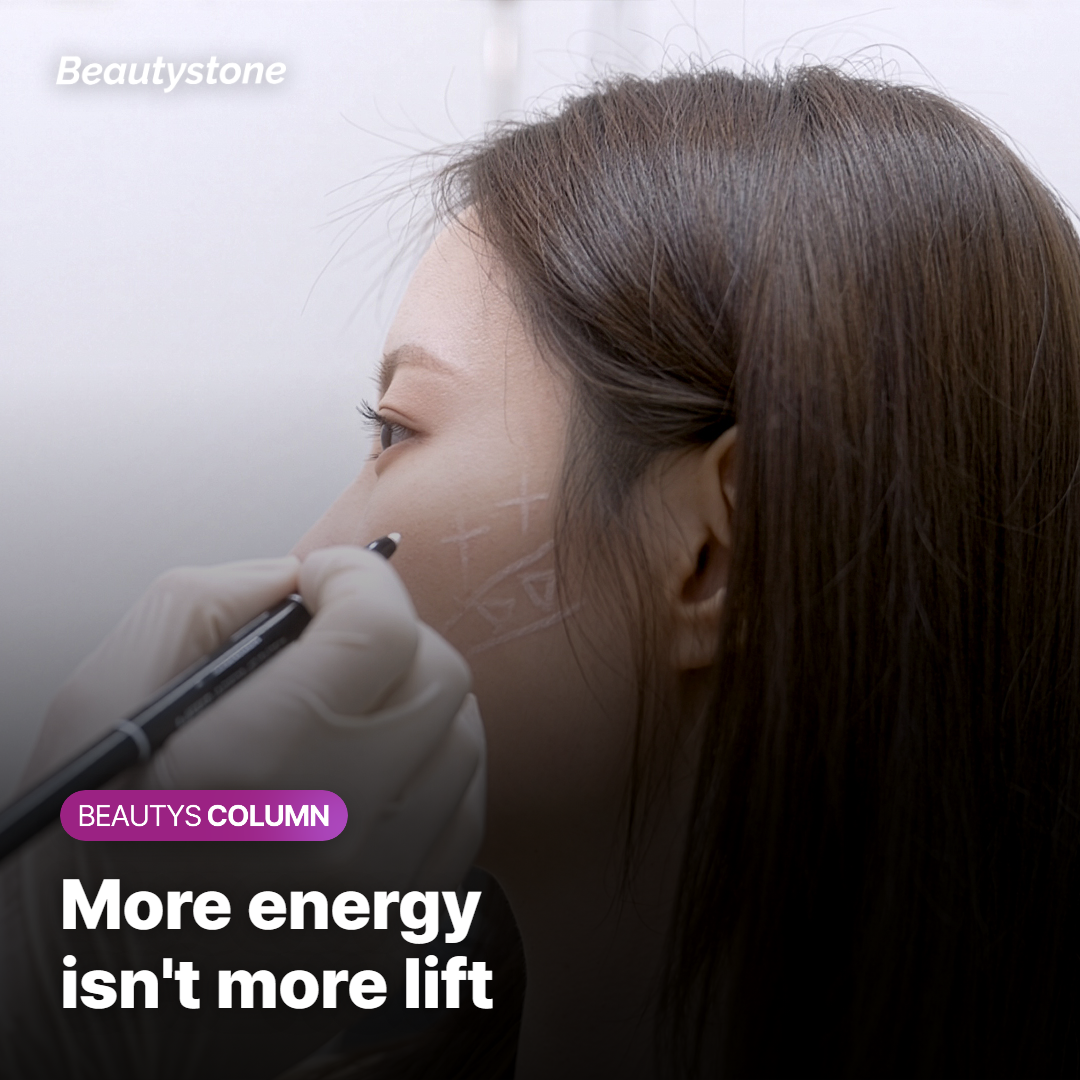
The split should follow your skin, area by area. At the exam, the doctor gently pinches the skin to judge thickness and looks at the jawline, cheeks, and mouth area separately, sorting out where it's sagging and where volume has thinned out. Because there's a proposal to keep settings lower where cheeks are thin and hollow, that area's share of the energy is worth checking on its own.
Non-surgical tightening tends to work best when sagging is mild*. If sagging is significant, adding more kJ isn't the answer; it's better to look at the full range of options, surgery included. Individual results vary, and how much you see depends on your skin.
*Based on American Academy of Dermatology patient guidance on skin tightening.
| Quote item | What it counts | What to ask when comparing |
|---|---|---|
| Total kJ | The sum of energy delivered | How many kJ go to each area |
| Shot count | How many times the laser fired | The strength per shot (J/cm²) and the window size |
| Areas | Where the heat goes | Jawline, cheeks, mouth area: which are included |
| Sessions | How many treatments | How many sessions, and how many weeks apart |
Line up two quotes row by row using this table, and the real difference shows up much more clearly than it does from the kJ number alone.
How Many Sessions Does Titanium Lifting Take, and How Long Does It Last?
Even if the kJ per session is the same, a different session count changes the total cost. Lasers that heat the deeper skin without injuring the surface are usually done in 3 to 5 sessions, and results show up gradually over 2 to 6 months after the last one*. That's why the price of one session can give you the wrong picture of the full cost.
*Based on American Academy of Dermatology patient guidance on laser skin tightening.
Studies on the face used different schedules, too. In one, 28 women had a three-wavelength laser 5 times, 2 weeks apart, and skin samples taken 2 weeks after the last session showed more collagen and elastic fibers in the dermis. It was a preliminary study with no comparison group, so it can't say how visible that change is.
With a different diode laser (810 and 940 nm), 30 people had 4 sessions, 3 weeks apart. Their sagging scores were better at 1 month and again at 6 months after the last session, and the researchers concluded that maintenance treatments are needed. In a small series of 10 women who had Soprano Titanium for facial contouring, sessions were 3 weeks apart, up to 3 in total.
So how long does titanium lifting last? There isn't a fixed number. Research points toward keeping results with maintenance sessions, and the timing of the next one is best decided by comparing with your earlier photos. Results differ from person to person.

Titanium Lifting Side Effects: What Fades and What Needs a Call
Mild redness and swelling right after treatment are expected and pass on their own. For laser hair removal, common reactions such as discomfort, swelling, and redness usually settle within 1 to 3 days*. If you notice any of the changes below, don't wait it out; take a photo and contact the clinic right away:
*Based on American Academy of Dermatology guidance on laser hair removal.
- Blisters
- A cluster of small blisters around the mouth (a cold sore flare-up)
- Redness or swelling that lasts more than 3 days or keeps getting worse
- Skin that turns lighter or darker than the area around it
Blisters, infection, scarring, and changes in skin color are rare but reported with laser hair removal. After treatment, stay out of the sun and don't use tanning beds.
It's better to put off treatment in these cases:
- You're pregnant
- There's a skin infection where you'd be treated
- You take a medication that doesn't mix with heat treatments (tell the doctor what you take)
The Bottom Line: How to Compare Two Titanium Lifting Quotes
When you get a quote, first check that it lists the total kJ, the split by area, and the number and spacing of sessions. If it only shows a total kJ, ask: how many kJ go to my jawline, and how many to my cheeks? If two quotes plan a different number of sessions, multiply the per-session price by the sessions so both are on the same plan before you compare.
Like any procedure, titanium lifting comes with trade-offs, and the right plan depends on your skin, how much sagging you have, and your budget. Beautystone is a clinic in Seoul's Hapjeong area, near Hongdae. When you reach out, include a photo of the area that's sagging, any lifting treatments you've had and when, and the dates you'd like to come in.
Sources
- Skin changes in 28 women after 5 sessions of a 755, 810, and 1064 nm laser, 2 weeks apart — Lasers Med Sci, 2023
- Facial sagging after 4 sessions of an 810 and 940 nm diode laser, 30 people — J Cosmet Dermatol, 2015
- Facial contouring with a three-wavelength Soprano Titanium laser, 10 cases — J Cosmet Dermatol, 2024
- Settings and results of three-wavelength laser hair removal, 11 men — J Drugs Dermatol, 2020
- Three-wavelength laser hair removal across six skin types, 36 people — J Cosmet Dermatol, 2023
- Low energy with many passes vs. high energy in single pulses, 810 nm diode hair removal on both legs — J Drugs Dermatol, 2009
- Safety considerations for energy-based devices when facial volume is lost — Clin Cosmet Investig Dermatol, 2026
- Sessions, timing of results, and who is a good fit for non-surgical skin tightening — American Academy of Dermatology
- Common reactions and rare side effects after laser hair removal — American Academy of Dermatology
Frequently Asked Questions
Q. How much does titanium lifting cost, and why do quotes differ so much?
A. Titanium lifting quotes differ mainly because they count different things: total kJ, shot count, which areas are covered, and how many sessions are included. A higher kJ usually means a wider area or more passes, not a stronger result. To compare fairly, ask each clinic for the kJ by area and the session plan, then multiply the per-session price by the number of sessions.
Q. Does titanium lifting hurt?
A. Titanium lifting uses many gentle passes, so strong pain is uncommon. In a small series of 10 women who had Soprano Titanium for facial contouring, 2 reported mild pain. If you're sensitive to pain, numbing cream can be used, and the approach is decided at the exam based on the area and your sensitivity.
Q. Is firing three wavelengths at once better than a single-wavelength laser?
A. It hasn't been shown that three wavelengths at once work better than one. A hair removal study of 11 men on this device noted that whether combining wavelengths adds a benefit is still unclear. The facial studies using three wavelengths didn't compare them directly with a single-wavelength laser either.
Q. How long does titanium lifting last?
A. Diode laser lifting like titanium is generally kept up with maintenance sessions rather than lasting on its own. In one study of a different diode laser, 30 people who had 4 sessions still showed better sagging scores at 1 and 6 months after the last one. The researchers concluded that maintenance is needed, and the timing of your next session is best set by comparing with earlier photos.
Q. If my face is thin with little cheek volume, should I get more kJ?
A. For a thin face with little cheek volume, splitting the energy by area usually comes before adding more kJ. One proposal suggests avoiding unnecessary deep heat where facial volume is already low. The same device has also been used to reduce facial fat, so hollow areas are marked separately at the exam when the split is planned.
Q. Is titanium lifting enough if my sagging is significant?
A. With significant sagging, laser lifting like titanium tends to help less. Non-surgical tightening works best for mild sagging and doesn't produce the change a facelift can. That's why the degree of sagging is checked first, and options from other lifting treatments to surgery are weighed from there.
Q. Can I wear makeup and go to work the same day?
A. With non-surgical tightening, you can often put on makeup right after treatment. Most sessions take an hour or less, and apart from brief redness or swelling, there's usually little downtime. If redness or swelling lasts more than 3 days, let the clinic know right away.
Q. Can I get titanium lifting if I have darker skin?
A. People with darker skin can be treated with a three-wavelength diode laser like titanium. In a hair removal study of 36 people across all six skin types, from very light to very dark, there were no serious adverse events. After treatment, it's still important to avoid the sun and tanning beds.