![[Column] Bumpy Skin After Juvelook — How Long Should You Wait?](/_next/image?url=https%3A%2F%2Fwazsqvuzlsxxykdisytt.supabase.co%2Fstorage%2Fv1%2Fobject%2Fpublic%2Fblog-images%2Fuploads%2Flocale-featured%2Fjuvelook-total-guide%2F20260629081639-en-auto-v1.webp&w=3840&q=75)
Juvelook Bumps: How Long Until They Go Away?
Is It a Juvelook Side Effect? 5 Ways to Tell Normal Reactions from Real Problems

Juvelook Side Effects: Normal Reactions vs. Real Problems — How Can You Tell?
Hello, I'm Dr. Wi Young-jin from Beautystone Clinic. "I developed these symptoms after my Juvelook procedure — could this be a side effect?" I receive a surprisingly large number of inquiries like this from patients who had their Juvelook procedure done at other clinics.
Quite a few people mention feeling something unusual under their skin after the procedure. In some cases, it's a completely normal reaction — but in others, there may be a genuine concern that needs attention.
Failing to distinguish between the two can lead to unnecessary anxiety, or worse, missing a warning sign that actually matters. Today, I'd like to walk you through exactly how I assess this in my clinic.
Let's Quickly Cover What Juvelook Actually Is
Juvelook is a Skin booster that combines PDLLA with hyaluronic acid. The hyaluronic acid is encapsulated in a liposome structure, allowing it to be delivered deep into the skin. The goal is to simultaneously provide hydration and stimulate Collagen production.
Because it contains two active components, the skin's response can be somewhat complex. Understanding this structure is key to making sense of any side effect discussion.
Symptoms Right After the Procedure — Most Are Normal
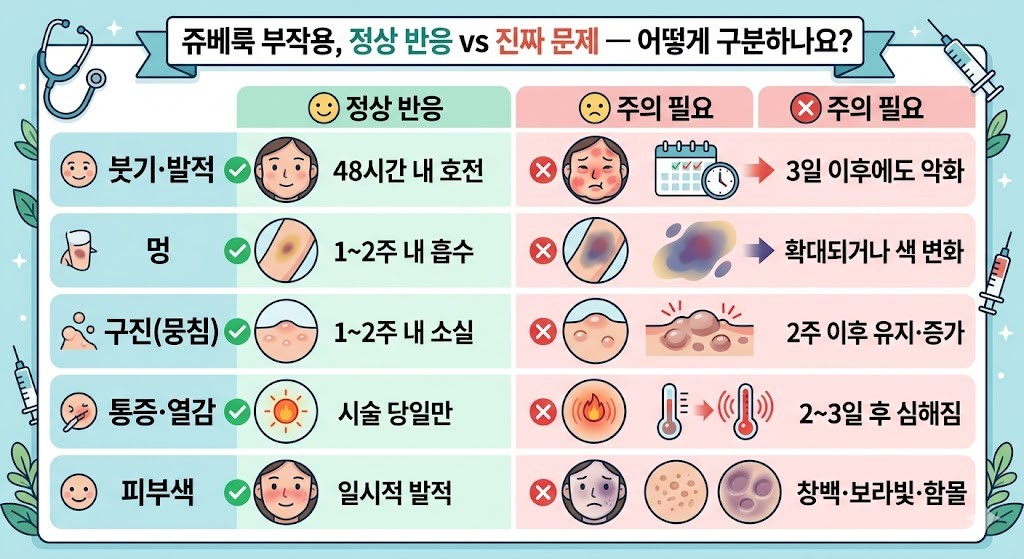
Reactions that appear on the day of the procedure and within the first 2–3 days generally fall within the normal range.
1. Injection Marks and Swelling
Since the product is injected directly with a needle, these are expected and typically resolve within 48 hours.
2. Bruise
Areas with a rich blood supply — such as under the eyes and around the mouth — are more prone to bruising. These are typically absorbed within 1–2 weeks. 3. Small Papules (Bumpy Texture) The hyaluronic acid distributes within the skin and may be temporarily palpable, but usually disappears within 1–2 weeks.
4. Mild Redness
This is a temporary reaction caused by the injection stimulus and is completely normal.
Dr. Wi Young-jin's Clinical Notes
Papules that linger are most commonly seen when too much product is concentrated in a single area. This is precisely why the injector's technique — distributing the product evenly — makes such a significant difference.
If you're concerned about bruising, it's advisable to temporarily discontinue aspirin or omega-3 supplements about one week before your procedure.
Watch Out for These — Signs of a Real Side Effect
The following symptoms should be evaluated differently from typical post-procedure reactions.
1. Papules or Nodules That Persist
Beyond the two-week mark without any improvement.
2. Progressive Redness
Accompanied by Heat sensation and Pain.
3. Skin Depression or Purplish Discoloration
Signs that may indicate tissue necrosis.
4. Severe Allergic Reaction
A hypersensitivity response to PDLLA itself — this is extremely rare, but if it occurs, do not wait. Contact a clinic immediately.
Normal Reaction vs. Requires Attention — Comparison Table
Symptom | Normal Reaction | Requires Attention |
Swelling & Redness | Improves within 48 hours | Worsens after 3 days |
Bruise | Absorbed within 1–2 weeks | Spreading or changing color |
Papules (Lumps) | Resolves within 1–2 weeks | Persists or increases after 2 weeks |
Pain & Heat Sensation | Only on the day of procedure | Worsening 2–3 days later |
Skin Color | Temporary redness | Pallor, purple discoloration, or depression |
Key Takeaway
If your symptoms persist or worsen beyond two weeks,
that is no longer within the range of a normal reaction.
How to Minimize the Risk of Side Effects
The risk of side effects depends just as much on the injector's skill and technique as it does on the product itself. Incorrect injection depth or volume can lead to nodules and lumps. High-volume, assembly-line style procedures in particular make it difficult to assess each patient's individual skin thickness with the care it deserves.
Be sure to review the following before your procedure.
- History of keloid scarring or Filler-related side effects
- Pregnancy or breastfeeding
- Autoimmune conditions
- Active inflammation or severe Acne
Frequently Asked Questions (FAQ)
Q. Is it okay to press or squeeze the bumps?
Forcibly squeezing or pressing on them can lead to Infection and inflammation. Please leave them alone and allow time for them to resolve naturally.
Q. Can I wear makeup right after the procedure?
Face cleansing is fine from the evening of the same day, and makeup can be applied from the following day. This helps reduce the risk of Infection.
Q. What should I do if I experience a side effect?
Contact the clinic where you had the procedure first.
They have the most complete picture of your treatment. If you're near Hongdae or Seoul, you're also welcome to reach out to us directly. Feel free to contact us anytime via KakaoTalk or phone with any questions. This has been Dr. Wi Young-jin.