Filler vs. Lifting: Volume Loss or Sagging?
When volume loss and sagging appear on the same face, filler and lifting each handle a different change. Here's how to tell which one blurs your face line more, and what to ask about the filler itself.

Wi Young-jin
Chief Director, Myeongdong
When hollow cheeks and sagging show up on the same face, getting only filler or only lifting tends to leave the other change in place. Filler adds back volume that's been lost, and lifting works on tissue that has loosened, so each one mainly handles a different change. Some reports do describe skin moving upward after certain areas were filled, but those results come with conditions, so the first step is working out which change is blurring your face line more right now.
In this article, we'll use a 3D camera study of cheek filler and a review of how each facial layer ages to show what filling can and can't move, and what to ask before you pick one.
The short version
- When volume loss and sagging appear together, start by sorting out which one blurs your face line more.
- A 3D study that filled the cheeks found no pull on the skin toward the nasolabial folds, and reports of skin moving after other areas were filled come with conditions.
- Your first check: what looks like sagging may partly be deep volume that's gone.
- Fillers differ in how well they hold their shape and how far they spread, so ask about the product too.
Volume Loss or Sagging: How Does Each Show Up on Your Face?
Volume loss shows up first as a dip where shadows collect, while sagging shows up as tissue moving down so that an edge looks heavier. The two don't always arrive separately, though. A review of how each facial layer ages treats shrinking deep cheek fat as the main suspected reason the front of the cheek flattens, leaving the shallower fat above it without support so that it looks like it's sagging. Not every finding agrees: newer research gathered in that review found the deep fat stays relatively well preserved with age.
So part of what reads as sagging in the mirror can actually be lost volume. Before your visit, take one photo from the front under overhead light, noting where the shadows fall, and one in profile, showing whether the edge of your jawline has dropped. Having both makes it easier to point to the look that bothers you more. Confirming which one it is happens in the exam, where your provider feels the tissue and watches you make a few expressions.

Does Filling Lost Volume Also Lift Sagging Skin?
Not necessarily, and it helps to look at two kinds of data separately. In one study, 77 people had hyaluronic acid filler placed in their cheeks and were photographed with a 3D camera before and after. Among the 37 whose expressions matched in both sets of photos, the skin between the injection site and the nasolabial fold (the line running from the side of the nose to the corner of the mouth) showed no pull, and photos of the nasolabial folds showed no difference either. That study only looked at cheek injections, so it didn't compare other areas or any lifting treatment.
The second kind is a set of reports pooled in the same review. After filling the superficial fat compartment of the temple, the superficial compartment of the inner cheek, or the fat that runs from the outer temple down into the cheek, skin in the midface or lower face moved in a lifting direction. For the superficial layer of the temple, that movement came with a catch: it could disappear depending on the injection technique, the amount used, and how lax the skin was. That's why how far your skin will follow the filler isn't something to settle in advance. The useful first step is telling apart laxity and volume loss as the thing blurring your face line.
Can Lifting Alone Fill Out Hollow Cheeks?
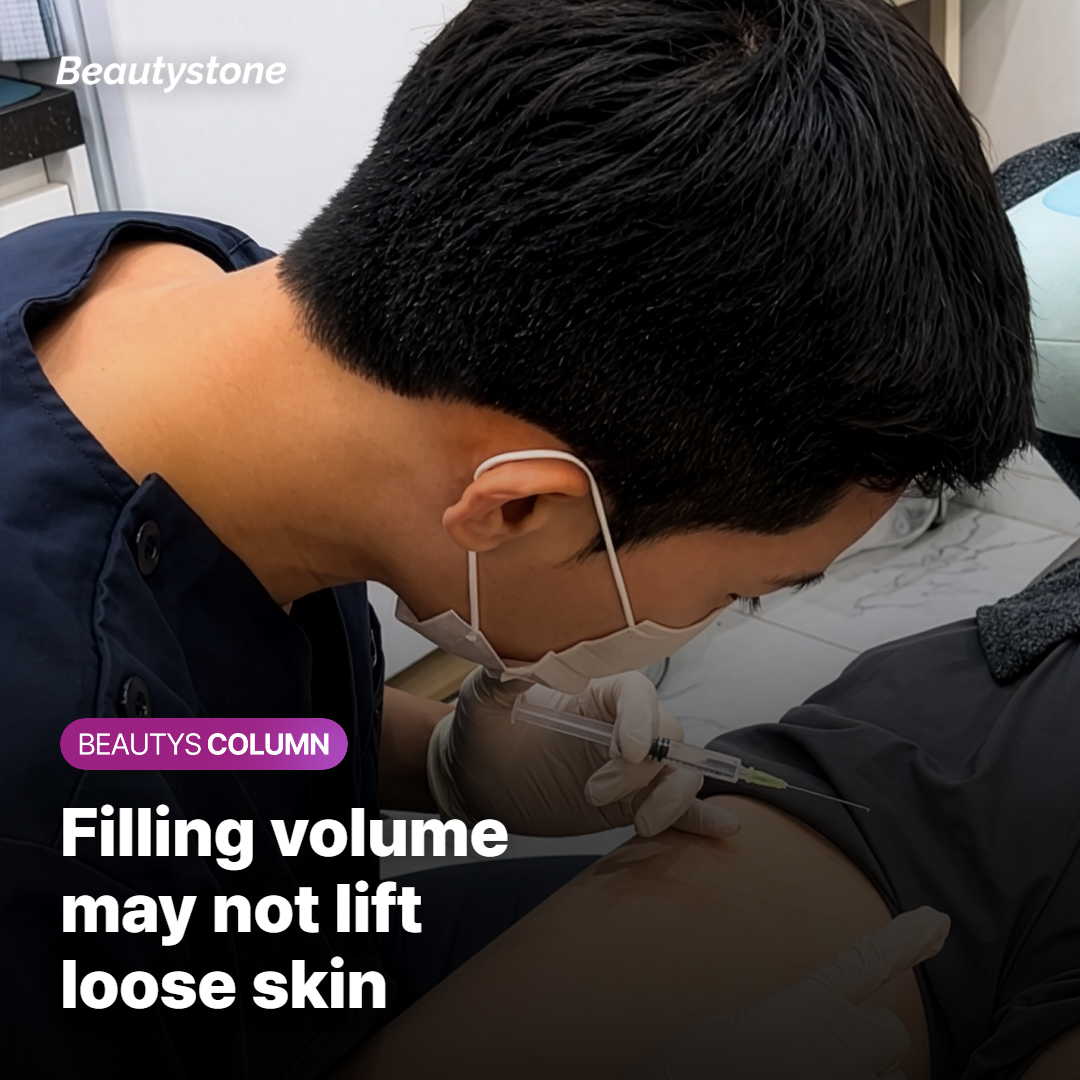
Lifting works on tissue that has loosened, so it doesn't put material back in to replace volume that's gone. If a hollow spot bothers you as well, ask at your consultation how that spot would look after lifting alone. When both concerns are mixed on one face, picture what would be left after choosing only one before you decide.
| Main change blurring your face line | With filler only | With lifting only | What to check first at your consultation |
|---|---|---|---|
| Volume is gone and a shadow forms | Volume is added where it was lost | The hollow may remain | Which depth of volume has decreased |
| Tissue has loosened and moved down | Adding volume alone may not resolve it | This option works on loosened tissue; how much it covers is confirmed at your consultation | How far the laxity extends and how thick your skin is |
| Both are mixed | The laxity may remain | The hollow may remain | Which one looks bigger |
If your face is closer to the last row, knowing what each choice leaves behind means fewer surprises when you see the result. It's also the moment to talk through whether to handle the leftover change later or plan for both from the start.
Why Ask How Firm the Filler Is and How Far It Spreads?
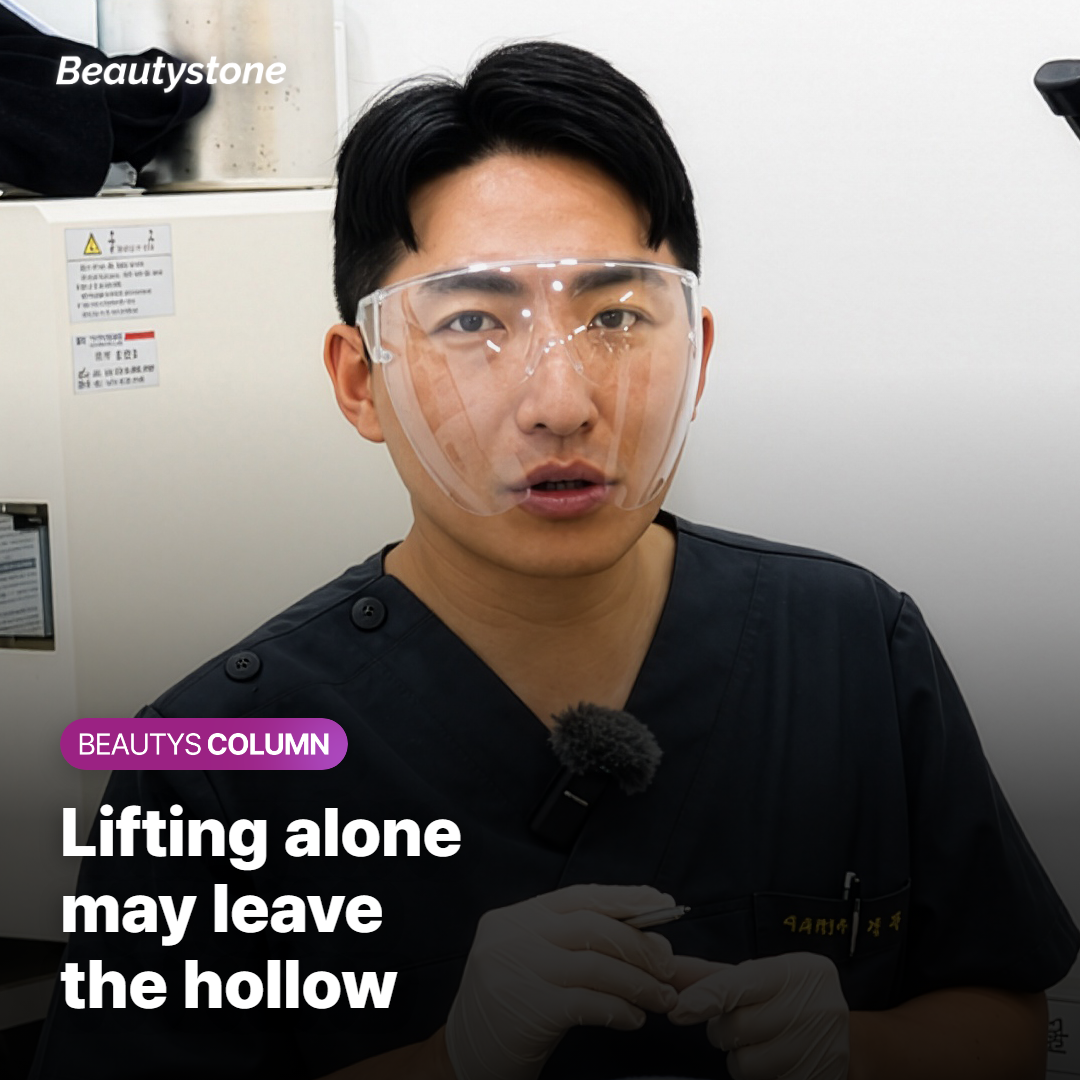
Even among hyaluronic acid fillers, the degree of crosslinking, the concentration, and the particle size change how well a product holds its shape and how far it spreads. Products high in both elasticity (how readily a material springs back after being pressed or stretched) and cohesivity (how strongly it holds together) try to keep their shape where they were placed even under pressure. Softer, less cohesive products spread further into the surrounding tissue. So the right product depends on whether the goal is building support deep down or smoothing a shallow area.
If filler from an earlier treatment is still there, a product with different properties could end up layered in the same spot. Bringing the name of the earlier product makes that call a lot easier.
For building support from a deep layer, products with moderate or higher elasticity and cohesivity are the ones matched to the job. Support here means shaping the contour from deep underneath, which is a different approach from lifting treatments that work directly on loosened tissue.
Filler Risks: When Should You Postpone or Get Care Right Away?
Filler has conditions to screen for before treatment and separate signs to watch for afterward. Tell your provider before treatment, and postpone if needed, in these cases:
- Inflammation or infection where you'd be injected, such as acne, a rash, or hives (wait until it heals)
- A condition that makes bleeding hard to stop
- A history of severe allergic reactions or anaphylaxis
- An allergy to local anesthetics such as lidocaine, to collagen, eggs, or animal-derived ingredients, or to ingredients made through bacterial fermentation
- A tendency to form thick, raised scars such as keloids (safety hasn't been established in this case)
Bruising, swelling, and redness after treatment often settle within a few days, sometimes taking up to a few weeks. Don't wait on the signs below.
- If the skin near the injection site turns white, gray, or blue, or you have pain that isn't what you expected, don't wait. Get medical care first.
- If a wound that oozes develops, see a doctor.
- If your vision blurs or changes, go to the nearest emergency room right away.
- If you suddenly have slurred speech or trouble speaking, numbness or weakness in your face, arms, or legs, trouble walking, facial drooping, a severe headache, dizziness, or confusion, head to the nearest emergency room right away.
Filler blocking a blood vessel is described as unlikely. If it does happen, it can cause tissue death (necrosis), vision problems up to and including blindness, and stroke, and the damage can be permanent*.
*Based on the US FDA's guidance on dermal fillers.
In these moments, getting examined comes before sending the clinic a message.

Planning Filler or Lifting Around a Trip to Seoul
If you're fitting either treatment into a visit to Korea, plan around three points.
Your flight home: unless you had sedation that day, there's no reason to push back your flight because of the treatment.
What one visit can do: filler is among the treatments that change shape on the same day, while most treatments bring you gradually closer to how you used to look rather than changing a lot at once. On a face with both concerns, the change you don't treat on this trip will still be there when you fly home, so factor that into which one you choose.
Once you're back: you can reach the clinic through its consultation chat and send photos. If any of the warning signs above shows up, see a local doctor or go to an emergency room first.
The Bottom Line: Ask Which Change Blurs Your Face Line More
Choosing one treatment for a face with two changes means part of the picture stays as it is, and how much that matters depends on which change is larger on your face. At your consultation, start with: "Is volume loss or sagging doing more to blur my face line?" That puts filler and lifting on the same scale. If filler comes up, follow with which depth of volume it would rebuild and how elastic that product is. Beautystone is a clinic in Seoul's Hapjeong area. When you reach out, send a front photo and a profile photo, the type and timing of any filler or lifting you've had before, and the spot that bothers you most.
Sources
- Conditions to mention before filler, common reactions, and signs of a blocked blood vessel (US FDA)
- Whether cheek filler pulls the skin near the nasolabial folds, a 3D camera study of 77 people (Plast Reconstr Surg, 2018)
- How each facial layer adds to hollowing and sagging, skin movement after filling different areas, and filler properties, a review (Clin Cosmet Investig Dermatol, 2021)
Frequently Asked Questions
Q. If I have both volume loss and sagging, should filler or lifting come first?
A. There's no single fixed order for filler and lifting when you have both volume loss and sagging. The order depends on which change blurs your face line more, whether the two treatments overlap in the same area, and what any filler you've had before is made of. Whether to do both on the same day or space them apart is also decided during the exam, based on that same assessment.
Q. Is it safe to get filler again and again over the years?
A. The safety of getting filler repeatedly over a long period hasn't been evaluated in controlled clinical trials, according to the US FDA. Before adding more, it's safer to first check what's left from earlier treatments: the ingredient, a rough amount, and when it was done. If you don't have those records, say so at your consultation.
Q. What if I feel a lump in my cheek long after getting filler?
A. A lump you can feel in your cheek after filler may be a nodule forming in or under the skin, and these can appear weeks to years after treatment. Some need treatment with injections, oral antibiotics, or surgery, so it's worth getting it checked once you notice it. If the spot turns red or painful, get it seen right away.
Q. Should I wait on filler if I'm pregnant or breastfeeding?
A. Filler safety during pregnancy or breastfeeding hasn't been established, according to the US FDA. That's why it's safer to plan on postponing filler during this time. If you're planning a pregnancy or currently breastfeeding, mention it at the start of your consultation, and the timing can be set again once you've finished breastfeeding.
Q. Can filler in the temples lift the eyes?
A. Filler in the temples has been reported to move skin in a lifting direction in the middle or lower face, rather than around the eyes. Those reports, pooled in a 2021 review, involved the superficial fat of the temple, and whether that lift stayed or vanished could turn on three things: how it was injected, how much was used, and how loose the temple skin was. If the eye area is your main concern, mark it in your photos so it's looked at directly in the exam.