
Choosing a Botox Clinic? Check These 3 Things
A good botox consultation names the product, writes units per area, watches you frown before dosing, and explains which symptoms need care right away. Here's how to check each one.

Pick a botox clinic by what happens in the consultation: they name the product and write down the units for each area, they watch your face at rest, frowning, and with raised brows before splitting the dose, and they tell you which symptoms mean you should call or get care right away. Price and photos are worth comparing only after those three are in place.
Here's why. Botox units aren't a shared currency, so "20 units" means little until you know which product it refers to. Faces aren't standard either, since frown patterns and left-right differences vary from person to person. Below, we walk through what to ask, what a careful exam looks like, and what to watch for once you're back home.
Quick summary
- Choose a botox clinic by three checks: the product name with units per area, an exam of your face in motion, and clear warning signs to act on.
- Units: Units are specific to each product, so a quote without the product name can't be lined up against another quote.
- Frown patterns and left-right differences vary, so the same "between the brows" area may call for different spots and doses.
- Timing: The effect usually starts in 2-4 days, peaks around 10 days, and wears off after about 3 months.
Which Product and How Many Units Should Your Quote Show?
Your first question is simple: "Which product are you using, and how many units go into each area?" Botulinum toxin is dosed in units, but each product measures its units its own way.
According to the US FDA-approved label for Xeomin, its units are specific to how that product is prepared and tested, and they can't be compared to or converted into units of any other botulinum toxin product.
*Unit: the number used to describe the strength of a botulinum toxin dose. Each product measures it differently, so the same number doesn't mean the same amount across brands.
So a line like "frown lines, 20 units" only becomes useful once a product name sits next to it. In Korea you may hear names such as Xeomin or Coretox, a Korean botulinum toxin. Neither name tells you which one suits you better, and that isn't the point of asking. What matters is that the clinic says which product it's using and writes the units per area on your quote or chart.
That written note matters even more when you're traveling. If your next session happens back home or at another clinic, your new provider can start from a real record instead of guessing. Without it, you'd be comparing numbers that don't measure the same thing.
A few things are worth seeing in writing before you agree to treatment:
- The product name, not just "botox"
- Units for each area, such as frown lines, forehead, or crow's feet, rather than one total
- The date of treatment, so you know when the next session could be considered

Why Should the Doctor Watch You Frown Before Dosing?
Because the muscles that pull your brows together don't move the same way in everyone, and the injection spots and dose should follow that movement. Frown lines between the brows mostly come from two places: the corrugator muscles along the inner brows and the procerus, a small muscle at the bridge of the nose.
*Corrugator: a pair of small muscles along the inner brows that draw them down and inward, creating vertical lines between the brows.
In a photo study of 334 adults in Brazil, researchers sorted frowns into five patterns based on how the brows moved. They suggested placing more of the dose in the most-used muscles and less in the less-used ones. Among 36 people who came back for another session, the frown returned to its original pattern as the effect wore off. It was a photo analysis without a control group, so it describes how faces move rather than proving one dosing plan works better.
A 3D photo study of 29 Korean adults found a similar spread. U-shaped and "11"-shaped frowns each made up 38%, X-shaped frowns 14%, and pi-shaped frowns 10%. In 62% of people, the skin on the left and right sides moved differently when they frowned.
That's why a quick look at a relaxed face isn't enough. In the consultation, notice whether the doctor does the following:
- Asks you to rest your face, then frown, then raise your brows
- Checks brow height and forehead lines on both sides, not just the middle
- Explains where the dose goes in each area and why one side might get a little more or less
If the plan is set before anyone has watched you frown, you're getting a standard map rather than one drawn for your face.

How Many Units Go Between the Brows, and How Often?
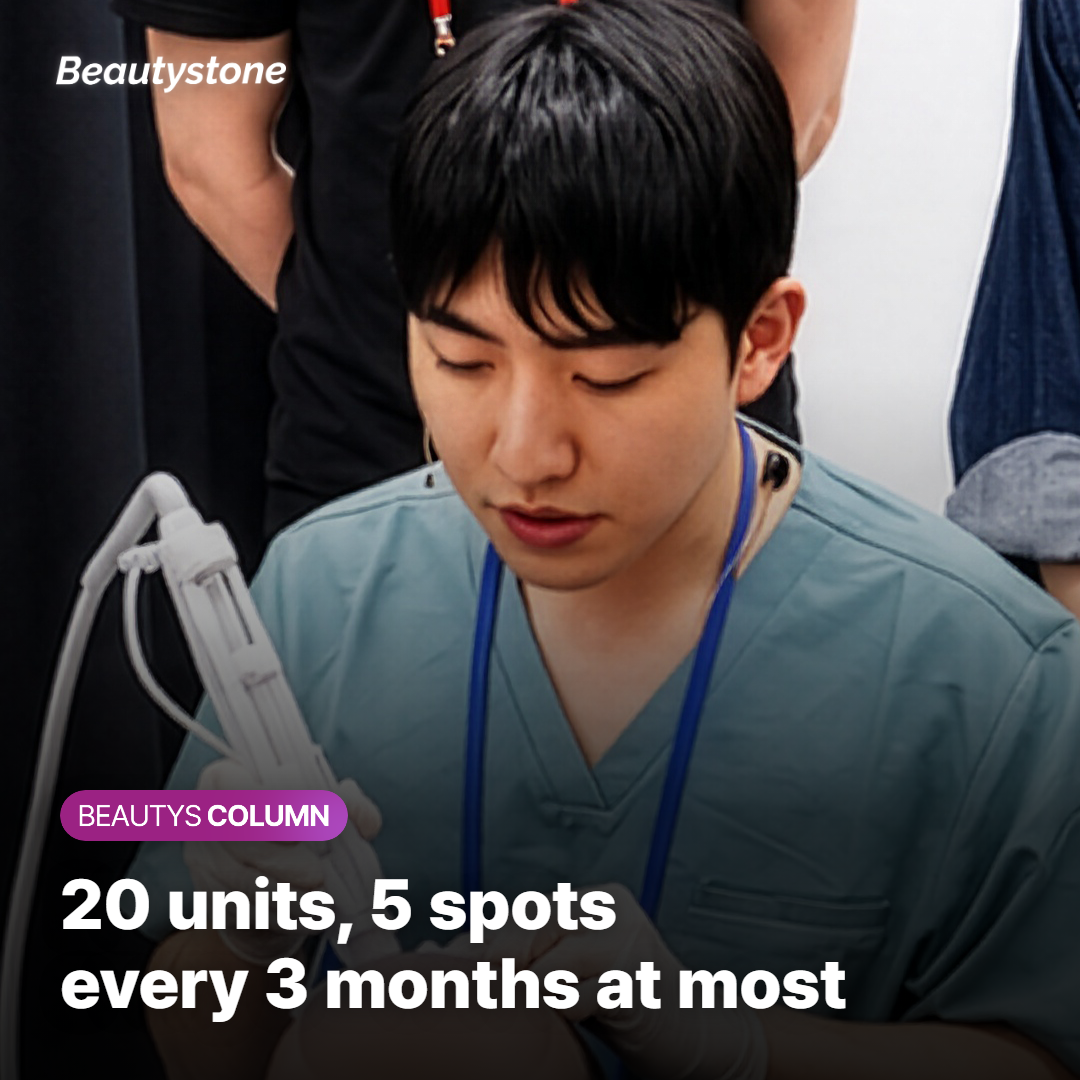
For Xeomin, the standard frown-line dose is 4 units at each of 5 spots, 20 units in total: 2 spots in each corrugator and 1 in the procerus. Retreatment shouldn't come more often than every 3 months.
That 3-month line is easy to forget on a trip. If it's been only a few weeks since your last session at home, tell the clinic before anything is planned. An early top-up stacks a new dose on top of one that's still working, and it makes it harder to tell which dose actually did the job.
Where the needle goes matters as much as how much. To reduce the chance of a drooping eyelid, injections should stay away from the muscle that lifts the upper eyelid, and corrugator injections should sit at least 1 cm above the bony ridge under the brow.
You don't need to memorize anatomy to use this. Just ask, "Which spots will you avoid so my eyelids and brows don't drop?" A careful doctor can point to them on your face and explain the distance. If the answer is vague, that tells you something too.
Keep in mind that 20 units is the starting reference for one product and one area. Your own plan may split it differently, which is exactly why the exam in the previous step comes first.
When Can You Judge Botox Results If You Fly Home Soon?
Give expression lines 3-4 weeks before you decide how botox worked, and give muscle-slimming goals such as the jaw 6-8 weeks. The effect usually starts in 2-4 days, peaks around 10 days, and wears off after about 3 months.
For a short stay in Seoul, that timeline has a practical catch: you'll likely leave before the result settles. Looking in the mirror on day 3 and deciding it "didn't work" is simply too early. How much you see also depends on your muscles and skin, and results differ from person to person.
A little planning makes the check easier from home:
- Take a photo of your frown and raised brows before treatment, in good front lighting
- Take the same photos again at 3-4 weeks for frown, forehead, or crow's feet
- Keep the product name, units per area, and date together with those photos
The before photo is more useful than it sounds. Since the frown tends to return to its original pattern as the effect fades, that photo shows your next provider how your face moved before treatment.

Botox Side Effects: What's Normal and What Needs Care Now?
The most common reactions come from the injection itself: pain, bruising, swelling, or redness where the needle went in. Some people get a mild headache 2-4 hours after forehead injections. In frown-line trials where 535 people received 20 units, headache was reported in 5%, compared with 2% in people given a placebo. If redness or swelling gets worse or spreads, contact the clinic right away.
Less often, the toxin's effect can spread beyond the treated area. Symptoms may appear anywhere from hours to weeks after the injection, which means you could already be home. Don't wait these out:
- Drooping eyelids, double vision, or blurred vision: contact the clinic that treated you and see a doctor right away
- Muscle weakness that spreads across your body: get medical care right away
- Trouble swallowing, speaking, or breathing: get immediate medical care, and go to the nearest emergency room
Messaging the clinic is a good way to keep them informed, but it doesn't replace being seen in person. If you're abroad when symptoms start, the record of product, units, and date helps any doctor understand what you received.

The Bottom Line: What to Take Home From Your Botox Visit
Leave with a written record, whether you come back to the same clinic or not. It saves your next provider from starting the dose from scratch.
| Record | Why it helps | What to ask |
|---|---|---|
| Product name | Units can't be converted between products | Which product are you using today? |
| Units per area | The baseline for adjusting your next dose | How many units for each area? |
| Before photo of your frown | The original pattern tends to come back | Can I keep a photo from before treatment? |
| When to judge results | Lines and muscle slimming settle at different times | When should I check the result? |
| Who to contact | Eyelid droop or trouble swallowing can show up weeks later | Where do I reach you if something feels off? |
Before you book anywhere, ask one question: "Which product, and how many units in each area?" The answer tells you whether this quote can be compared with any other. If you'd like to talk it through with Beautystone, a clinic in Seoul's Hongdae area, you can message the clinic through the consultation button on this page. In your first message, mention which area bothers you most (frown lines, forehead, or crow's feet), and if you've had botox before, the product name and the date of your last session.
Sources
- Xeomin prescribing information: units, dosing, warnings, and side effects — US National Library of Medicine DailyMed, 2026
- Five frown patterns and tailored dosing in 334 adults — Dermatologic Surgery, 2012
- 3D analysis of frown movement in 29 Korean adults — Annals of Dermatology, 2025
- Botulinum toxin: timing, common reactions, and who shouldn't have it — DermNet
Frequently Asked Questions
Q. Does a cheaper botox quote mean fewer units?
A. You can't tell from the price alone. Botox units are specific to each product, so only quotes that list both the product name and the units per area can be compared fairly. If a quote leaves either one out, ask the clinic to add it before you decide.
Q. Can I switch to a different botox product than last time?
A. You can, but copying last time's unit number onto a new product won't give you the same dose, because units can't be converted between botulinum toxin products. Bring the previous product name, the treated areas, the units, and the date so the doctor can set a new dose from that record.
Q. Can I treat frown lines, forehead, and crow's feet in one session?
A. Yes, they're often treated together. For Xeomin, the combined maximum for those three areas is 64 units, and forehead lines are meant to be treated together with frown lines to minimize brow droop. If a plan treats the forehead alone, it's worth asking why.
Q. Can I get botox while pregnant or breastfeeding?
A. Botulinum toxin is avoided during pregnancy and breastfeeding. If you're pregnant, nursing, or planning a pregnancy, mention it before you book a date. Treatment can be reconsidered after that period.
Q. Can I get botox if I have a muscle weakness condition?
A. Botulinum toxin isn't used in people with ALS (motor neuron disease) or myasthenia gravis. If you've been treated for muscle weakness or take medication for it, share the diagnosis and the medication name at the consultation.
Q. I had an allergic reaction to botox before. Is a different brand OK?
A. A known allergy to any botulinum toxin product or its ingredients means botulinum toxin isn't used, even under a different brand name. Xeomin, for example, contains human albumin and sucrose. Describe what happened and name the product before the consultation.
Q. Should I wait if I have a breakout where I'd be injected?
A. Yes. An infection at the injection site, such as an inflamed pimple or an infected cut, means treatment should wait until it has cleared. Show the spot at the consultation so a new date can be set.