
Acne Scar CO2 Laser: How Many Sessions?
Sunken acne scars fill in gradually with fractional CO2 laser, not in one visit. Here's what studies show about improvement per session, pigmentation and how it compares.

Fractional CO2 laser doesn't fill sunken acne scars in a single visit. When a dermatology center in Singapore reviewed 107 Asian patients, most saw their scar texture improve by less than half, and other studies found that the improvement grew as sessions were added. So the more useful question before booking isn't "how many sessions until it's gone?" but "what level of change am I aiming for, and over how many sessions?" Setting that target first is what keeps people from feeling let down after one or two treatments.
The other thing that shapes the final result is the dark patching that can appear after treatment, known as post-inflammatory hyperpigmentation. It's common in medium and darker skin tones, including most Korean and East Asian skin, and how quickly it fades turned out to be linked to how good the end result looked. In this article, we'll walk through why one session can't do the whole job, how much change to expect as sessions add up, how fractional CO2 compares with microneedling and erbium lasers, what to do about dark patches afterward, and what to sort out before you book. It's written from the perspective of Beautystone Clinic, a dermatology clinic in the Hongdae–Hapjeong area of Seoul.
Why One Session Doesn't Fill a Sunken Acne Scar
Most acne scars that look like dents or shallow craters are atrophic scars. During a deep breakout, inflammation damages the collagen in the dermis, the supportive layer under the surface. When that layer heals with less tissue than before, the surface above it sinks, and the edges of the dent catch light and cast a small shadow.
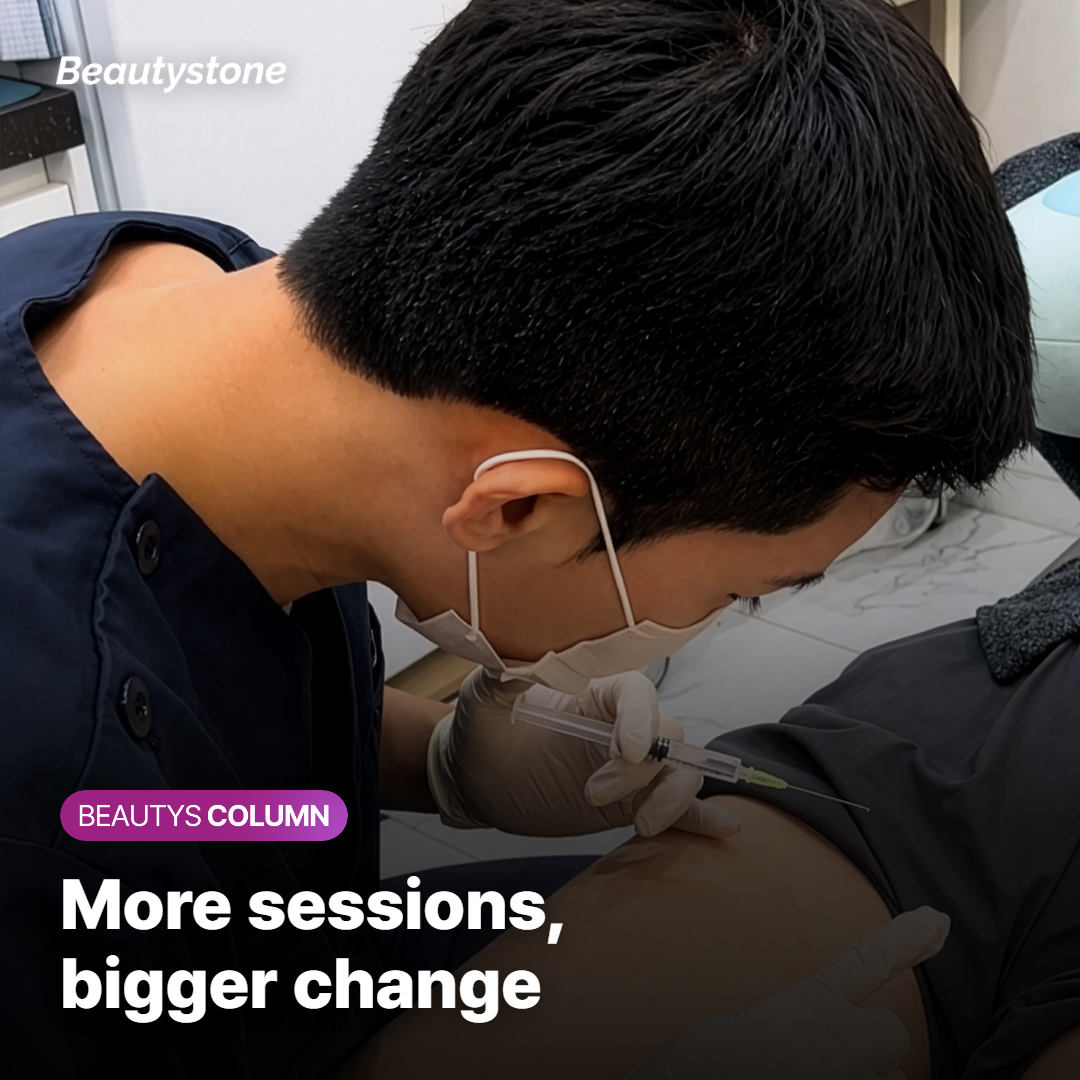
A fractional CO2 laser doesn't resurface the whole face at once. It vaporizes the skin in thousands of very thin columns and leaves the skin between those columns untouched. Those untouched bridges let the surface heal quickly, while the injury around each column prompts the dermis to build new collagen. Over the following weeks and months, that new collagen lifts the floor of the scar a little.
That design is also the reason it works in steps. Because each session only treats a fraction of the skin, recovery is shorter than with older full-surface lasers, but the amount of lift from any one session is limited. It's a bit like filling a pothole by adding thin layers: each layer helps, and the road only looks level after several.

How Much Improvement to Expect by Session
The Singapore study looked back at 210 fractional CO2 treatments given to 107 Asian patients with skin types II to V, so each person had about two sessions on average. After the final session, patients graded their own change. According to the 2017 report in Dermatologic Surgery, 66.4% reported less than 25% improvement in skin texture, 30.0% reported 25% to 50%, 3.7% reported 51% to 75%, and 0.9% reported more than 75%.
The picture changes when more sessions are planned from the start. In a study from a university hospital in North India, 104 people had four sessions six weeks apart, and their scars were graded again after each one. Average improvement rose from 0.56 after the first session to 1.62 by the end of the course, and about 81% of patients said they were satisfied or very satisfied. A retrospective study of 82 patients in China reached a similar conclusion: among people who had one to three sessions, three sessions were linked to better outcomes.
Put together, one or two sessions usually soften the texture, while three or four give the improvement room to build. These are averages from groups of patients, though. How deep and how wide your scars are will move the result up or down even with the same number of sessions, which is why the plan should start from the scars themselves rather than a fixed package.
Fractional CO2 vs Microneedling and Erbium Lasers
If you've been researching acne scar treatment, microneedling (including radiofrequency microneedling) and erbium lasers will have come up too. Recent pooled analyses don't support the idea that fractional CO2 is always the stronger choice.
A 2026 meta-analysis of 17 studies comparing fractional CO2 with needling-based treatments found no significant difference in scar score reduction. Fractional CO2 did carry about three times the risk of dark patches compared with standard microneedling, and the authors concluded that skin type, scar type and possible complications should guide the choice.
A separate 2026 meta-analysis comparing fractional CO2 with erbium-based lasers pooled five studies. People treated with erbium lasers were less likely to reach more than 50% improvement than those treated with CO2, but CO2 was more painful and its downtime was about 3.67 days longer on average. When only the randomized studies were counted, the difference in improvement was no longer statistically clear.
Scar shape matters as well. Narrow, deep "ice pick" scars don't respond the same way as broad, shallow ones. In one small randomized trial on ice pick scars, a technique that fires the CO2 laser point by point into each scar was compared with a chemical method and came out ahead.
Side Effects and Risks: Dark Patches After Treatment
Dark patching after fractional CO2 isn't rare in Asian skin. In the Chinese study, 60 of 82 patients (73%) developed it, and in 26 (32%) it lasted longer than three months. Importantly, the people whose dark patches faded within three months also had better scar outcomes. The Singapore study reported other side effects as well, including blistering in 4.0%, a flare of inflammatory acne in 1.7% and new scarring in 0.6%.
How the skin is cared for right after treatment can change those numbers. In a split-face study of 40 patients with skin type IV in Thailand, the side that received a short course of steroid ointment for the first two days developed dark patches 40% of the time, compared with 75% on the side that received petroleum jelly alone. Ointments like this should only be used as directed by the treating clinic, for the product and number of days it specifies.
If a darker area is slowly getting lighter over a few weeks, that's the expected course, and the main job is to stay out of the sun while it fades. If it's still getting darker or spreading after three months, or if you notice blisters or oozing at any point, show it to the clinic that treated you before the next session is booked.
What to Plan Before You Book
At Beautystone Clinic, we look at the shape and depth of your scars and your skin type first, then set the number of sessions, the interval between them and a recovery schedule together. If your skin tends to hold on to dark marks, we adjust the energy and spacing with that in mind. When you get in touch, it helps to share:
- When your scars formed, and whether you still get inflamed breakouts
- Any scar treatments you've had before, and whether your skin darkened afterward
- The dates of any important events or your travel dates to Seoul
The Bottom Line
Fractional CO2 laser lifts sunken acne scars gradually rather than all at once. In the largest Asian study here, most patients saw less than half their texture improve after about two sessions, while a four-session course showed improvement building with each round. It doesn't clearly outperform microneedling, it brings a higher risk of dark patches in Asian skin, and how fast those patches fade is tied to the final result, so aftercare is part of the treatment. If you're planning a trip to Seoul and want a realistic session plan for your scars, send Beautystone Clinic a WhatsApp message with a few clear photos and your past treatment history.
Frequently Asked Questions
Q. How long is the recovery after each session?
A. In a randomized trial comparing four sessions of fractional CO2 with a non-ablative 1540 nm laser, crusting, flaking and redness after CO2 lasted 5.2 days on average, compared with 2.1 days of redness after the non-ablative laser. If your schedule is tight, it's worth planning the session date around that.
Q. Can I start while I still have active breakouts?
A. Acne can flare after treatment. The Singapore study reported it in 1.7% of patients and the Chinese study in about 9.8%. If you have a lot of inflamed acne, it's usually better to calm it down first, and the timing can be decided together at your consultation.
Q. I get cold sores often. Is that a problem?
A. Please mention it beforehand. In the same randomized trial, one patient in the CO2 group had a herpes outbreak after treatment. If you have a history of cold sores, a preventive plan can be agreed on before the session.
Q. Will my acne scars disappear completely?
A. In the Singapore study, fewer than 1% of patients reported more than 75% improvement. A more realistic goal is to reduce the shadows and unevenness so the scars are less noticeable, rather than to erase them.