
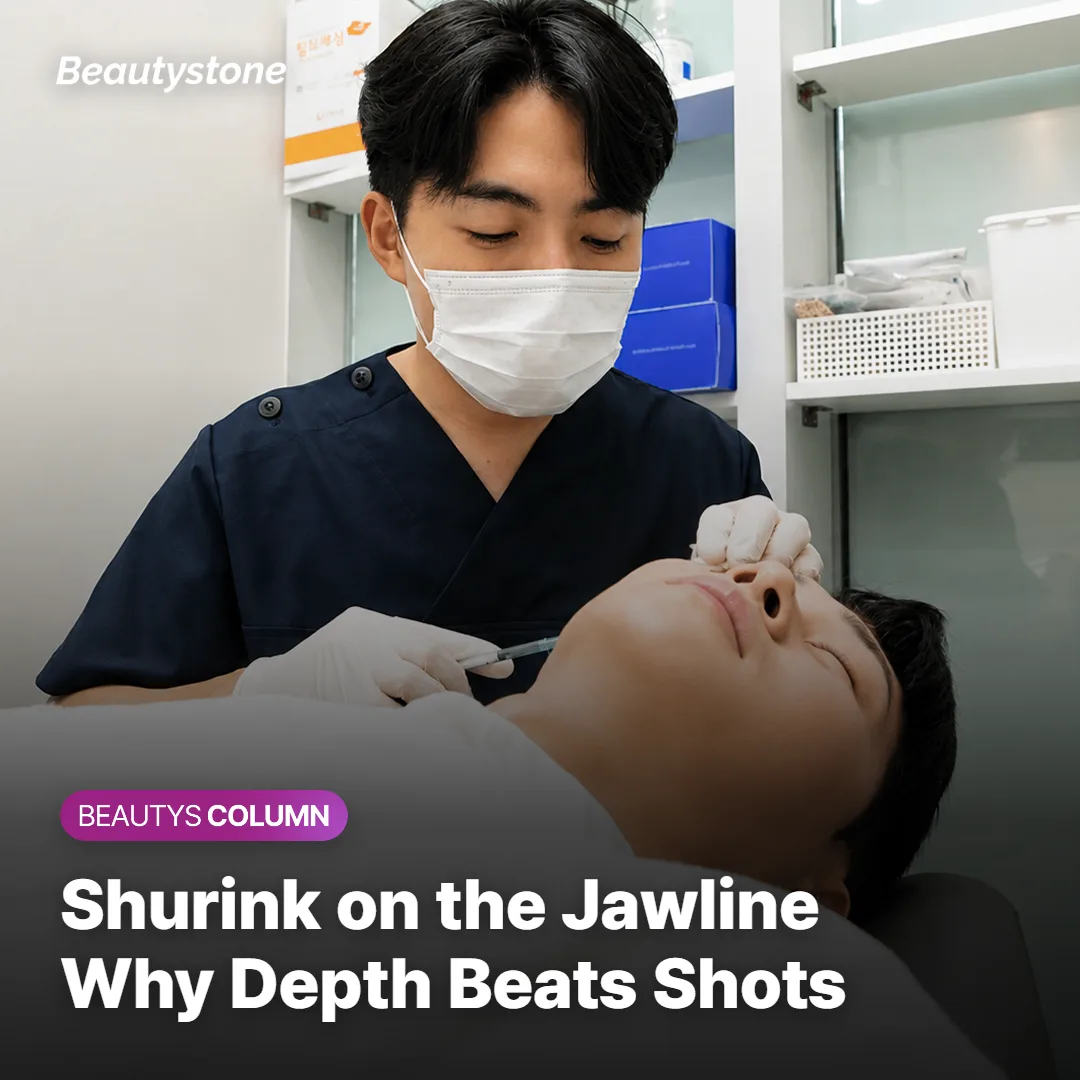
Shurink on the Jawline: Why Depth Beats Shots
On the jawline, the tip your provider chooses matters more than the shot count on your receipt. Here’s how Shurink depth works, why the deepest tip is a poor default along the jaw, and what a realistic timeline looks like.

If you’ve ever walked out of a Shurink session with a number stuck in your head — 300 shots, 600 shots, 900 — you’re not alone. Shot count is the figure clinics quote, the figure friends compare, and the figure most people assume decides the outcome. Along the jawline, though, it’s one of the weaker predictors of how a result turns out. What tends to matter more is which transducer tip was used, and how deep that energy actually landed. In this article, we’ll cover what each Shurink tip does, why the deepest tip is a questionable default along the jaw, how depth and shot count interact, what a realistic session-by-session timeline looks like, and when Shurink isn’t the right tool at all.
What Is Shurink, and What Do the Tips Do?
Shurink is a high-intensity focused ultrasound (HIFU) treatment. It concentrates ultrasound energy at a fixed depth below the skin surface, creating tiny thermal coagulation points that your body then repairs. That repair response — not the treatment itself — is what drives the gradual tightening people notice over the following weeks.
Here’s the part that gets skipped in most consultations: the depth isn’t something the provider dials in. It’s decided by which transducer tip goes on the handpiece, and each tip is built to deliver its energy to a specific layer.
- 1.5mm: the dermis, the layer associated with surface texture, fine lines and superficial crepiness rather than lift.
- 3.0mm: the subcutaneous fat and the more superficial part of the SMAS*, which is where a lot of the contour work along the lower face happens.
- 4.5mm: the deep SMAS, the layer providers reach for when the goal is lifting heavier tissue rather than refining the surface.
*SMAS (superficial musculoaponeurotic system): the fibrous, muscle-linked layer sitting between skin and facial muscle that most lifting treatments aim to tighten.
So when two people compare notes, report the same shot count, and describe completely different outcomes, the tip selection is usually a bigger part of the explanation than anything else on the chart.

Why the 4.5mm Tip Is a Problem on the Jawline
Because the jawline is thin, and there’s bone sitting directly underneath it.
Across the cheek, there’s a reasonable cushion of skin and subcutaneous fat above the deep SMAS, which gives a 4.5mm tip room to do its job. The jawline is a different piece of anatomy. The skin is thinner, the fat layer over the bone is shallower, and the mandible — the jawbone itself — runs close beneath the surface. Push energy to 4.5mm along that border and it can travel past the SMAS toward bone.
Two things follow. First, sensation changes: energy landing near periosteum tends to produce a sharp, jolting pain rather than the dull heat people describe elsewhere on the face. Second, and more importantly, the marginal mandibular nerve runs along that region. Delivering deep energy over it raises the risk of irritating it, which is a trade-off with very little upside when the tissue there was never thick enough to need that depth.
That’s why many providers step down to the 3.0mm tip along the jaw. It reaches the more superficial part of the SMAS — the layer that actually holds contour in that zone — while keeping the energy away from bone and from structures that don’t appreciate being heated.
It’s a common consultation story: someone comes in after several hundred shots elsewhere, frustrated that the jaw looks much the same. When the treatment record shows a single deep tip used from ear to chin, adding more shots at that same depth rarely changes the picture. Redistributing the depth usually does more.
Does Shot Count Actually Matter?
It does — it’s just the second question, not the first.
Shot count describes how much total energy was delivered. Tip selection describes where that energy went. Getting the second one wrong means the first one can’t rescue you: energy placed in a layer that isn’t holding your contour doesn’t become useful just because there was more of it. In practice, contouring plans for the lower face often start from a rough split between the deeper and the shallower tip, then get adjusted to the person on the table.
- Fuller lower face, thicker subcutaneous fat: the deeper tip typically carries more of the plan in the areas that can safely accommodate it, since there’s more tissue between the surface and bone.
- Leaner face, thinner skin: the shallower tip usually takes on more of the work, targeting the superficial SMAS precisely instead of pushing depth the tissue can’t support.
- Mixed picture: most people are, and that’s the point — the ratio is a judgment call made per zone, not a single setting applied across the whole face.
It also helps to know how Shurink sits next to the other devices people compare it with, because they aren’t interchangeable:
| Treatment | Energy Type | Layer It Targets | Jawline Consideration |
|---|---|---|---|
| Shurink | Focused ultrasound (HIFU) | Dermis through deep SMAS, depending on tip | Depth is set by swapping tips, so the jaw can be treated more shallowly than the cheek |
| Ultherapy | Focused ultrasound (HIFU) | SMAS-focused | Delivers energy at higher intensity per point, so provider judgment near the jaw matters |
| Thermage | Radiofrequency (RF) | Broad, bulk heating of the dermis | Heats a wider area rather than discrete points; less suited to deep, heavy laxity on its own |
None of this means one device beats the others. It means the question “how many shots did you get?” leaves out most of what determined your result. Individual results vary, and a plan that worked beautifully for a friend may be the wrong map for your anatomy.

What to Expect, Session by Session
Most jawline plans run as a short series rather than a single visit — commonly three sessions spaced around three weeks apart. The logic is cumulative: each round adds another wave of collagen remodeling while the previous one is still active, and the tightening effect builds on itself.
- Day of treatment to two weeks: mild swelling and tenderness are common, and any “tighter” feeling this early is usually temporary rather than the real result.
- Three to four weeks: collagen remodeling is underway, and this is typically when subtle changes along the jaw border start to be visible in photos rather than just felt.
- After the second and third session: the cumulative effect tends to be more noticeable than any single session produced on its own.
- Around six months: many people are still holding the contour they gained, though this varies with age, skin quality and how much laxity there was to begin with.
If you’re hoping for a next-day change, this isn’t that treatment. The trade-off for skipping downtime is that the result arrives slowly, and it asks for patience through the first few weeks when not much appears to be happening.

Side Effects and Risks
Redness, mild swelling and tenderness along the treated border are common and usually settle within a few days. If they worsen or spread instead of easing, contact your provider right away.
Small bruises can happen, particularly in thinner-skinned areas, and typically fade over about a week. Discomfort during the session is real but manageable for most people: topical numbing cream is standard, and some clinics add a nerve block when deeper settings are used. The sharpest sensations tend to cluster exactly where energy comes closest to bone, which is another practical argument for choosing depth carefully along the jaw.
The complication worth understanding before you book is nerve irritation. Temporary weakness or asymmetry around the lower lip has been reported after deep energy delivery near the mandibular border. It’s uncommon, and it’s typically temporary when it does occur, but it’s the specific reason that a blanket 4.5mm approach along the jaw is a poor default.
Seek medical care right away if you develop fever, spreading redness, escalating pain, blistering or an open wound at a treated site, or facial asymmetry that isn’t settling. These are not things to wait out at home.

Who’s a Good Candidate for Jawline Shurink?
Shurink tends to suit people with mild to moderate early laxity who still have reasonable skin quality and some soft tissue along the jaw — and who want gradual change without taking time off.
It’s a weaker fit when there’s significant sagging with very little underlying fat to work with. In that situation, focused ultrasound has less to tighten, and providers often combine approaches: a radiofrequency device for skin-level tightening, or neuromodulator placement to soften the muscular pull that drags the lower face down. Some degree of laxity sits outside what energy devices can address at all, and an honest consultation should say so rather than sell you a series.
Your provider should also screen for the practical exclusions — active skin infection or open lesions in the treatment area, recent procedures in the same zone, and anything in your history that changes healing. Bring your previous treatment records if you have them. Knowing which tips were used last time is far more useful than remembering the shot count.
The Bottom Line
- Shurink’s depth is set by the transducer tip, and each tip reaches a different layer.
- The jawline has thin skin over close-lying bone, which makes the deepest tip a risky default there.
- Shot count matters less than where that energy was placed, and the ratio should change with your anatomy.
- Expect a short series and a slow build rather than an overnight change.
Like any energy-based procedure, it comes with trade-offs, and individual results vary. Ultimately, the choice depends on your anatomy, your goals and your tolerance for a gradual timeline.
If you’re considering Shurink for your jawline, the most useful question to bring to a consultation isn’t “how many shots do I need?” — it’s “which tips are you planning to use along my jaw, and why?” Beautystone is a dermatology clinic in the Hapjeong area of Seoul; you can see current offers at our promotions page.