

Ultherapy Results: Too Early at One Month?
Ultherapy results emerge gradually as Collagen regenerates over 8–12 weeks. Don't evaluate based on one-month reviews.

Why Judging Ultherapy Results After Just One Month Will Cost You
As the seasons shift into autumn, my clinic fills up with patients who say,
"I want to get something done before winter sets in."
And among them, a surprisingly large number say:
"I had it done somewhere else about a month ago, and honestly, I don't see much difference."
Today, I want to walk you through exactly why that happens.

The bottom line. Ultherapy heats the SMAS Layer to deliver gradual Lifting that becomes visible over 8–12 weeks.
What makes or breaks results. It's not about what you see immediately after — it's whether you're evaluating at the point when Collagen has fully regenerated.
What we'll cover today. Depth, shot count, and timing — where results are actually determined.
Where Do Ultherapy Results Actually Come From?
Ultherapy is a Lifting device that concentrates ultrasound energy into a single focal point to heat the SMAS Layer.
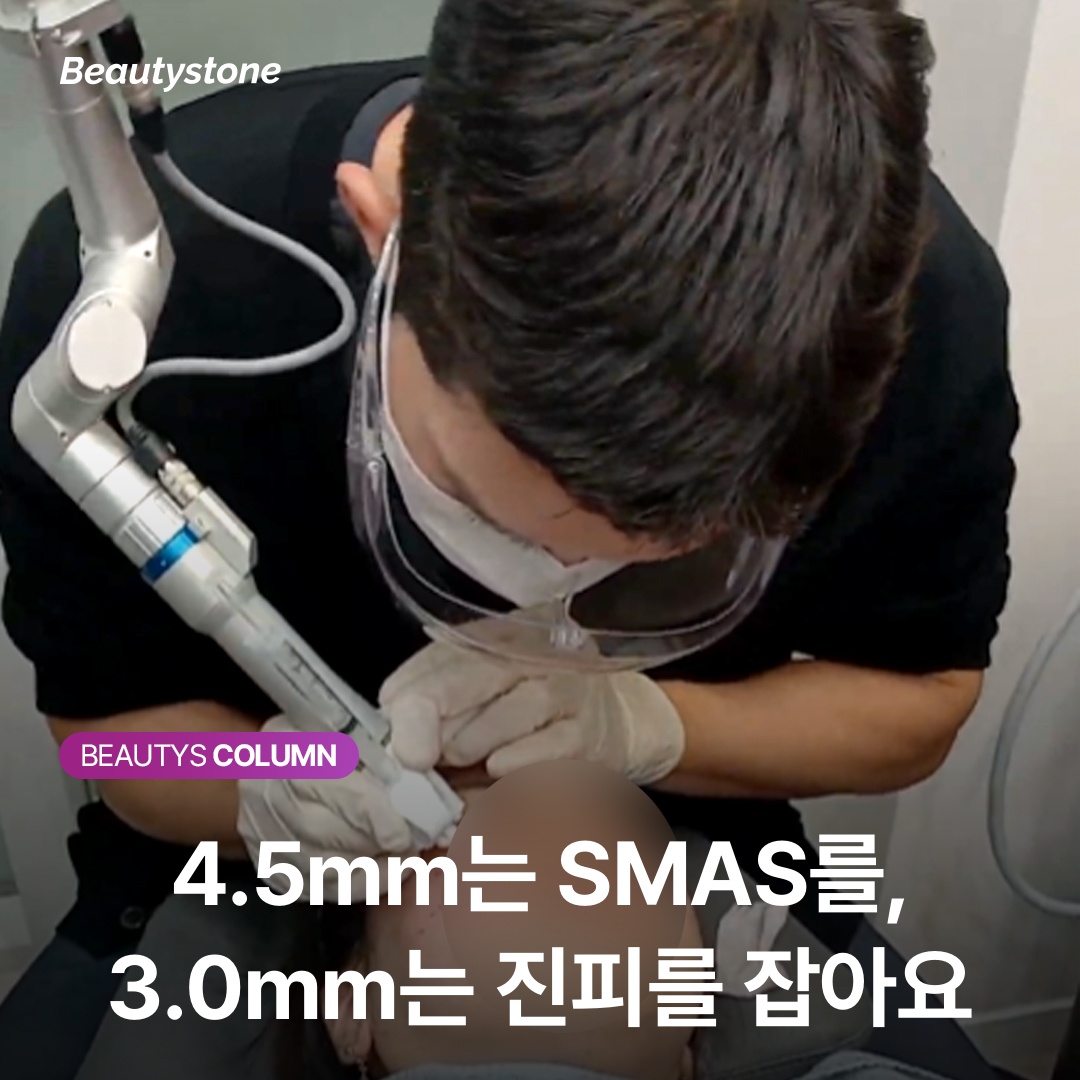
The 4.5mm transducer is the key component.
This depth directly targets the SMAS Layer (superficial musculoaponeurotic system).
The SMAS is the fascial structure beneath the face —
it's only when this layer undergoes coagulation and contraction that true "lifting" can occur.
The 3.0mm transducer targets the deep Dermis, while the 1.5mm addresses the superficial Dermis.
Even with the same Ultherapy device, the results vary dramatically depending on
which transducer is used and how shots are distributed across each depth.
When Do Ultherapy Results Actually Appear?
Not immediately after the procedure — results emerge gradually as Collagen regenerates, typically becoming visible around 8–12 weeks post-treatment.
Key Takeaway
Ultherapy at 4.5mm depth directly stimulates the SMAS Layer to produce genuine Lifting —
but results don't appear right away. They develop gradually as Collagen regenerates over 8–12 weeks.
Most "I see no results after a month" reviews are simply evaluations made far too early.
This might be hard to grasp from text alone, but it becomes very clear when you look at real cases.
Last week, a 41-year-old patient came in to see me.
She had received 600 shots at another clinic a month prior and came in frustrated, saying, "Nothing has changed at all — is this a scam?"
I walked her through it using her photos.
Right after the procedure, there's only mild micro-Swelling and a slight immediate contraction.
The real Lifting begins to appear around week 8, when new Collagen starts forming in the SMAS Layer.
It typically peaks at 12 weeks and is maintained for approximately 12 months — that's the standard curve.
I asked her to wait two more months,
and when she returned at the 8-week mark, she was the first to say, "I can finally see a difference."
The prevalence of "no results after a month" reviews
is rarely due to a poorly performed procedure — in most cases, it's simply a matter of evaluating too soon.
Collagen synthesis doesn't happen over days; it unfolds over weeks.
Patients in their 30s tend to maintain results for 12–18 months,
while those in their 50s may see results taper off around 8–10 months.
Sun exposure and significant weight changes are the two biggest factors affecting how long results last.

Ultherapy is not a procedure where your face lifts the moment you walk out of the treatment room.
The true results only become visible when Collagen has fully developed — typically between 8 and 12 weeks post-procedure.
Please don't judge your results based on a one-month review — it's simply too early.
300 vs. 600 Shots — How Does the Difference in Ultherapy Results Break Down?
Shot count isn't just a number — what determines results is how those shots are distributed across different depths.
This is something that comes up constantly when patients compare notes with friends.
"I had 300 shots and you had 600 —
why do our results look similar?" is a question I hear all the time.
If 300 shots were spread thinly across the entire face at shallow depths,
while 600 shots were concentrated at 4.5mm,
the 600-shot case will actually deliver a far more noticeable Lifting effect.
The defining factor is how thoroughly the SMAS Layer was coagulated.
That's why clinics that compete purely on shot count to justify lower prices can be a red flag.
Some clinics distribute 600 shots as 200 at 4.5mm + 200 at 3.0mm + 200 at 1.5mm,
while others put more than half of those shots into the 1.5mm depth.
The latter may improve Skin Texture at the surface, but it does almost nothing to address sagging.
So which category applies to you?
One thing I always make sure to mention:
for patients with less facial fat or a lean build,
overloading shots at 4.5mm can actually make the cheeks appear more hollow.
This is not a decision to make based on a shot distribution chart alone — it requires a hands-on assessment in person.


The Three Questions I Get Asked Most About Ultherapy Results
Q1. How long do Ultherapy results last after a single session?
A. This varies from patient to patient, but on average, I'd say to expect around 12 months.
That said, some patients in their early 30s maintain results for up to 18 months,
while those over 50 may find results fading after 8–10 months.
If you skip Sunscreen or lose more than 5kg in body weight, results can dissipate in as little as six months.
Patients who commit to annual sessions tend to report the highest satisfaction over time.
There's another question that comes up in the same conversation.
Q2. It's been a month since my Ultherapy procedure and I still don't see results. Did it fail?
A. This exact concern came up just this morning — a 38-year-old patient came in with the same question.
"I had it done a month ago and when I look in the mirror, I look exactly the same," she said.
I walked her through a photo comparison and explained:
this is a procedure where SMAS Collagen doesn't begin to fully develop until around week 8 — evaluating at the one-month mark is simply too early.
In my experience, about seven out of ten patients notice a change themselves starting around week 8, with the most visible improvement at 12 weeks.
Please don't make refund or re-treatment decisions based on one-month reviews — give it at least two months first.
Finally, one more thing worth addressing:
Q3. Once Ultherapy results fade, is it okay to get the procedure frequently?
A. My answer here is fairly direct: once a year is the appropriate interval.
Collagen needs 8–12 weeks to fully develop —
if you introduce another round of stimulation during that window, you're not boosting the effect; you're actually disrupting the Collagen that's already forming.
Some devices can be done every 3 weeks over multiple sessions, but Ultherapy operates on a fundamentally different principle.
If anyone recommends getting Ultherapy every 6 months, I'd approach that suggestion with caution.
Ultimately, Ultherapy results aren't made in the treatment room — they're built over the two to three months that follow.
In my next post, I'll cover what you can do during the 8–12 week recovery window to help your results develop more fully — including Sunscreen use, recovery creams, and the right timing for combining other procedures. This has been Dr. Wi Young-jin.