

Thermage and Thin Skin: 3 Questions Patients Ask
The myth that repeated Thermage thins your skin is one of the most common concerns I hear in my clinic. Let me break it down using the FLX/CPT difference and the science behind RF and HIFU.

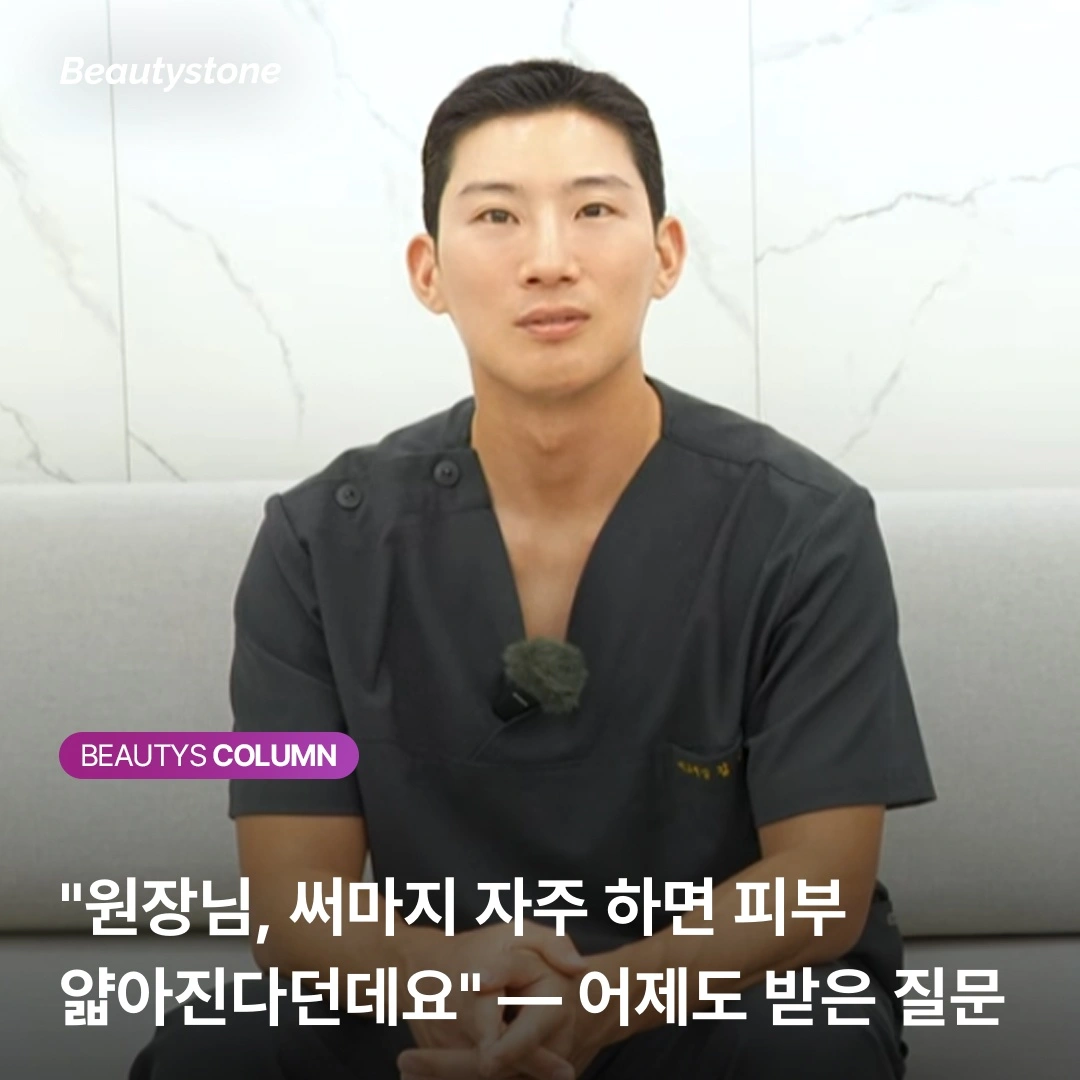
"Doctor, does Thermage thin out your skin
if you do it too often?"
— A question I got just yesterday
Let me give you the answer upfront.
Repeated Thermage does not thin your skin —
in fact, it makes the dermis denser and more structured.
Here's exactly why.
Thermage Uses RF — So How Is It Different
From Ultrasound?
Thermage is a monopolar Radiofrequency (RF) device that heats the entire dermis in a broad, planar manner to stimulate Collagen regeneration.
Unlike HIFU devices such as Ultherapy, Thermage doesn't work in isolated points — it heats in a wide surface area.
HIFU delivers precise Thermal Coagulation Points at around 65°C to lift and tighten,
while RF heats all layers of the Dermis uniformly to between 40–45°C.
That's why Thermage excels at improving Skin Texture and Elasticity,
while HIFU is better suited for lifting sagging facial contours.
The right starting point depends entirely on what concerns you most.
Why Does the Dermis Actually Get
Denser With Repeated Procedures?
Dr. Wi Young-jin's Key Insight
Does Thermage thin your skin with repeated use?
Actually, it makes it denser.
I hear this concern two or three times a week in my clinic.
Just last month, a 44-year-old patient came in debating whether to skip her session.
Her skin measurements showed her dermis was already quite dense — so I actually recommended she take a break this round, not because of thinning, but simply for efficiency.
Thermage FLX keeps the epidermis cool while concentrating heat precisely within the Dermis at a depth of approximately 2.5–4.3mm.
Because the epidermis remains protected while only the dermis is heated, you get immediate tissue contraction followed by gradual Collagen formation over 3–6 months.
When you come back for another session a year later, a new layer of Collagen is built on top of what was already created.
The myth that skin gets thinner often stems from confusing subcutaneous fat loss — which can reduce facial volume — with actual dermal thinning.
The dermis itself does not decrease in thickness.
In fact, clinical studies consistently show an increase in dermal thickness following Thermage.
Dr. Wi Young-jin's Summary
Thermage is a procedure that heats the Dermis
to generate new Collagen.
With repeated sessions, the dermis doesn't thin —
it becomes more compact and structured.
However, changes in facial fat (subcutaneous tissue)
and changes in dermal thickness are two completely different things.
Confusing the two leads to a lifetime of misconceptions.
So — Is Thermage the Right Procedure for Me?
Concern | Recommended Option | Notes |
Skin Texture, Pores & Elasticity | Thermage FLX | Full dermal remodeling |
Jawline Sagging & SMAS Layer | HIFU (Ultherapy, etc.) | Focal coagulation for lifting |
Significant Volume Loss / Sunken Appearance | RF & HIFU not recommended | Volume restoration first |
Both Texture & Sagging | HIFU first | Add RF after 6 months |
For patients who have already experienced significant volume loss in the cheeks, Thermage can sometimes make the face appear more hollow.
In those cases, I recommend starting with a Collagen booster or volume-restoring procedure before layering on RF.
The 3 Questions I Hear Most Often
in My Clinic
Q1. My face looks more gaunt after Thermage —
does that mean my skin got thinner?
In most cases, this is not due to dermal thinning.
It's more likely that the subcutaneous fat in the area was partially affected by the heat.
This can happen when too many shots are delivered to areas with naturally thin fat layers, such as the cheeks.
Dermal thickness, by contrast, tends to increase — and this can be confirmed via ultrasound imaging.
Q2. Can I get Thermage every year for the rest of my life?
You don't need to commit to annual sessions indefinitely.
For most patients in their late 30s to early 50s, an annual schedule is a reasonable starting point.
After that, extending the interval to every 18 months to 2 years is often sufficient.
Once the dermis has become sufficiently dense, additional heating sessions yield diminishing returns.
Q3. Is it normal to look a little puffy
for a few days after Thermage?
Mild Swelling and flushing lasting from the day of the procedure through about day 3 is completely normal.
This is a natural response to the heat accumulating in the Dermis.
However, if Pain persists beyond a week or you notice any indentation or depression, contact the clinic where you had the procedure right away.
If there's one thing to take away from today —
Thermage does not thin your skin.
It fills and densifies your dermis, layer by layer.
In my next post, I'll walk you through
how we determine the right number of shots for a Thermage session.
This is Dr. Wi Young-jin — see you next time.
Further Reading
"Does Thermage Actually Work?" An Honest Look at Lifting from Inside the Clinic — Thermage in Seoul
Thermage 600 Shots & Pricing: 3 Reasons Custom Design Matters More Than Finding the Cheapest Option
Frequently Asked Questions
Q1. Does repeated Thermage treatment thin your skin?
No — clinical studies consistently show an increase in dermal thickness following Thermage, not a decrease. Repeated sessions tend to make the dermis denser and more structured rather than thinner.
Q2. What's the difference between Thermage and HIFU devices like Ultherapy?
Thermage is a radiofrequency device that heats the entire dermis broadly to around 40–45°C, while HIFU delivers precise thermal points at around 65°C. That's why Thermage tends to excel at improving skin texture and elasticity, while HIFU is better suited to lifting sagging contours.
Q3. How long does it take to see collagen results after Thermage?
You typically get immediate tissue contraction right after treatment, followed by gradual collagen formation over the next three to six months, with new collagen building on top of previous sessions over time.
Q4. Why do some people think Thermage thins the skin?
The myth often comes from confusing subcutaneous fat loss, which can reduce facial volume, with actual dermal thinning. The dermis itself doesn't decrease in thickness with repeated Thermage — the opposite tends to be true.