Juvéderm MD Code: Does Filler Placement Work?
MD Code reframes Juvéderm filler as a structural tool: small amounts placed at eight strategic points lift tissue from underneath instead of just filling in hollows and folds.

Wi Young-jin
Chief Director & CEO, Myeongdong
If you've asked for filler and walked out feeling puffier instead of lifted, you're not alone. A lot of people assume more product means more lift — but volume and lift aren't the same thing, and treating them as if they are can leave your face looking heavier without actually correcting sag. Juvéderm's MD Code technique takes a different approach: instead of filling in hollows, it places small amounts of filler at specific support points to lift tissue from underneath. In this article, we'll cover what MD Code actually is, how the technique works, what treatment looks like from start to finish, the risks you should know about, and how to tell if it's a good fit for you.
What Is the MD Code Technique?
MD Code is an injection protocol developed for Juvéderm dermal fillers that maps the face into eight defined points instead of treating it as one continuous canvas. Rather than filling every hollow or crease you can see, the technique targets a small number of load-bearing zones — mostly around the cheekbones, temples, and jawline — where a small amount of filler placed at the right depth can lift a much larger area of tissue above it.
It's a shift in philosophy as much as technique. Traditional filler tends to follow a "fill what's flat" logic: if there's a hollow under the eyes or a deep nasolabial fold, that's where the syringe goes. MD Code instead asks where the face has lost structural support, then rebuilds that support first. Folds and hollows often soften on their own once the tissue above them has somewhere to rest.
| Approach | Where filler goes | What it tends to change |
|---|---|---|
| Traditional volumizing | Visible hollows and folds | Local smoothness, sometimes added heaviness |
| MD Code | Eight structural support points | Overall lift, folds soften indirectly |
How Does Strategic-Point Injection Work?
The mechanics come down to two things: where on the face the filler goes, and how deep it's placed. For the cheek points — often labeled Ck1, Ck2, and Ck3, moving from the front of the cheekbone to its outer edge — a provider typically places somewhere around 0.2 to 0.3 cc per point. That's a small amount, and the total across all three points is usually under a full cc.
What makes that small amount effective is depth. Placed too shallow, in the upper dermis, filler mostly just adds surface volume — you'll notice fullness, but not much lift. Placed deep, at or near the periosteum (the layer covering bone) or in the deep fat compartments, the same amount of product acts more like a scaffold. It pushes the tissue sitting above it upward and outward, which is what creates a lifting effect rather than a purely volumizing one.
This is also why MD Code isn't just "the same filler in different spots." A provider needs a solid understanding of facial anatomy — including where the major blood vessels run — to place product safely at that depth. Precision matters more here than in more superficial filler work, which is part of why the technique is provider-dependent in a way that simple volumizing sometimes isn't.

What Happens During Treatment?
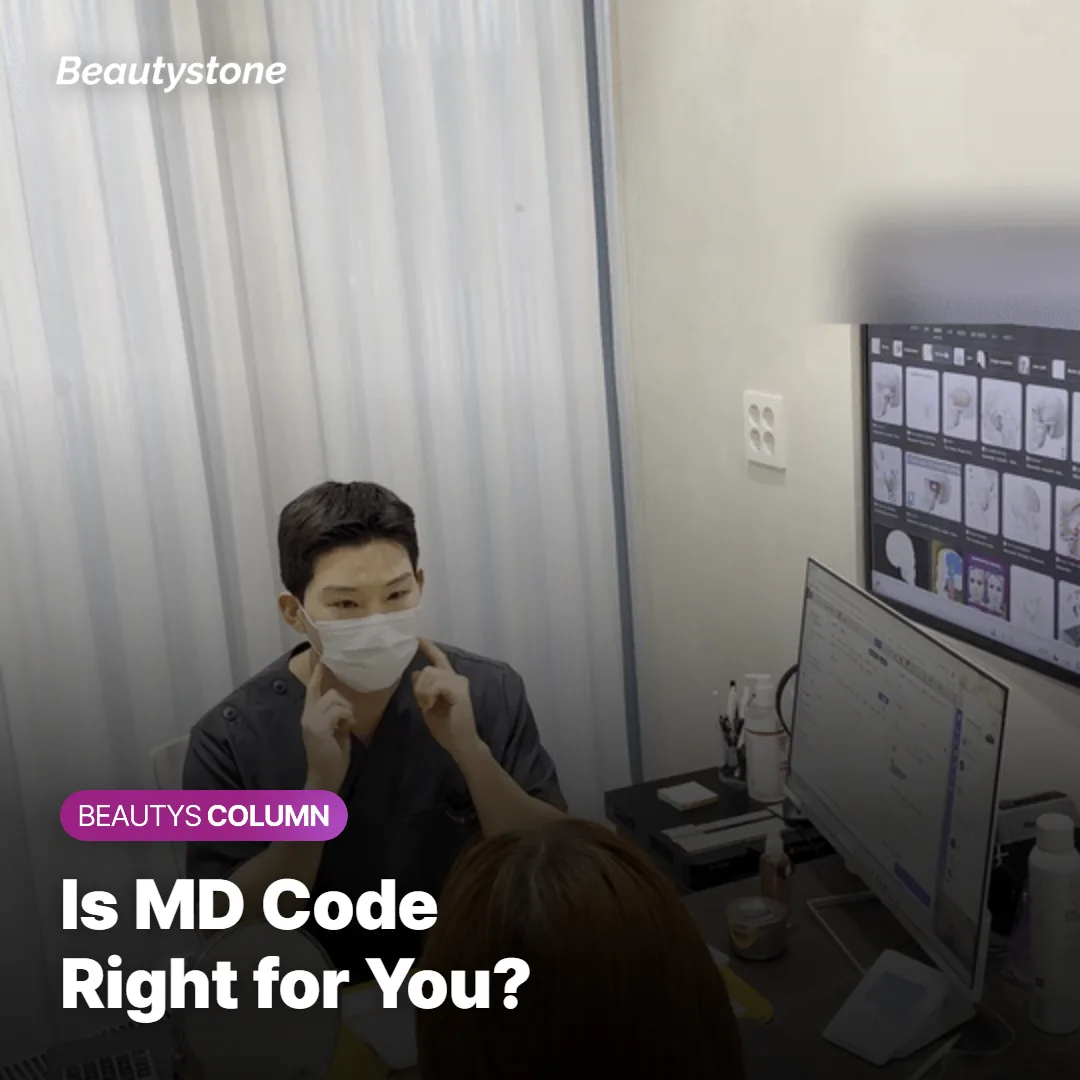
A typical MD Code session starts with an assessment of where your face has lost support — not just where you see lines or hollows, but where the deeper structure has changed. Your provider will usually mark the relevant points before injecting, since precision at each site matters more than the total volume used.
- During injection: Small amounts are placed at each targeted point, often with a fine needle or cannula. Sessions typically run 20 to 40 minutes depending on how many points are treated.
- Immediately after: Mild swelling and tenderness at the injection points is common. You may notice a temporary raised mark at each site that flattens within a day or two.
- First 48 hours: Swelling tends to peak, then starts to settle. Bruising, if it happens, is usually most visible during this window.
- 1 to 4 weeks: Swelling resolves and the filler settles into its final position. This is typically when the lifting effect becomes easiest to see, since early swelling can mask the actual result.
Results build gradually rather than showing up all at once, so it's worth waiting the full few weeks before judging the outcome.

Side Effects and Risks
Like any injectable procedure, MD Code carries some downsides worth knowing about upfront. Redness, mild swelling, and tenderness at the injection points are common and usually settle within a few days. Bruising happens occasionally, especially around the cheek and temple points, and typically fades within a week to ten days.
Because MD Code targets deeper layers and areas with more blood vessels than typical dermal filler placement, the technique also carries a higher bar for provider skill. Vascular complications — where filler is accidentally injected into or compresses a blood vessel — are rare but serious, and they're one of the main reasons anatomy expertise matters so much here. Warning signs include unusual or worsening pain, skin that turns unusually pale or dusky, or blistering near the injection site. If you notice any of these, contact your provider or seek medical care right away rather than waiting to see if it resolves on its own.
Individual results and recovery vary, and your provider should walk you through your specific risk factors — including prior filler, allergies, and any vascular conditions — before treatment.
How Much Does Juvéderm MD Code Cost?
Cost depends heavily on how many points are treated, how much filler is used, and where you're getting the procedure done, so it's hard to give a single number that applies broadly. A first session might use as little as 1 cc if only a few points need support, or 2 to 3 cc if more of the face is being addressed — and pricing typically scales with volume.
In Seoul, clinic pricing for MD Code and similar filler protocols varies by provider experience and the brand of filler used, and it's worth asking specifically what's included — the consultation, the filler itself, and any follow-up. A consultation is really the most reliable way to get an accurate quote for your specific case; current offers and pricing details are listed at /en/promotion.
Who's a Good Candidate for MD Code?
MD Code tends to work best for people who are relatively new to filler, or who want a natural-looking lift without heavily volumizing any one area. Because the technique relies on very specific placement, it's most effective when a provider is working with your face's original structure rather than filler that's already there.
That's also its main limitation: if you've had a significant amount of filler in the nasolabial folds or mid-face already, especially over multiple sessions, MD Code isn't always something a provider can layer in right away. Existing filler can sit exactly where a support point needs to go, throwing off the placement the technique depends on. In that case, your provider may recommend dissolving some existing filler first, or spacing out treatment so your face can be reassessed before adding new points.
MD Code also pairs well with other lifting approaches. Some patients get a thread lift first for tissue that's already sagging, then add MD Code months later to reinforce the cheek support points — the two work through different mechanisms, so combining them isn't redundant.
The Bottom Line
MD Code reframes filler as a structural tool rather than a volumizing one. Instead of chasing every hollow or fold, it places small amounts of product at eight strategic points to rebuild support from underneath — which is why a provider might use less than a full cc and still produce a noticeable lift.
- Placement and depth matter more than total volume.
- Results typically take a few weeks to fully settle and become visible.
- It's not always a good fit for faces with a lot of existing filler already in place.
- Like any procedure, it comes with trade-offs, including bruising and, rarely, more serious vascular risk.
Ultimately, the choice depends on your skin, your goals, and your budget. If you're considering Juvéderm MD Code, a consultation is the best way to find out what fits you. Beautystone is a dermatology clinic in Seoul's Hapjeong area — see current offers at /en/promotion.
Frequently Asked Questions
Q1. Does the Juvéderm MD Code technique hurt?
Most people describe it as mild discomfort rather than sharp pain, especially since fillers used for MD Code usually contain a numbing agent like lidocaine. Your provider may also apply a topical numbing cream beforehand if you're sensitive to needles. Some tenderness at the injection points afterward is normal and typically fades within a day or two.
Q2. How long do MD Code results last?
With a hyaluronic acid filler formulated for structural support, results typically last 12 to 18 months, and areas with less movement, like the cheekbones, can hold up closer to two years for some patients. Areas near the mouth and jaw, which move more, tend to break down faster. Individual results vary based on metabolism, filler type, and how much was used.
Q3. How much does Juvéderm MD Code cost?
Pricing depends on how many points are treated and how much filler is used, so it varies by clinic and case. A consultation is the most reliable way to get an accurate quote; current pricing and offers are listed at /en/promotion.
Q4. Can I get MD Code if I've already had filler in my face?
It depends on where and how much. If you have a significant amount of existing filler in the nasolabial folds or mid-face, your provider may need to dissolve some of it first or reassess your structure before adding new support points, since existing product can interfere with precise placement. If your filler history is minimal, MD Code can usually be layered in without issue.