
Re2O Results Timeline: Weeks 4, 8 and 12
Re2O doesn't reshape your face on the day, so the first week is for photos, not judgments. In a 20-week study, skin density rose at week 4 and visible changes followed from week 8. Here's what each check shows, which reactions are normal, and what to look at if nothing changes.

Wi Young-jin
Chief Director, Myeongdong
If your skin looks unchanged the morning after Re2O, judge the result from photos taken once the swelling has gone down, not from the mirror right after treatment. In a study that followed 20 people for 20 weeks after a single Re2O treatment, skin density rose first at week 4, and doctors' overall improvement scores were higher than a comparison booster from week 8. Re2O isn't an injection that reshapes your face on the day, so a quiet first week doesn't mean it failed.
In this article, we'll cover what changes at week 4, what you can see at weeks 8 and 12, which reactions are normal, and what to look at if nothing has changed by week 8.
Quick summary
- If you've had Re2O, compare photos at week 4 and week 8 with your before photo instead of judging it in the first few days.
- Timeline: skin density and elasticity at week 4, hydration and overall look at week 8, pore differences at week 12.
- Redness and mild swelling went away on their own, without treatment.
- If you need a visible change on the same day, filler is usually the one to look at first, not Re2O.
When Does Re2O Start Working, and Why Does Day 1 Look the Same?
Looking the same the day after is normal. Re2O is made from human skin tissue with the cells removed, leaving only the collagen framework, which is then ground into fine particles (an acellular dermal matrix*). Instead of adding volume on the day, the idea is that your own skin cells settle into that framework so the skin fills in gradually.
*Acellular dermal matrix: the supporting framework of skin, mostly collagen, that's left after the cells are taken out.
That's why the smooth look you may notice in the first few days is usually swelling. Once it goes down, your skin can look just like it did before, and that's exactly when many people decide it didn't work. This stretch is for taking photos, not for judging.
Take a front and side photo on treatment day, by the same window or lamp and at the same distance. That photo becomes the baseline for every comparison you make later. You may also see the product listed as Elravie Re2O when you search for the Re2O skin booster.

Re2O Results at 4 Weeks: What Changes First?
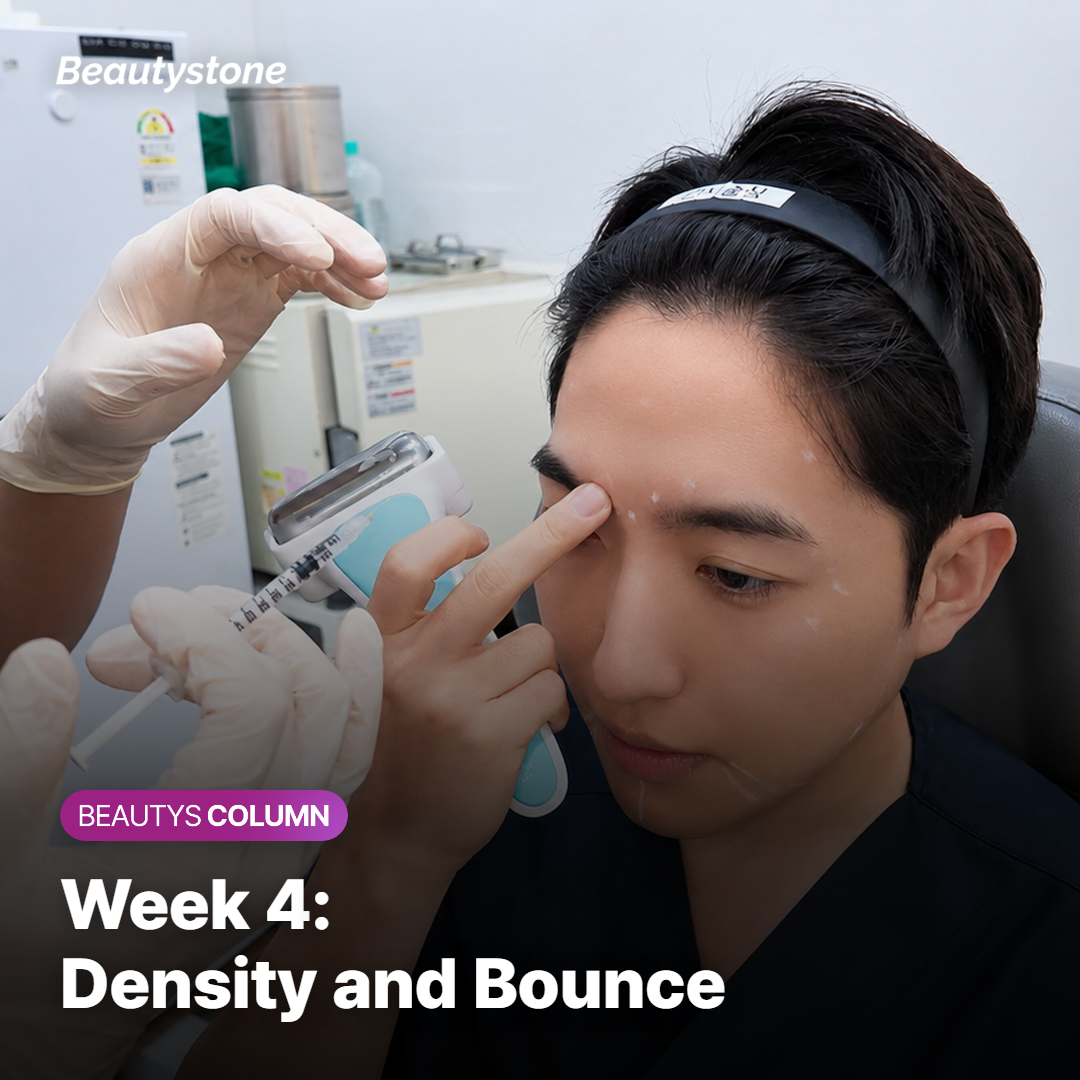
At week 4, the first change is usually how firm and springy your skin feels when you press it, more than what you see in the mirror. In a split-face study, 20 adults had Re2O injected into one cheek and a hyaluronic acid (HA) skin booster into the other, once, and were followed for 20 weeks.
On the Re2O side, skin density rose from about 65% at the start to about 73% at week 4. Elasticity was also higher than on the HA side at that point. Individual results vary.
Even so, differences in photos are small at this stage, and many people don't notice much on their own. Because the measured change came before the visible one in the study, a note on how your cheek feels to the touch tells you more at week 4 than a photo does.
Keep in mind that this was a small study of Re2O itself that stopped at week 20, so it can't tell us how long the change lasts beyond that.
Re2O Results at 8 and 12 Weeks: When Can You See the Difference?
Week 8 is the right time to compare what you can see. From week 8 through week 20, hydration and the doctors' overall improvement scores stayed higher on the Re2O side than on the HA side. A bigger drop in pore size showed up from week 12.
Here's a simple way to line up each check with what to do:
| Time point | What you may notice | What to do |
|---|---|---|
| Right after to week 1 | Swelling and redness; skin may look smoother | Take photos in the same light |
| Week 4 | Skin density and elasticity | Compare how your skin feels to the touch |
| Week 8 | Hydration and overall look | Put the new photo next to your first one |
| Week 12 and later | Pore size | Decide on your next step |
If your week 8 photo and your first photo look almost the same side by side, that's the point to decide what comes next. How much you see depends on your skin, so compare yourself with yourself, not with someone else's results.

Re2O Side Effects: What's Normal and When Should You Get Care?
Redness and mild swelling after Re2O went away on their own in the study, with no treatment needed. In a separate study of 202 people who had a different micronized dermal matrix product injected into their smile lines, swelling and pain were more frequent than with the comparison injection, but most cases were mild and cleared within 1 week. Since that was a different product, its numbers don't carry over to Re2O directly.
It's better to postpone Re2O if any of these apply to you*.
*Based on US FDA guidance on dermal fillers, which covers injections into the face like this one, not Re2O specifically.
- Inflammation or infection where you'd be injected, including acne or a rash
- A condition that makes bleeding hard to stop, or a past severe allergic reaction
- Pregnancy or breastfeeding, because safety hasn't been established
An injected product getting into a blood vessel is rarely reported. When it happens, it needs care fast, so the signs below call for medical care no matter how many days it's been since treatment*.
*Listed in the same US FDA guidance on dermal fillers.
- Unusual pain, or skin near the injection site turning white: get medical care right away
- Changes in your vision: go to the nearest emergency room
- Sudden difficulty speaking, numbness or weakness in the face, arms or legs, difficulty walking, or a drooping face: go to the nearest emergency room
- A severe headache, dizziness or confusion: go to the nearest emergency room
A message through the consultation button doesn't replace seeing a doctor in person.

No Re2O Results by Week 8? What to Look at Next
If nothing has changed by week 8, first check whether your concern is thin skin or lost volume. If your skin is thin and dull, continuing with a skin booster like Re2O is the path to look at. If an area has sunk enough to cast a shadow, filler is usually the one to look at first.
Filler is also the better fit if you want a visible change on the same day. Re2O works on the quality of the skin over weeks, so it isn't built to change your contour on the spot.
Before you decide, check your photos too. A different lamp, a different time of day or a slightly turned head can hide a change or invent one, so only compare photos taken the same way.
Fitting Re2O Into a Trip to Korea
If you're planning Re2O during a stay in Seoul, three points are worth thinking through before you book.
Your flight. Unless you had sedation that day, there's no need to postpone your flight home because of Re2O.
What one visit means. Some treatments, like filler, change your shape the same day. Most others bring you a little closer to how your skin used to be over time rather than all at once, and with Re2O the week 4 and week 8 checkpoints will likely fall after you're home.
After you fly home. If you're unsure whether something is normal, you can send photos to Beautystone through the consultation button on this page. We can't promise a reply time or remote care, so if any of the warning signs above appear, see a local doctor first.
The Bottom Line: Put Your Week 4 and Week 8 Photos Side by Side
The variable to carry with you is the time point: week 4 for how your skin feels, week 8 for what you can see. At week 8, take one photo in the same light and at the same angle as your first. Because the measured changes in the study came by week 4 and the visible ones from week 8, those two photos tell you more than any day in between.
One question is worth bringing to your consultation: looking at my week 8 photo, is my concern thin skin or lost volume? If you're considering Re2O, a consultation is where you can find out what fits you. Beautystone is a clinic in Seoul's Hapjeong area.
References
- 20 people with Re2O in one cheek, compared over 20 weeks: Int J Mol Sci, 2026
- 202 people with a different dermal matrix product in the smile lines: Aesthetic Plast Surg, 2026
- Common reactions and blood vessel warning signs after filler-type injections: US FDA
Frequently Asked Questions
Q. How many Re2O sessions do I need to see results?
A. There's no research-based number of Re2O sessions yet, because the study looked at a single treatment followed for 20 weeks. That's why deciding on a next session after looking at your week 8 photo is the practical approach. How thin your skin is and the change you want both shape the spacing your provider suggests.
Q. Re2O vs. Rejuran: do results show up at different times?
A. Re2O and Rejuran are made from different ingredients, so their timelines can't be lined up day by day. Re2O uses the collagen framework of human skin, Rejuran uses an ingredient taken from salmon, and no study has compared the two side by side yet. Choosing by your concern, thin skin or a rough skin surface, is more useful than choosing by timing.
Q. My face looks flatter a week after Re2O. Did it fail?
A. Looking flatter a week after Re2O usually means the swelling has gone down and your skin is back to how it looked before. The first few days looked fuller because of that swelling, so it isn't a sign of failure. Compare your week 4 and week 8 photos with your first photo before you judge.
Q. When can I wash my face and wear makeup after Re2O?
A. A gentle face wash is usually fine from the day after Re2O. Skip makeup over the needle marks on treatment day and cover them once they've closed. Hold off on scrubbing or exfoliating until the redness has settled.
Q. Does Re2O hurt?
A. Re2O is placed in small, shallow amounts across several spots on the face, so expect a stinging feeling. In the study, the product was mixed with a numbing ingredient (lidocaine) before injection. Other ways to ease discomfort, such as numbing cream, are decided at the consultation based on how sensitive your face is.
Q. How long does Re2O last?
A. How long Re2O lasts beyond 20 weeks isn't known yet, because that's where the study stopped. Skin density on the treated side was still above its starting level at week 20, the last check. Daily sunscreen and moisturizing are the basics for protecting your skin after treatment.
Q. I can feel a small bump where Re2O was injected. What should I do?
A. A small bump after Re2O that isn't painful or red can be watched while you keep an eye on its size. If it turns red, warm and painful to press, or keeps growing, have it checked in person whatever day it is. Writing down when you first noticed it and how big it was helps the doctor work out the cause.
Q. Does Re2O under the eyes show results on the same timeline?
A. Re2O under the eyes doesn't have its own timeline study yet; the 20-week results come from the cheeks. Skin under the eyes is thin, so swelling can stay visible longer, and it's best to compare photos in the same light once it has fully settled. If the hollow casts a deep shadow, filler is usually the one to look at first.