Exosomes for Skin: More Than Just Nutrients?
Exosomes aren't a nutrient delivery system - they're signaling vesicles from stem cells that tell inflamed skin cells to calm down, which is why they work especially well for acne-prone and highly reactive skin.

Last updated: July 2026
If your provider has ever mentioned exosomes and your mental filing cabinet immediately slotted it next to "vitamin ampoule" or "growth serum," you're not alone - a lot of skincare marketing treats it that way. The reality is a bit different, and it matters more if you're dealing with acne-prone skin or a complexion that seems to react to everything you put on it. In this article, we'll cover what an exosome actually is, how it calms inflammation at a cellular level, who tends to see the most benefit, and how it compares to PRP.
What Is an Exosome, Really?
The short answer? It's not a nutrient - it's a message.
Most people assume exosomes work the way a vitamin C serum or a peptide ampoule does: a "good" ingredient gets absorbed into the skin and does its job from there. That mental model makes sense for most skincare, but it doesn't really hold up for exosomes.
An exosome is a tiny vesicle - a microscopic sac - secreted by stem cells. Think of it less like a nutrient and more like a sealed envelope one cell sends to another. Inside that envelope are proteins, growth factors, and microRNA (miRNA), a type of molecule that helps regulate how genes get expressed. Together, that package carries instructions, not just raw materials.
Once it reaches a skin cell, the exosome doesn't just sit on the surface waiting to be absorbed. It fuses directly with the cell membrane and delivers its contents inside, essentially telling the cell to dial back its inflammatory response. That's a fundamentally different mode of action than most topical ingredients, which act on the cell surface or, at best, the membrane level.
How Do Exosomes Calm Skin Inflammation?
Here's what makes that distinction matter in practice: the depth at which something acts often determines how much it can actually change.
A typical moisturizing or brightening ingredient interacts with the outermost layers of a cell, occasionally nudging a receptor or slowing an enzyme. Useful, but limited. Exosomes work differently because they cross into the cell itself, delivering the miRNA and growth factor package straight to where gene expression and inflammatory signaling actually happen.
That's part of why two skin types tend to respond especially well: skin with active acne, and skin that's chronically reactive or hypersensitive. In both cases, the underlying issue isn't just a surface problem - it's a signaling loop that's stuck in an inflamed state, and interrupting that loop is exactly what exosomes are built to do.
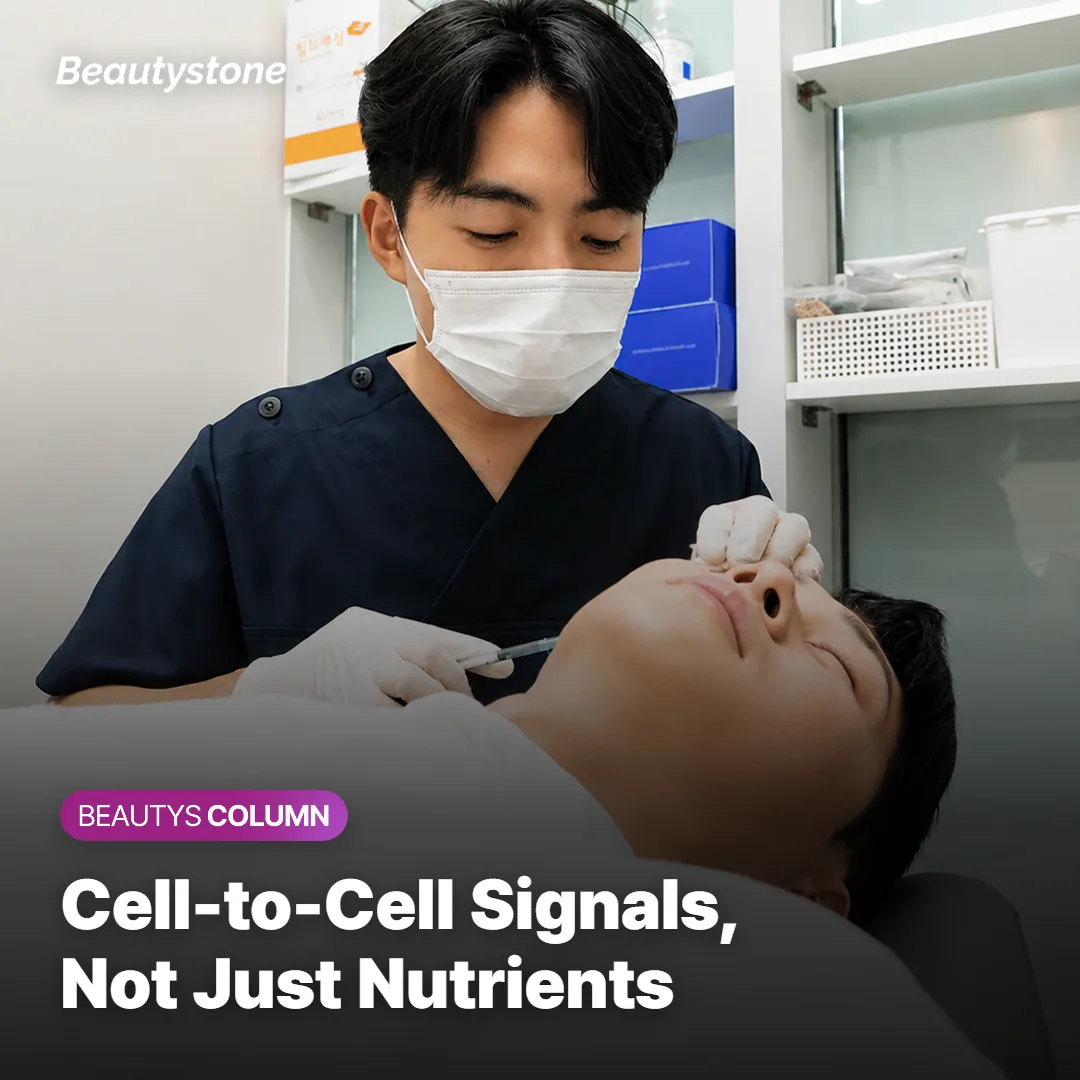
Who Actually Benefits: Acne-Prone and Reactive Skin
Not every skin concern calls for the same tool, so it's worth being specific about who tends to see results.
- Acne-prone skin: Acne isn't purely a sebum problem - chronic inflammation around the sebaceous glands is a major part of what keeps breakouts cycling. Because exosomes act directly on that inflammatory signal, calming often shows up faster than it does with treatments that only address oil or bacteria.
- Highly reactive, easily irritated skin: If your skin flushes at the first sign of a new product or stings from things that shouldn't sting, the barrier is usually overreacting to normal stimuli. Exosomes appear to support barrier-repair signaling alongside the anti-inflammatory effect, which is part of why this skin type often describes a calmer baseline over time.
There's a third pattern worth mentioning: skin that's been through round after round of resurfacing or "glow" treatments with no real change. If your skin still comes back irritated no matter what you try, the issue may not be a lack of treatment - it may be that nothing you've tried has addressed the signaling itself. Many providers use a short course of exosomes as a strategic first step precisely because it can make everything that comes after it work better.
One thing worth being upfront about: this isn't a lifting or volumizing treatment. If your main goal is firmer skin or more volume in a short window, a different procedure is a better fit. Exosomes are about upgrading the skin's baseline condition, and that kind of change tends to unfold gradually - usually over two to four weeks - rather than showing up immediately after a single session.
Exosomes vs. PRP: What's the Difference?
Exosomes and PRP get lumped together a lot, mostly because both are injectable, both come from a biological source, and both get filed under "regenerative" treatments. But they're not interchangeable.
| Aspect | PRP | Exosomes |
|---|---|---|
| Source | Concentrated platelets from your own blood | Signaling vesicles derived from stem cells |
| Strongest for | Wound healing, tissue regeneration | Inflammation control, cell-signaling repair |
| Good fit for | Post-procedure recovery, general rejuvenation | Acne-prone or highly reactive, easily irritated skin |
Neither one is categorically better - it depends on what your skin needs. Providers often lean toward exosomes first when sensitivity or reactivity is the dominant complaint, since that's the specific problem they're built to address.
What to Expect: Timeline and Session Plan
Exosomes aren't a one-and-done treatment, and that's by design. Because the goal is to shift a signaling pattern rather than deliver a single dose of an ingredient, repeated sessions do more of the work than any single visit.
- Sessions one through three: Typically spaced about two to three weeks apart, this initial phase is where most of the signaling shift happens.
- Maintenance: After the initial series, a session every one to two months is common for keeping the effect stable.
- Visible change: Most people notice a difference somewhere in the two-to-four-week range, once the effect has had time to build rather than immediately after the first session.
If you try one session and think "eh, not much happened," that's not necessarily a sign it isn't working - it's more likely a sign you haven't given the repeated stimulation enough time to add up. Providers generally recommend judging results after the initial series rather than after a single visit.

Side Effects and Safety Considerations
Exosome treatments are generally well tolerated, and most people describe the experience as mild rather than dramatic.
- Redness and mild swelling at the treatment site are common in the first day or two and typically settle on their own.
- Tenderness or slight warmth right after treatment is normal and usually short-lived.
- Sunscreen matters in the days following treatment, since freshly treated skin is more sensitive to UV exposure.
- Your full medical history matters, including any active skin infection or a history of keloid scarring - bring this up with your provider before starting.
If redness spreads well beyond the treated area, you develop a fever, or discomfort gets worse instead of better after the first day or two, that's not typical - contact your provider or seek medical care right away rather than waiting to see if it resolves on its own.

How Much Does It Cost?
Pricing for exosome treatments varies quite a bit depending on the clinic, how many sessions your plan calls for, and whether it's combined with another procedure like laser resurfacing. Because exosomes are so often used alongside post-laser recovery or as part of a broader plan for acne-prone or reactive skin, the total can shift based on what else is included in a given visit.
Rather than guessing at a figure that may not reflect what a specific clinic charges, a consultation is the most reliable way to get an accurate session plan and price. Beautystone, a dermatology clinic in Seoul's Hapjeong district, lists current offers at /en/promotion, which is worth checking before you book.
The Bottom Line
Exosomes aren't a fancy nutrient delivery system - they're signaling vesicles that tell inflamed skin cells to calm down, which is why they tend to shine for acne-prone and highly reactive skin in particular. A few points worth keeping in mind:
- Exosomes are vesicles from stem cells carrying proteins, growth factors, and miRNA - they fuse with the cell membrane and act from inside the cell, not just on its surface.
- Acne-prone skin and chronically reactive, easily irritated skin tend to see the clearest benefit, since both involve inflammatory signaling that exosomes are built to interrupt.
- This isn't a lifting or volumizing treatment - visible change builds gradually, usually over two to four weeks, and a typical plan runs an initial series every two to three weeks followed by maintenance every one to two months.
- Compared with PRP, exosomes lean toward inflammation control and cell-signaling repair rather than wound healing and tissue regeneration.
Like any procedure, it comes with trade-offs - mild redness in the first day or two and a treatment plan that takes a few sessions to show its full effect. Ultimately, the choice depends on your skin, your goals, and your budget. If you're considering exosomes for acne-prone or reactive skin, a consultation is the best way to find out what fits you. Beautystone is a dermatology clinic in Seoul's Hapjeong area - see current offers at /en/promotion.
Frequently Asked Questions
Q1. Is an exosome treatment the same as a vitamin serum or ampoule?
No - that's actually the most common misunderstanding. A vitamin serum supplies nutrients that sit at the surface or membrane level of a cell. Exosomes are vesicles that fuse directly with the cell membrane and deliver proteins, growth factors, and miRNA inside the cell, essentially sending a signal to calm inflammation rather than just feeding the skin.
Q2. How many sessions do I need, and when will I see a difference?
A typical plan starts with three sessions spaced about two to three weeks apart, followed by maintenance every one to two months. Most people notice a change somewhere in the two-to-four-week range - it's not the kind of treatment that shows results overnight, so it helps to judge it after the initial series rather than a single visit.
Q3. What's the difference between exosomes and PRP?
PRP is a concentrate of your own platelets, and it's especially good at supporting wound healing and tissue regeneration. Exosomes are signaling vesicles derived from stem cells, and they lean more toward calming inflammation and repairing cell-signaling patterns. Neither is universally better - it depends on your skin and your goals, though people with highly reactive skin often start with exosomes.
Q4. How much does an exosome treatment cost, and where can I check pricing?
Cost depends on the clinic, the number of sessions, and whether it's combined with another procedure, so it varies from person to person. A consultation is the most reliable way to get an accurate plan and price. Beautystone, a dermatology clinic in Seoul's Hapjeong district, lists current offers at /en/promotion.