Cold Sores & Facial Procedures: Is It Safe?
If you've had cold sores in the past, you've probably wondered whether facial procedures are off the table. The reassuring news is that a history of HSV-1 doesn't automatically rule you out — but there are real factors that determine whether the timing is right for you.

If you've ever had a cold sore — that telltale tingle, then blister, at the corner of your mouth — you're not alone. HSV-1 (herpes simplex virus type 1) affects a large portion of adults worldwide, and most people carry it without frequent flare-ups. But once the virus is in your system, it stays there, lying dormant in nerve tissue until something wakes it up.
One of the most common questions we hear at Beautystone is: "I had cold sores years ago — does that mean I can't get laser treatments or fillers around my face?" The answer isn't a flat yes or no. It depends on your history, the type of procedure, and a handful of manageable factors. In this article, we'll cover how to assess your own risk level, which procedures pose the highest reactivation risk, the warning signs that mean you should reschedule, and what a well-prepared clinic should do to protect you.
Why Facial Procedures Can Trigger a Cold Sore Outbreak
HSV-1 lives in a cluster of nerve cells called the trigeminal ganglion — roughly behind your cheekbone, branching toward your lips, chin, and nose. The virus stays suppressed when your immune system keeps it in check. Certain stressors can tip that balance and let the virus reactivate.
Facial procedures introduce several of those stressors at once:
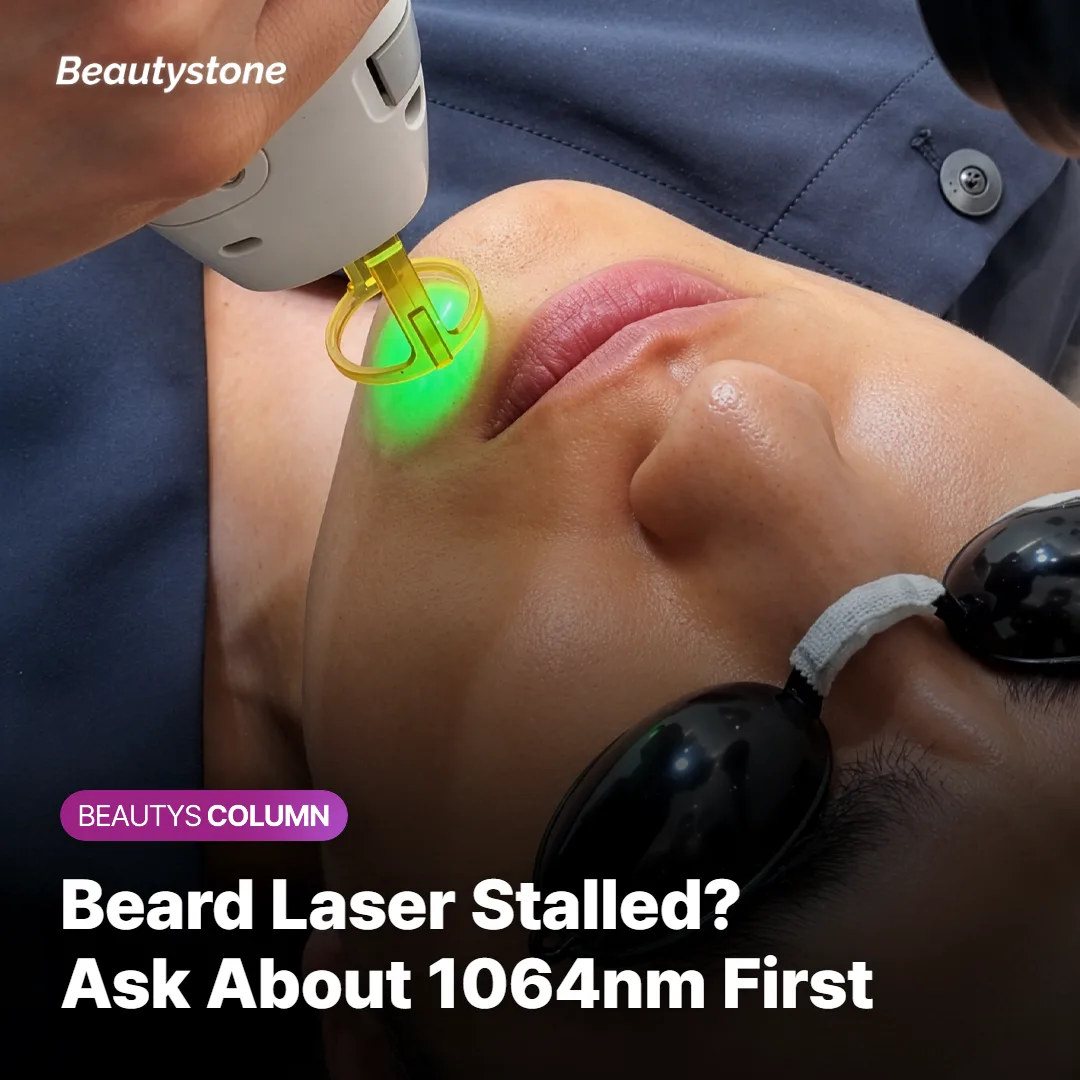
- Physical trauma to the skin: Laser resurfacing, microneedle RF (like Secret RF or Potenza), and chemical peels damage the outer skin layers — a recognized trigger for HSV reactivation in susceptible individuals.
- Heat delivery into deeper layers: HIFU devices (Shurink, Ultherapy) and RF lifting treatments generate localized thermal energy, which can stimulate the nerve tissue where HSV-1 sits dormant.
- Needle-based treatments near the lip area: Lip filler and perioral injections put mechanical stress right in the classic HSV-1 territory.
- Systemic stress response: Anxiety before a procedure, disrupted sleep, or a weakened immune state around the appointment date all lower your body's HSV suppression threshold.
It's important to note that reactivation doesn't happen to everyone with HSV-1 — in fact, many people with a distant cold sore history go through facial procedures without any issue. What matters is understanding your personal pattern.
How to Honestly Assess Your Own Risk Level
Your personal cold sore history is the most useful data point — more useful than a general guideline. Here's how to think through it honestly before you book anything.
Frequency matters most. Someone who had one cold sore in their teens and hasn't had one since faces a very different risk profile from someone who gets flare-ups every few months or every time they're stressed. If you can count your lifetime outbreaks on one hand, your dormant viral load is likely lower and your immune control stronger. If you get them regularly — say, two or more times a year — your risk of procedure-triggered reactivation is meaningfully higher.
Location matters too. Cold sores that appear right at the lip line or inside the corner of the mouth are in the highest-risk zone for procedures targeting the lower face, perioral area, or lips. Cold sores that have only appeared elsewhere — near the nose, for example — may still carry some risk, but the overlap with common treatment zones is smaller.
When was your last outbreak? The general principle, recognized across dermatology, is that you should not undergo ablative or thermally aggressive facial procedures while you have an active cold sore, or in the days immediately following one. Even if a lesion looks fully healed, the local viral activity hasn't necessarily returned to baseline. Most providers recommend waiting at least two to four weeks after an outbreak has fully resolved.
What are your usual triggers? If your cold sores reliably appear after sun exposure, illness, or periods of high stress — and you can recognize those triggers — you have more control over your timing. If they seem to appear randomly, predicting safe windows is harder and prophylactic antiviral medication becomes a more important part of the picture.
Which Procedures Carry the Highest Reactivation Risk?
Not all facial treatments are equal when it comes to HSV-1 risk. The key variables are how much thermal or mechanical stress the procedure delivers, and how close to the perioral nerve territory it's applied.
| Procedure Type | Risk Level for HSV-1 History | Key Reason |
|---|---|---|
| Full-face ablative laser resurfacing | High | Widespread skin barrier disruption, heat, immune activation |
| Fractional laser (full face) | Moderate–High | Similar mechanism, less aggressive but still triggers nerve area |
| Lip filler or perioral injections | Moderate–High | Direct mechanical trauma in classic HSV-1 territory |
| Microneedle RF (Secret RF, Potenza) — full face | Moderate | Heat + puncture, especially around lower face |
| HIFU / Shurink — full face including perioral | Moderate | Deep thermal energy near trigeminal branches |
| RF lifting (Oligio, Thermage) — cheek/jaw focus | Low–Moderate | Heat, but typically less perioral trauma than ablative methods |
| Skin booster injections (forehead, cheek only) | Low | Minimal trauma away from lip area |
The takeaway here: procedures involving the perioral area (around the mouth and chin) or full-face aggressive resurfacing deserve the most caution. Treatments focused away from the lower face — forehead lifting, temple filler, upper-cheek skin boosters — are generally lower risk, though they're not completely zero-risk for someone with a highly active HSV-1 history.
Individual results vary, and your provider needs to assess your specific history before categorizing your risk.
The Clear Green and Red Lights for Scheduling
Timing your procedure around your HSV-1 history comes down to a few clear signals. Think of these as your personal traffic light system.
Green light — reasonably safe to proceed:
- You haven't had an outbreak in at least six months (or longer).
- You've never had a cold sore that was triggered by a past cosmetic procedure.
- You don't have any current immune stressors (illness, major life stress, poor sleep pattern).
- You're comfortable disclosing your history to your provider and they've responded with a clear plan — including antiviral prophylaxis if appropriate.
Red light — reschedule before proceeding:
- You currently have an active cold sore, or one that only healed in the last two to three weeks.
- You're in a known trigger phase — fighting off a cold, under extreme stress, or sleep-deprived.
- You've had a procedure-triggered outbreak before and haven't discussed antiviral coverage with a provider this time.
- You feel any prodromal symptoms — the itching, tingling, or burning sensation that typically precedes an outbreak by 24 to 48 hours.
If you're in red-light territory, rescheduling isn't a failure — it's the right call. A responsible clinic will have a clear postponement policy for exactly this situation.
Side Effects & Risks If HSV-1 Is Not Managed
What actually happens if a procedure triggers HSV-1 reactivation in a treated area? The range of outcomes varies considerably.
On the mild end, you might get a localized cold sore at the lip line that resolves within one to two weeks — uncomfortable and inconvenient, but manageable with antiviral medication. On the more serious end, especially with ablative procedures or laser resurfacing, HSV-1 can spread more widely across the treated zone. Reactivation in compromised skin heals more slowly, can result in post-inflammatory hyperpigmentation (dark spots), and in rare cases, can lead to scarring if the infection isn't treated promptly.
Redness and crusting after a procedure is common and usually settles within a few days — but if that redness spreads, clusters of small blisters appear, or you develop a fever or flu-like symptoms alongside skin changes, contact your provider right away. In that scenario, you'll want oral antiviral medication started as soon as possible.
Antiviral prophylaxis — typically oral acyclovir or valacyclovir started a day or two before the procedure and continued for several days after — is standard practice for high-risk procedures in patients with a known HSV-1 history. If your clinic hasn't mentioned this conversation for an aggressive laser treatment, it's worth raising it yourself.
What a Responsible Clinic Should Do for You
You can judge whether a clinic takes this seriously by how they handle the intake conversation. Here's what responsible care looks like in practice:
- Intake questionnaire: Any competent clinic should ask about HSV history in their pre-procedure health form — not just acute illness. If no one's asked, bring it up yourself.
- Antiviral coordination: For high-risk procedures (ablative laser, full-face fractional, perioral fillers), a good clinic will either prescribe prophylactic antivirals directly or tell you to coordinate with your GP. This isn't optional care — it's standard protocol.
- Clear rescheduling policy: If you show up with a prodrome or an active lesion, you should be rescheduled without penalty. A clinic that pressures you to proceed isn't acting in your best interest.
- Post-procedure monitoring: You should receive explicit instructions about which symptoms after the procedure warrant calling the clinic. HSV reactivation can present within 24 to 72 hours of a procedure.
At Beautystone, a dermatology clinic in Seoul's Hapjeong neighborhood, pre-procedure health history — including HSV status — is part of the standard consultation. For perioral procedures or full-face laser treatments, antiviral prophylaxis is discussed as a routine safety measure, not an afterthought.
The Bottom Line
A history of cold sores doesn't have to stop you from getting the facial procedures you're considering — but it does require honest self-assessment, the right timing, and a provider who takes it seriously.
- HSV-1 can be reactivated by laser resurfacing, HIFU, microneedle RF, and perioral injections — particularly in patients with frequent or recent outbreak history.
- Your risk level depends on frequency of past outbreaks, recency of the last one, your current immune status, and which procedure zone is being treated.
- Active or prodromal cold sores are a clear reason to postpone. Antiviral prophylaxis can significantly reduce risk for high-risk procedures.
- The clinic's intake process matters: a good provider will ask, have a plan, and support rescheduling when needed.
Like any procedure, there are trade-offs to weigh and risks to manage. Ultimately, the decision depends on your personal history, the procedure you're considering, and whether you and your provider have a clear plan in place. If you're thinking about a procedure and you're unsure where you land, a consultation is the lowest-stakes way to get clarity. Beautystone is a dermatology clinic in Seoul's Hapjeong area — current offers are at /en/promotion.