Sunscreen and Makeup After Laser: Day 1 to 7
Sunscreen still goes on first after a treatment. What changes is when tone-up cream and BB cream are allowed back, and how you are allowed to touch your face while they are.

Here is the short answer first: sunscreen goes on before tone-up cream or BB cream, and that order does not change because you had a treatment. What changes is everything around it. In the week after a laser, a toning session, or a lifting appointment, the sunscreen step gets stricter, the makeup steps get delayed, and reapplication stops being optional.
Treated skin is temporarily more reactive to light than it was the week before. That is why clinics send you home talking about sun protection rather than about results. Pigment problems after energy-based treatments usually trace back to the days afterward rather than to the device, and sun exposure is the part of those days you control.
This is general information from Beautystone, a skin clinic in the Hapjeong area of Seoul. Individual results and healing times vary, and the clinic that treated you sets your real timeline. If their instructions differ from anything below, follow theirs.
Why Treated Skin Plays by Stricter Sun Rules
Sunscreen has one job on an ordinary day: block UV so you are less likely to deal with sunburn, premature fine lines, and dark spots years from now. It is built to sit against skin without changing its color much, and protection is all it is meant to do. Skipping it costs you slowly, and the bill stays invisible until it is not.
The week after a treatment is not an ordinary day. Lasers, toning, fractional resurfacing, microneedling, and lifting devices all work by creating controlled injury and letting your skin repair it. During that repair window the barrier is doing more work than usual, and the cells that produce pigment are easier to provoke. Ultraviolet light provokes them well.
So the same exposure lands differently. A lunchtime walk in July is a small debt on untreated skin. In the days after a pigment laser such as PicoWay, a hair-removal laser such as GentleMax Pro Plus, or an ultrasound lifting session such as Shurink, that walk is aimed at skin that is already inflamed.
- Post-treatment redness can settle into brown instead of fading, which is likelier on skin that pigments easily after any insult.
- Reaction follows the treatment map, so patchiness shows up in the zones worked hardest rather than across the whole face.
- Heat counts alongside light. A long walk in direct sun, a sauna, or a hot commute can keep a treated area flushed for longer.
- The window is short. Most of the added risk sits in the first days to weeks, not forever.
None of this makes a treatment fragile. It means the result you paid for is partly decided at eight in the morning for a week or two, and individual healing windows vary.
The First Days: Sunscreen First, Everything Else Waits
Start with the aftercare sheet from your own clinic, because the first day or two often has a specific routine: minimal products, no actives, no fragrance, sometimes an ointment. Sunscreen rejoins that routine as soon as your clinic says the skin can tolerate it, and shade covers the gap until then.
Once it is back in, apply it the way the label assumes you will. General dermatology guidance is to apply generously to dry skin about 15 minutes before heading outside, since that is roughly what gets you near the SPF number on the tube. A full-face amount is closer to a teaspoon than most people expect. Then let it settle a minute or two into a matte finish.
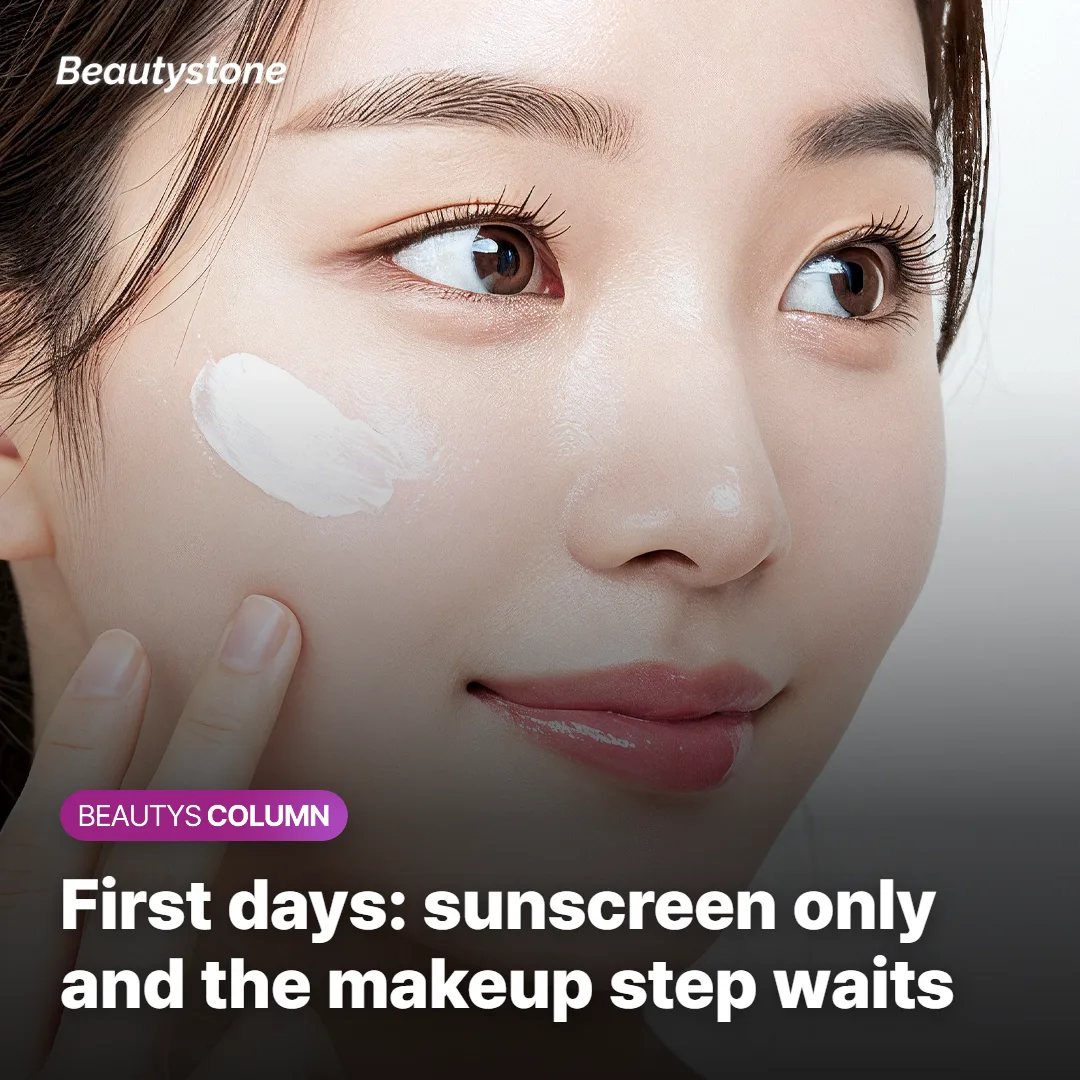
The motion changes, though. On healing skin, press and pat the product on in sections instead of sweeping it across the face. Sweeping drags at flaking edges and tugs at tender areas. If one zone was treated and the rest was not, dose that zone deliberately rather than assuming your cheek pass covered it.
Below is the pattern clinics commonly describe after a straightforward, non-ablative session. Anything that leaves crusting or open skin runs on a longer clock, and your clinic beats a general table.
| Stage | Sunscreen | Tone-up or BB cream | Reapplication |
|---|---|---|---|
| Treatment day | Only if your clinic clears it, shade otherwise | Skip | Not applicable |
| While skin is red or flaking | Daily, patted on gently | Skip, removal friction is the problem | Stick or powder only |
| Once flaking has settled | Daily, full layer | Thin tone-up cream, one product | Normal touch-ups, patted |
| Back to baseline | Daily, full layer | Tone-up or BB, whichever suits | Normal touch-ups |
Makeup waits for a reason that has nothing to do with pigment being dangerous. Everything you put on has to come off, and removal means cleanser, friction, and a hand working across your face.
Bringing Tone-Up and BB Cream Back Without Undoing the Work
Tone-up cream is a moisturizer base with a little white or pink pigment mixed in. Its job is to make skin tone look slightly brighter and more even, not to cover a blemish or a dark spot. BB cream sits further along the same spectrum: protection, hydration, and more coverage in one product, with shade matching that suddenly matters.
Both list an SPF number, and both are measured at a lab thickness nobody applies in real life. Spreading tone-up cream that thickly would look chalky within minutes. Closing that gap is what the sunscreen underneath is for, and during a treatment week the gap matters more, because the skin under it is the skin you are protecting.

Two post-treatment quirks are worth knowing. Freshly treated skin often runs pink for several days, and a white or pink cast over pink skin reads odd rather than bright. And shade-matching BB cream against flushed skin gives the wrong answer, because the shade that disappears on day three looks too light once your color settles.
- Go back to one product, not two. Layering both makes the base heavier and likelier to separate around the nose by midday.
- Keep the layer thinner than usual for the first week back, so removal takes one gentle pass instead of three.
- Use a mild cleanser and warm rather than hot water. The scrub-it-off habit causes more trouble than the cream does.
- If a treated zone stings when product goes on, it is not ready. Leave it bare and give it shade instead.
While you are healing, tone-up cream is usually enough on its own. Save the heavier base for the day your skin has stopped reacting to everything you do to it.
Reapplying Sunscreen Over Makeup During a Treatment Week
SPF fades over a day. A lunchtime walk chips away at what you applied that morning, and during a treatment week that morning layer is the one thing you cannot let quietly expire. The obstacle is mechanical: liquid sunscreen breaks up whatever is underneath it instead of blending in.
- Stick, cushion, and pressed-powder sunscreens are built to go over makeup. A stick is easiest when only one treated zone needs a redose.
- Pat, do not rub. On a normal week that habit protects your makeup. On a treatment week it protects the skin.
- Aim for early afternoon, around 2 to 3 p.m., which covers the stretch where the morning layer thins out.
- Indoors and away from windows, a light touch-up is enough. Outdoors, treat it as a scheduled step, not a maybe.
- Keep the applicator clean. A cushion puff that has lived in a bag for a month is not what you press onto healing skin.
For a long stretch outside, the honest answer is that reapplication alone will not carry you. A brimmed hat and the shaded side of the street do more for a treated area than a third pass of powder.
What Sunscreen Cannot Fix, and Who Should Wait
Sunscreen prevents. It does not reverse. Tone-up cream brightens optically, which is a lighting trick rather than a change in the pigment itself, and neither one moves a spot that has already set. Pigment that is already there is a treatment conversation, while pigment that has not happened yet is a sunscreen conversation.
The two overlap. A course of toning or pigment treatments works on what is already there, and the sun protection you keep between sessions decides whether the next one starts from a better baseline or from where you began.
- Good fit for the full routine: skin that has settled, with no flaking or stinging, and a plan that is finished or on a break.
- Should wait: anyone whose skin is still crusting, peeling, weeping, or tender under a light touch.
- Be extra careful: people who darken easily after a spot or scratch, and anyone with melasma, where light and heat both count.
- Realistic payoff: steady sun protection defends the result you paid for. It is insurance on a treatment, not a second one.
Some things are not a skincare question. Pain that grows instead of fading, redness spreading beyond the treated area, warmth that expands, blistering, oozing, or a fever after a session can signal infection or a burn. Contact the clinic that treated you the same day, and if you cannot reach anyone or symptoms are escalating, seek urgent care.
One practical note if you were treated away from home: follow-up may have to happen where you live. Ask before you leave who to contact, what a normal recovery week looks like, and what would justify seeing a local clinician instead.
If you are booking a consultation, bring questions rather than a product list. How many days until makeup is fine, which sunscreen format suits the treated area, when tone-up cream returns, and which pigment changes are expected versus worth a call.
Frequently Asked Questions
How long after a laser treatment can I wear tone-up or BB cream?
There is no single number, since it depends on how aggressive the session was and how your skin is healing. The usable rule is that makeup waits until the skin has stopped flaking and no longer stings when product goes on, and until the clinic that treated you clears it.
My tone-up cream lists an SPF number. Is that enough while my skin is healing?
No. That number is measured at a thickness almost nobody applies, so real-world protection falls short of the label. On healing skin, where a gap tends to show up as uneven color rather than as nothing at all, the full layer of sunscreen underneath does the work and the tone-up cream only handles tone.
How do I reapply sunscreen over makeup without disturbing treated skin?
Use a stick, cushion, or pressed-powder format and pat it on rather than rubbing. A stick is the easiest way to redose one treated zone without touching the rest of your face. Early afternoon, around 2 to 3 p.m., is a reasonable checkpoint.
Will daily sunscreen fade the dark spots I already have?
Sunscreen keeps existing spots from darkening further and helps prevent new ones, but it does not undo what is already there. Fading set pigment is a clinical conversation, and individual results vary. If those spots are why you are considering a treatment course, sunscreen protects that investment between sessions.