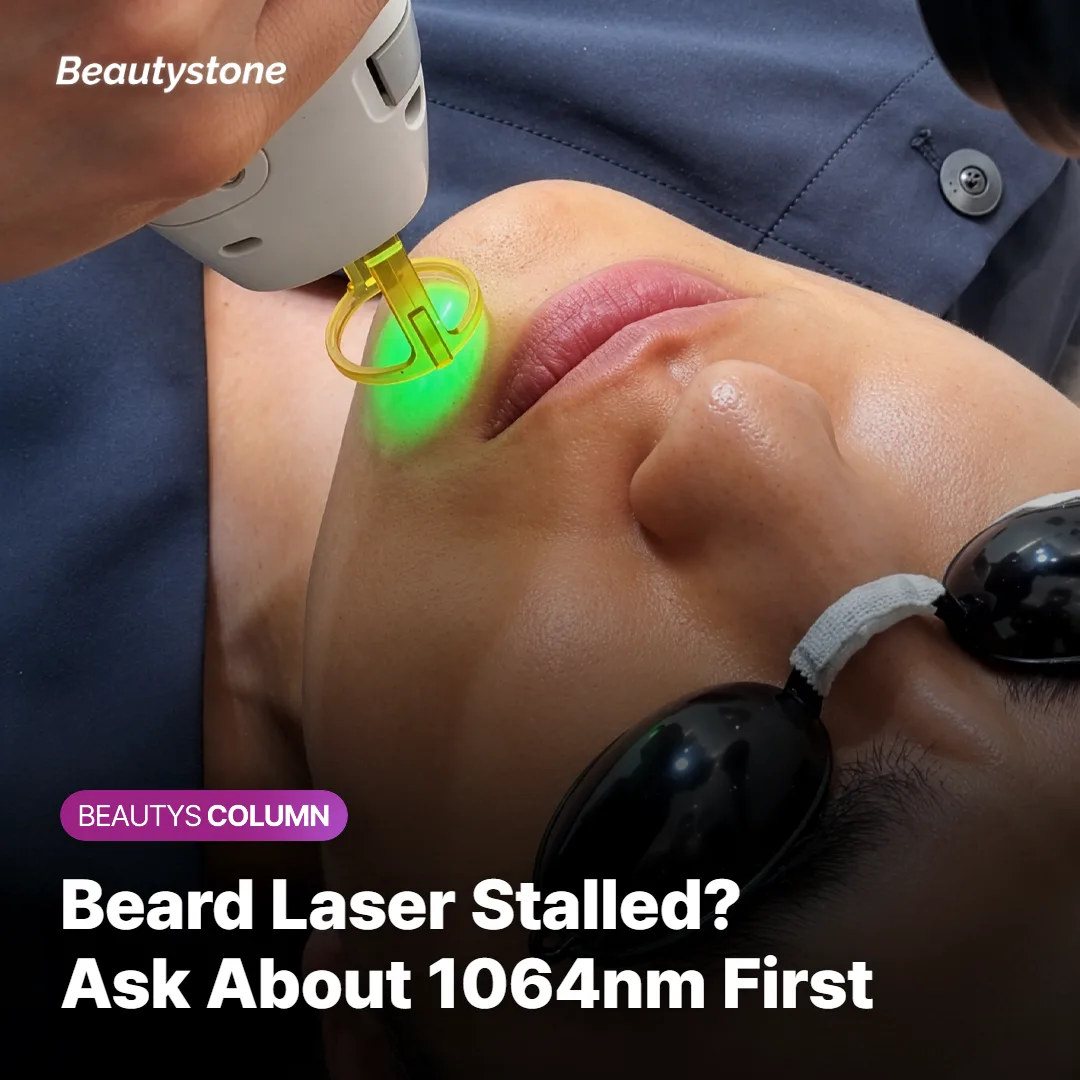
Beard and Face Laser: Why 1 Package Fails Both
Beard hair is thick and deeply rooted, so it takes more sessions. Fine facial fuzz is lighter, so changes come more gradually. Here's what to know before planning your sessions.

If you find yourself shaving in front of the mirror a little too often and start wondering whether laser hair removal might be the answer, you've probably come across some conflicting information. One source says beard removal takes a lot of sessions, while another says fine facial fuzz on women is hard to get rid of. It's the same general area — the face — so why do the results sound so different? That's exactly the confusion we'd like to clear up.
The short answer. Laser hair removal works by targeting pigment in the hair follicle, and the response varies depending on melanin concentration and hair thickness. That's why coarse, dark male beard hair and fine, light female facial fuzz respond differently — even with the same device. The number of sessions, level of discomfort, and downtime can differ quite noticeably by area. This post summarizes frequently asked questions we receive at Beautystone Clinic.
Same Face, Two Very Different Follicle Environments
Laser hair removal works by having the melanin pigment inside the follicle absorb light energy, which generates heat that gradually weakens the hair root. The denser the melanin and the thicker the hair, the more concentrated that energy becomes in each follicle. Conversely, lighter and finer hair scatters the energy, producing a weaker response.
Male beard hair tends to have deep follicles with thick, dark hair shafts*. Many people notice a visible reduction in regrowth after just the first few sessions. Female facial fuzz, on the other hand, has shallower follicles with less melanin, so changes tend to appear more gradually even with the same equipment. The phrase "facial hair removal" actually covers two quite different biological situations.
Hair shaft: the portion of the hair that grows above the skin surface, as distinct from the hair root, which sits beneath the skin.
Beard Removal Shows Noticeable Change Per Session — But Requires More Sessions Overall
Beard follicles follow a clear growth-and-rest cycle, and at any given time only about 20–30% of follicles are in the active growth phase. This means not all hairs are affected at once — follicles enter their growth cycle in waves, and each session targets the ones currently active. Many people notice their regrowth slowing down noticeably after the first two or three sessions.
Beard removal typically requires 6 to 10 or more sessions. Because the follicles are deep and dense, each session needs to deliver sufficient energy to produce results, which means post-procedure redness and a burning sensation tend to be more pronounced than in other areas. Those who avoid shaving for the first 24 hours after the procedure and follow up with Moisturizing and Calming care tend to experience shorter downtime.
Female Facial Fuzz Takes More Sessions, But the Procedure Itself Is Gentler
Because fine facial fuzz is lighter and thinner, the impact of each session is less dramatic than with beard hair. The general benchmark is around 8 to 12 sessions for the same area, though this varies considerably from person to person depending on follicle condition and hormonal factors. Areas like the upper lip, chin, and sideburn lines may have slightly coarser hair for some individuals, meaning response rates can differ even across different zones of the same face.
The discomfort and downtime associated with the procedure itself are generally milder than for beard removal. Most people experience only brief stinging and mild redness that subsides within a few hours, and many are comfortable wearing makeup from the next day onward. That said, if you have hormonally driven hair growth — such as that associated with PCOS — where coarser hairs appear in patches, the response curve will differ, so it's worth getting that evaluated first.
Even on the Same Face, the Risk of Irritation Differs
Because beard removal uses higher energy levels to reach deeper follicles, and because frequent shaving can leave micro-abrasions on the skin, a bit more attention to pre- and post-procedure care is warranted. Avoiding shaving for 24 hours after your session, temporarily pausing alcohol-based toners, and applying Sunscreen diligently can help reduce the risk of temporary post-inflammatory hyperpigmentation.
For women, since makeup use and daily sun exposure are routine, preventing hyperpigmentation is especially important. It's a good idea to pause strong acidic products — high-concentration AHA or retinol — for about a week around each session. In both cases, those who maintain SPF 50 or higher sunscreen consistently between sessions tend to see more stable results.
Why Beard and Facial Fuzz Shouldn't Be Grouped Under the Same Package
As outlined above, beard hair and fine facial fuzz represent two distinct follicle situations. Rather than locking in a fixed package from the start, a more reliable approach is to assess the results after the first session, then schedule subsequent sessions every 4 to 6 weeks based on how much regrowth appears. Patients who evaluate results through 3 to 4 sessions before committing to additional ones generally report higher overall satisfaction.
During your consultation, reviewing photos together and assessing hair thickness, color, and regrowth rate helps give you a clearer picture of where your results curve is likely to land. This post is intended as general information only — the actual number of sessions and energy settings should always be determined by a physician who has personally assessed your follicle condition and skin type.
Frequently Asked Questions
Q. When can I shave again after a beard laser hair removal session?
A. It's best to avoid shaving for 24 to 48 hours after your procedure to minimize irritation. Once the Heat sensation has subsided, you can resume shaving — an electric razor tends to be gentler in the first few days. Please hold off on alcohol-based aftershave on the treated area for the time being.
Q. Is it true that laser hair removal on women's faces makes the fuzz grow back thicker?
A. Generally speaking, this is not accurate. Shaving cuts the hair shaft at the surface, which can make the blunt edge appear thicker — but laser targets the follicle itself to reduce the amount of hair that regrows. There is no mechanism by which laser hair removal causes individual hairs to grow back coarser.
Q. How long should I wait between sessions?
A. It depends on the area and your individual regrowth rate, but beard removal is typically spaced 3 to 5 weeks apart, while female facial fuzz is usually 4 to 6 weeks. Since each session is most effective when follicles are in their active growth phase, it's more efficient to come in when you notice visible regrowth rather than on a very frequent schedule.
Further Reading
- Half of Our Beard Removal Patients Don't Know How Deep Their Follicles Are
- "Heavy Beard: 20 Sessions, Average Beard: 15" — The Truth About Beard Laser Hair Removal (feat. SNU Specialist) | Seoul Beautystone
- [GentleMax Pro Plus] Is Facial Fuzz Removal the Same as Removing Dark Spots? | Seoul Beautystone
- Hongdae Laser Hair Removal