

Does Thermage Help Pores and a Weak Barrier?
Enlarged pores and fine lines that don't respond to a richer moisturizer are often a sign your skin barrier and collagen are breaking down together, and Thermage is one of the few treatments built to address both at once.

If your makeup stops sitting right by midafternoon and your pores look bigger than they used to, it's tempting to blame dryness and reach for a richer moisturizer. But if that swap hasn't made much of a difference after a few weeks, the real story is usually happening below the surface, not on it.
Enlarged pores and fine lines that show up together, especially through your 30s, are often a sign that collagen support and your skin barrier are breaking down at the same time. That's a structural issue, not a hydration issue, and it's one reason Thermage keeps coming up as a first-line option for this exact combination. In this article, we'll cover how Thermage works, what results actually look like month by month, who's a good candidate, and what it costs.
What Is Thermage, and Why Does It Help With Pores and the Skin Barrier?
Short answer: Thermage is an FDA-cleared radiofrequency (RF) device that heats the deeper layers of your skin to trigger new collagen production, without breaking or removing the surface.
That distinction matters more than it sounds. Pores that stretch out and fine lines that stop bouncing back aren't just a texture problem. They're usually tied to collagen loss around hair follicles and expression lines. Because Thermage doesn't resurface or peel the skin, it's one of the few collagen-building options still on the table even when your barrier is already compromised.
The area under your cheekbones and along the sides of your nose, sometimes nicknamed the "butterfly zone," is usually where this shows up first. It's also often the first place people notice their foundation clinging to visibly larger pores.
How Does Thermage Actually Work?
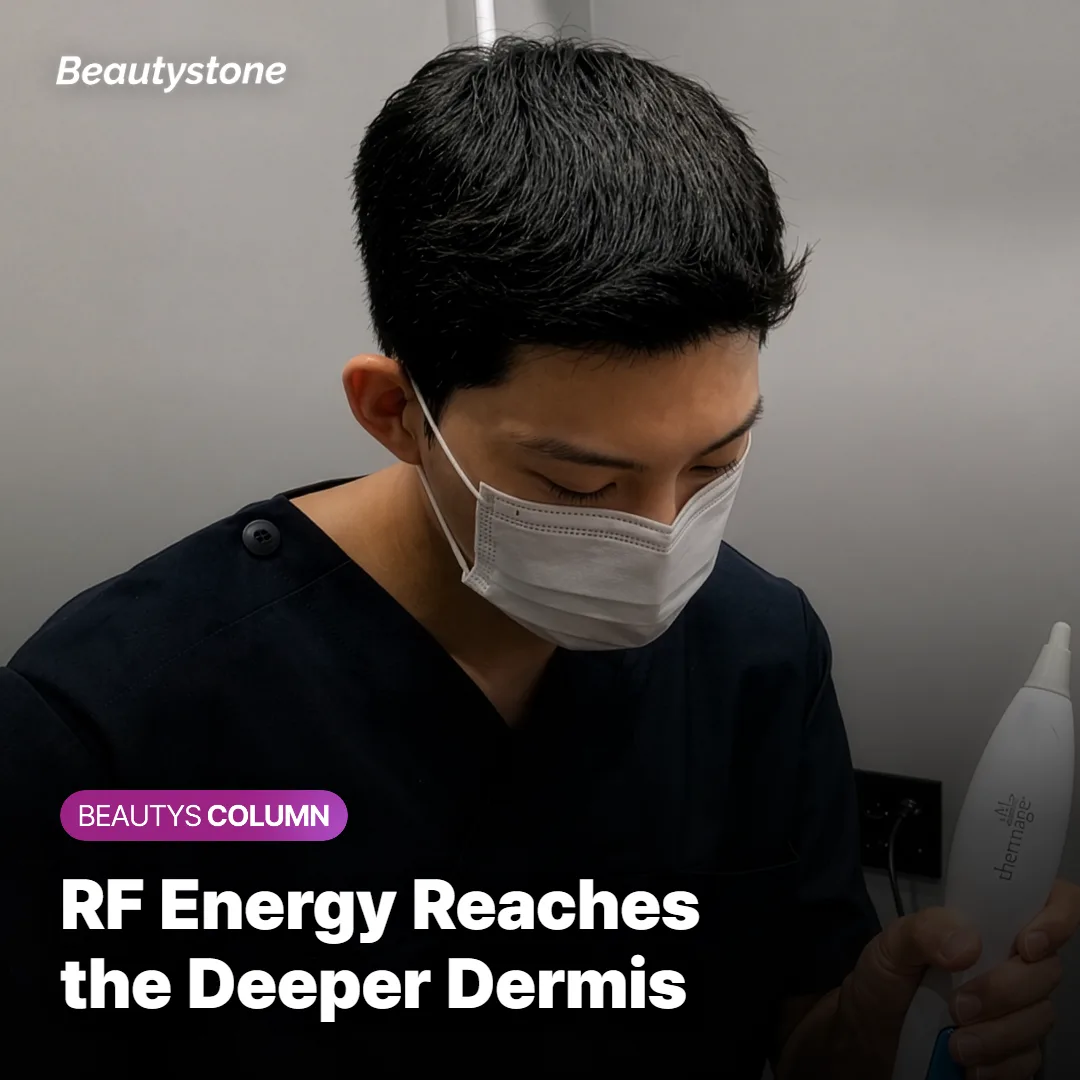
Thermage delivers RF energy through the skin's surface down into the dermis, where it heats existing collagen and signals your body to start rebuilding. The device doesn't damage the outer layer in the process, which is what sets it apart from resurfacing treatments like lasers or peels.
In your 20s, pore size is mostly about oil production. Past 30, the picture changes: collagen around each pore thins out, and the elasticity that used to hold pores round starts to give way. The same thing happens along expression lines, where a thinning collagen network means a crease doesn't fully bounce back anymore. Creams can smooth the surface temporarily, but they can't rebuild the collagen underneath, which is the actual cause.
- Depth: Energy reaches the dermis, not just the top layer of skin.
- Surface impact: Minimal to none, with no peeling and no open wound.
- Mechanism: Heat tightens existing collagen right away and stimulates new collagen production over the following months.
What to Expect: Timeline From Treatment to Results
Right after treatment, most people just look a little flushed. Nothing dramatic. The real changes take longer to show up, because collagen remodeling isn't instant.
- 1 to 2 weeks: Skin may look slightly smoother, but this early glow is mostly surface-level and isn't the main effect.
- 1 to 2 months: Pores gradually start looking rounder and less stretched as collagen rebuilds around them.
- Around 6 months: This is typically when results peak, with pores, fine lines, and overall firmness looking their best.
- 12 months: Results fade gradually and aren't permanent. Many people are left with roughly half of the peak improvement, which is part of why providers often suggest a yearly touch-up.
One thing worth knowing going in: judging results too early is one of the most common reasons people feel let down. Give it a full three months before deciding whether it worked for you.

Who's a Good Candidate for Thermage?
Thermage tends to be the better first move if your main complaint is texture and firmness, like stretched-looking pores, fine lines, and skin that feels thinner or more reactive than it used to, rather than lost volume.
- Good fit: Enlarged pores, fine lines, and a skin barrier that tends to flare up with new products.
- Better suited elsewhere: If hollowing or lost volume is the main concern, a collagen booster or dermal filler may address that more directly. Thermage lifts and firms; it doesn't fill in sunken areas.
- Also worth considering: If your skin reacts to most active ingredients and resurfacing treatments, Thermage's no-downtime approach can be easier on a compromised barrier.
Side Effects & Risks
Thermage is generally well tolerated, and because it doesn't break the skin's surface, its risk profile tends to run lower than resurfacing options. That said, it isn't without downsides, and individual results and reactions vary.
- Common: Temporary redness, mild swelling, and a warm or tingling sensation during treatment. These usually settle within a few hours to a day.
- Less common: Temporary numbness, small surface blistering, or areas of unevenness, particularly if a provider uses an aggressive setting on already-sensitive skin.
- Rare: Fat loss or contour irregularities under the treated area, more often reported with older-generation devices or providers without much RF experience.
If you notice spreading redness, blistering that isn't improving, or worsening pain in the days after treatment, contact your provider or seek medical care right away. Choosing a board-certified provider with real experience on RF devices is one of the biggest factors in avoiding complications in the first place.
How Much Does Thermage Cost?
Pricing depends heavily on the clinic, the device generation, and how many "shots," or energy pulses, your treatment plan uses. A full face typically starts around 600 shots as a baseline, with more added if pores and fine lines are being targeted together. Cost also varies by country, and by whether you're booking a single session or a package.
Rather than guessing at a number, it's worth asking your provider for a written quote based on your skin and goals, since the right shot count and settings aren't one-size-fits-all. If you're curious what a Seoul-based clinic charges, Beautystone, a dermatology clinic in the Hapjeong area, lists current offers at /en/promotion.
The Bottom Line
If your pores have started looking stretched and your fine lines aren't smoothing out with moisturizer alone, that combination usually points to collagen loss and a weakened skin barrier working together, not just dry skin.
- Thermage works below the surface, using RF energy to rebuild collagen without breaking the skin's surface.
- Most people start noticing changes around 1 to 2 months, with results peaking near the 6-month mark.
- It's a better fit for texture and firmness concerns than for lost volume, and it's often tolerable even on reactive, barrier-compromised skin.
Like any procedure, it comes with trade-offs, and results aren't permanent. Most providers recommend a yearly session to maintain them. Ultimately, the choice depends on your skin, your goals, and your budget. If you're considering Thermage, a consultation is the best way to find out what fits you. Beautystone is a dermatology clinic in Seoul's Hapjeong area, and you can see current offers at /en/promotion.
Frequently Asked Questions
Q1. Can skincare alone shrink enlarged pores?
Not on its own. Richer creams can smooth surface texture temporarily, but they can't rebuild the collagen loss that's actually stretching out the pore shape. Past 30, pore concerns are usually a dermis-level issue, which is why a collagen-building treatment tends to be the more direct fix.
Q2. Is Thermage safe if my skin barrier is already compromised?
It's often a good option in that situation, since Thermage doesn't peel or resurface the skin's surface. That said, everyone's skin is different, so it's worth flagging a sensitive or reactive barrier to your provider before treatment so they can adjust the plan accordingly.
Q3. How many sessions do I need, and do results last?
Many people see their best results from a single session, typically peaking around 6 months. Results fade gradually after that and aren't permanent, so a yearly session is a common way providers suggest maintaining the improvement over time.
Q4. How much does Thermage cost, and is it worth it?
Cost depends on the clinic, device generation, and shot count, so it varies quite a bit. Whether it's worth it really comes down to your goals: if stretched pores and fine lines are your main concern rather than lost volume, it's often considered a strong first option.