Shurink vs. Onda vs. Titanium: Which First?
If a dropped jawline is the issue, look at Shurink first; a thick fold under the jaw points to Onda, and thin skin points to Titanium lifting. Here's how the three differ in depth, sessions, results at 1 and 3 months, and side effects.
Wi Young-jin
Chief Director, Myeongdong
If sagging is blurring your jawline, look at Shurink first; if it's fat you can pinch, look at Onda; if it's thinning skin, look at Titanium lifting. With Shurink, a HIFU (high-intensity focused ultrasound) device, most people see modest lifting build over 2 to 6 months after 1 session, while a laser like Titanium may take 3 to 5 sessions. Many faces have more than one of these causes, so the one that shows most decides the order. In this article, we'll cover how to tell the causes apart, how deep each device works, what a comparison study found at 1 and 3 months, how Titanium sessions are planned, side effects, and timing around a trip to Korea.
At a glance
- Dropped jawline with little fat: Shurink first. A thick fold under the jaw: Onda first. Thin skin and fine lines: Titanium lifting first.
- In one comparison, the microwave group (Onda's type of energy) improved more at 1 month, and the HIFU group pulled ahead by 3 months.
- If sagging is already advanced, all three may change less than you'd hope, and none of them matches a facelift.
Shurink, Onda, or Titanium Lifting: What's Blurring Your Jawline?
Pinch the skin under your jaw between your thumb and index finger. If there's little to pinch but your jawline has slid downward, Shurink is the one of the two to look at first. If a thick fold fills your fingers, Onda comes first. If neither sagging nor fat stands out but your skin has thinned, fine lines are multiplying, and makeup won't sit smoothly, Titanium lifting is the better place to start.
Next, look at your jawline sitting up and then lying back. If its shape changes a lot between the two, you're likely dealing with a loosened SMAS*. That layer holds the skin and fat in place from below, so when it slackens, your jawline can drop even without much fat to pinch.
*SMAS: a thin fibrous sheet that wraps the facial muscles and supports the skin above them.
One exception changes the order. If your face looks droopy because your cheeks have hollowed out, restoring volume comes before Shurink. Lifting a face that has lost volume won't fill the hollow.
How Do Shurink HIFU, Onda, and Titanium Differ in Depth?
All three tighten tissue with heat, but they use different energy and put that heat at different depths. The depths and wavelengths in the table are settings used in studies; your actual depth is set by how thick your face is.
| Choosing factor | Shurink | Onda | Titanium |
|---|---|---|---|
| Energy | Focused ultrasound | Microwave | Laser with three wavelengths |
| Settings in studies | 3.0 and 4.5 mm depths | 7 and 3 mm handpieces | 755, 810, and 1064 nm |
| Where heat gathers | Dermis and SMAS | Fat under the skin, dermis | Shallow to deep dermis |
| Concern to look at first | Dropped jawline | Thick fold under the jaw | Thin skin, fine lines |
| When results were judged | 2 to 6 months after 1 session | Compared at 1 and 3 months | 2 to 6 months after the last session |
Once you know whether sagging, fat, or skin thickness is behind the blur, the device choice follows from the fourth row.
How much can a single session move the jawline? In a study of 50 people treated with Ultraformer MPT, the device line Shurink Universe belongs to, a 3D scanner measured the jawline about 3 mm higher right after treatment. That study had no comparison group and measured only immediately afterward, so it may not match how your face looks months later. Results differ from person to person.
Onda Lifting vs. Shurink HIFU: What Changed at 1 and 3 Months?
If a quicker change matters most to you, compare Onda first; if a lift that keeps building matters more, compare Shurink first. In a study of 171 East Asian patients, those treated with a microwave device showed more improvement and higher satisfaction at 1 month. By 3 months, the HIFU group had pulled ahead in lifting, skin elasticity, and satisfaction.
Pain during treatment scored 2.3 for the microwave device and 4.7 for HIFU, so the microwave side felt milder. Both groups had only mild, short-lived reactions. That said, the study looked back at one clinic's records instead of randomly assigning people, so it's weaker evidence than a planned head-to-head trial. How much you'd notice depends on your own face.
How Many Titanium Lifting Sessions, and When Do Results Show?
Titanium lifting is planned as a series, not a single visit. A laser like this heats the dermis without wounding the top layer of skin, and the body rebuilds collagen slowly.
In a preliminary study, 28 women had a three-wavelength laser 5 times, 2 weeks apart. Skin samples taken 2 weeks after the last session showed more collagen and elastic fibers throughout the dermis. There was no comparison group, though, so you can't count on the same result.
Results tend to appear gradually 2 to 6 months after the last session*. Rather than judging Titanium after one visit, it makes more sense to finish the planned sessions and then compare photos taken in the same light. Everyone's skin is different.
*Based on American Academy of Dermatology patient guidance.
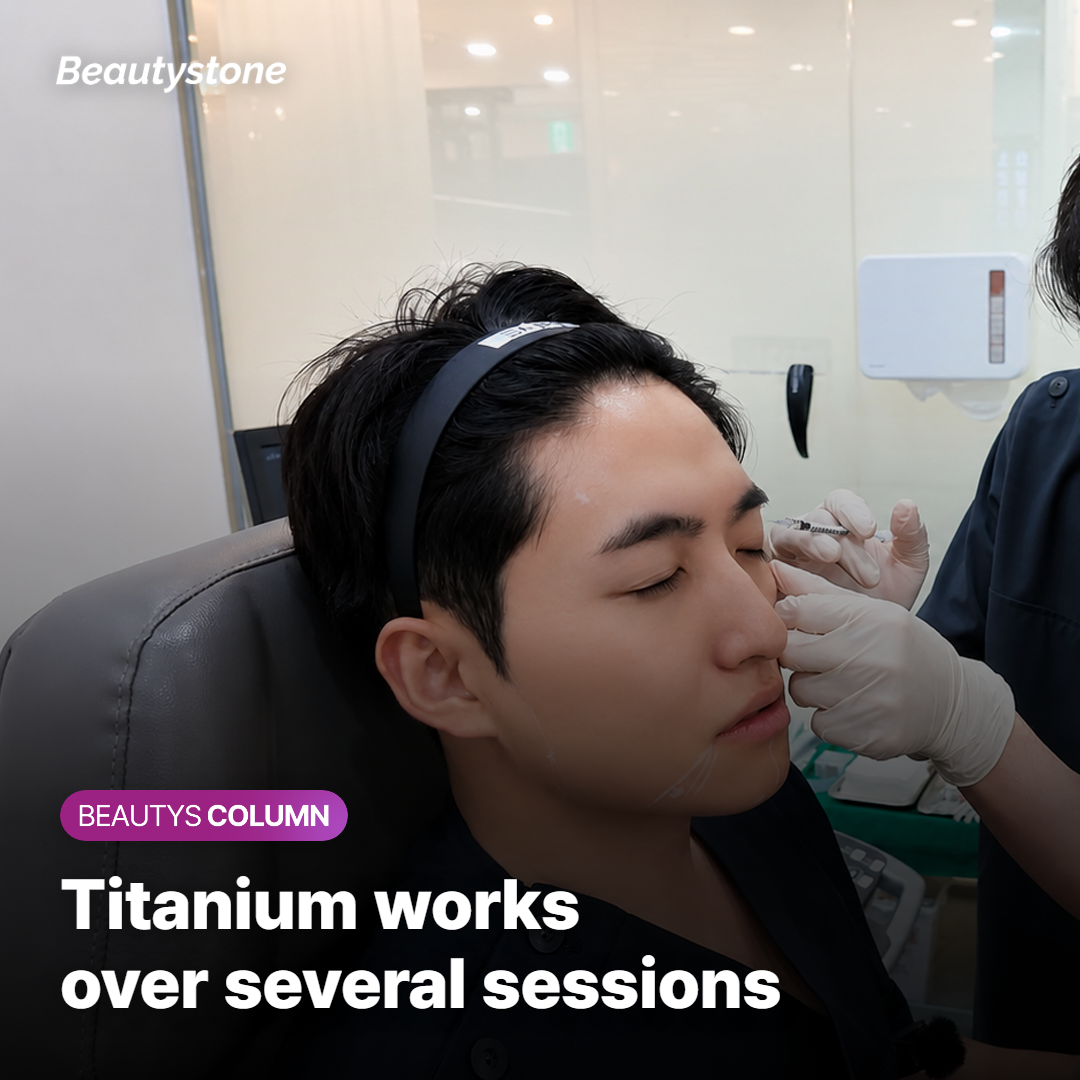
Shurink, Onda, and Titanium Side Effects: What's Normal?
None of the three devices breaks the skin, so brief redness and swelling are usually the only signs you've had treatment*. Most people go straight back to their day. If redness or swelling worsens or spreads, contact your provider right away.
*Based on American Academy of Dermatology patient guidance.
Serious reactions after focused ultrasound are rarely reported, but blistering, open sores, and tissue that sinks after swelling have been described. If you notice any of these, contact the clinic right away, no matter how many days it's been since treatment:
- Blisters or oozing
- Skin that breaks down or looks raw
- An area that looks sunken a few days later
- One side of your mouth moving oddly
Early wound care helps limit lasting marks, so don't wait to see if it fades on its own.
Hold off on treatment in these cases:
- You're pregnant
- There's a skin infection where you'd be treated
- You take certain medications that don't mix with heat treatments (bring your medication list to the visit)

Getting Shurink, Onda, or Titanium During a Trip to Korea
Unless you had sedation that day, there's no need to postpone your flight because of a Shurink, Onda, or Titanium session.
Some treatments, like filler, change your shape on the day. These three work the other way: they bring your face closer to how it used to look little by little rather than all at once. Titanium is planned as a series, so one visit during a trip isn't the full course, and what you see on the flight home isn't the final picture.
Once you're home, you can send photos taken in the same light through the consultation button on this page and ask about anything that worries you. If you notice blistering, oozing, or an area that keeps sinking, see a doctor where you are first instead of waiting for a reply.
The Bottom Line: Sagging, Fat, or Thin Skin?
The variable worth taking into your consultation is the layer: the SMAS for a dropped jawline, the fat under the skin for a thick fold under the jaw, or the dermis for thin skin. Before you decide, ask which layer the doctor would heat on your jawline and why. That one answer makes Shurink, Onda, and Titanium much easier to compare.
Not sure which cause is bigger? A side-profile photo is a good place to start. Beautystone is a clinic in Seoul's Hapjeong area, and at the first visit the doctor looks at your face sitting up and lying back, including any difference between the two sides, before deciding which layer to treat first.
Sources
- A microwave device vs. focused ultrasound in 171 patients, at 1 and 3 months (Aesthet Surg J, 2026)
- How far 7 areas of the face lifted right after Ultraformer MPT, measured in 3D (Plast Reconstr Surg Glob Open, 2024)
- Skin changes in 28 women after 5 sessions of a three-wavelength laser (Lasers Med Sci, 2023)
- A three-wavelength laser for facial fat contouring in 10 women (J Cosmet Dermatol, 2024)
- Rare blistering, sores, and sinking after focused ultrasound: case series (Lasers Surg Med, 2018)
- Sessions, result timing, and who suits nonsurgical skin tightening (American Academy of Dermatology)
Frequently Asked Questions
Q. I have sagging and a double chin. Should I get Shurink or Onda first?
A. If you have both sagging and a double chin, start with whichever one stands out more. If a thick fold under your jaw is the first thing you notice, Onda goes first; if the dropped jawline is bigger than the fat you can pinch, Shurink goes first. Whether to do both on the same day or space them apart depends on your skin thickness and how much redness you get, and that's decided at your visit.
Q. Will Onda alone sharpen my jawline if my skin sags a lot?
A. If your skin sags a lot, treating the sagging usually comes before reducing fat with Onda. When loose skin stays as it is and only the fat shrinks, the jawline may not look as defined as you'd expect. Which is bigger, the sagging or the fat, sets the order.
Q. Can I get Shurink if my cheeks are already thin?
A. If your cheeks are already thin, check whether the problem is sagging or hollowing before adding more Shurink shots. When hollowing makes your face look droopy, restoring volume comes before a lifting treatment. If it really is sagging, the Shurink area can be planned from there.
Q. Can Titanium lifting help with fat around the jaw?
A. Titanium-type three-wavelength lasers have been used for facial fat that has shifted downward. In a case series of 10 women who had up to 3 sessions, 3 weeks apart, satisfaction scores were good and no significant side effects were reported. It was a small study with no comparison group, so if a thick fold under your jaw is the main concern, compare Onda first.
Q. Does Shurink, Onda, or Titanium lifting hurt?
A. Shurink, Onda, and Titanium lifting can all feel hot or prickly during treatment, and that discomfort usually ends when the session does. In the small laser case series, only 2 of 10 women reported minor pain. If pain worries you, numbing cream can be used, and sedation may be an option for larger areas; which one fits depends on the treatment, the area, and how sensitive you are, and it's decided at your visit.
Q. Can I wear makeup and go to work the same day?
A. You can often apply makeup right after a nonsurgical lifting treatment like these. Brief redness and swelling are the usual traces, so most people go straight back to their day. If you see blisters or oozing, contact the clinic before thinking about makeup.
Q. I'm in my 50s and my skin sags a lot. Will these still work?
A. With a lot of sagging, all three devices may change your face less than you'd hope. Nonsurgical tightening tends to work best when sagging is mild, and it can't give the results of a facelift. The amount of sagging matters more than your age.
Q. I'm losing weight right now. Should I wait to get Onda or Shurink?
A. If your weight is still changing a lot, it's better to wait until it settles. Heat-based tightening tends to give better results when you're at a healthy weight and keep it there. If fat is your concern, you can look at your jawline again after the weight loss and choose the device then.
Q. Will I need more than one Shurink session?
A. One Shurink session is often enough to see modest lifting, but some people get more benefit from additional sessions. Whether a second session makes sense is easier to judge after the first has had time to show its result.