Why Juvelook Looks More Natural Than Filler
If you've held off on filler because you're worried about looking "done," Juvelook works differently — and the difference is all in the timeline.

If you've put off filler because you're worried about that overfilled look, you're not alone. A lot of people in their late 30s tell us some version of the same thing: they want to look like a well-rested version of themselves, not a different person. That's usually the moment Juvelook comes up.
In this article, we'll cover what actually makes Juvelook different from filler, why the same treatment can look completely different depending on where it's placed, the aftercare routine that protects your results, and what the timeline really looks like from injection day to the moment you notice a change.
What Is Juvelook, and How Is It Different From Filler?
Juvelook is a collagen biostimulator made from PDLLA (poly-D,L-lactic acid), a biodegradable material injected into the dermis. Unlike hyaluronic acid (HA) filler, Juvelook doesn't add its own volume to the treated area.
Filler works instantly — the moment it's injected, the treated area fills to roughly the volume that went in. Juvelook works on a delay. The particles are gradually broken down by your body, and as that happens, they stimulate your own collagen to grow in their place.
| What You're Comparing | HA Filler | Juvelook |
|---|---|---|
| When you see a change | Immediately | Gradually, over weeks |
| What creates the volume | The injected material itself | Your own collagen |
How Does Juvelook Create Such Natural-Looking Results?
Here's the simplest way to think about it: filler is like moving in a piece of furniture. The space fills instantly, and if it's placed slightly off, that's obvious right away. Juvelook is more like planting something in that same spot — it takes weeks to fill in, but by the time it does, it looks like it grew there.
That slow build is exactly why it tends to read as natural. Your tissue isn't stretched to accommodate a sudden volume of material. It's gradually replaced by tissue your body made itself, over roughly four to twelve weeks depending on the area and how your skin responds.
That said, "natural" isn't automatic. Where and how Juvelook is placed matters just as much as the product itself — and that's where technique comes in.
Why Technique Changes by Area: Cheeks, Folds, Forehead, and Jawline
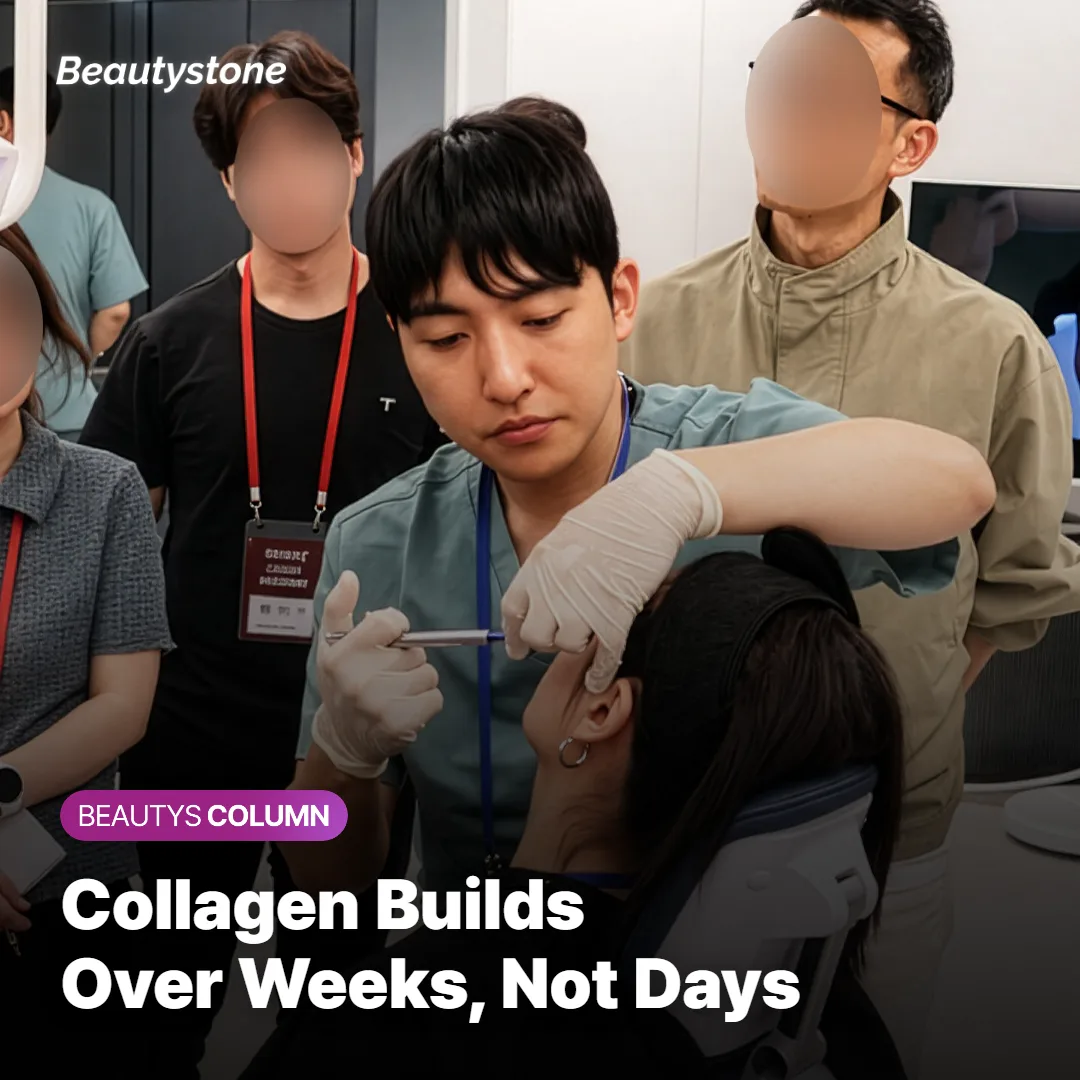
The same product, injected the same way, doesn't behave the same way in every part of the face. A provider who treats every area identically is missing something important.
- Cheeks: This is a broad, flat surface, so collagen that builds evenly across the area tends to restore an overall sense of firmness rather than a single "point" of volume.
- Nasolabial folds: These are more like a line than a surface, so the fold softens naturally only when the cheek volume on either side is supported too — treating the line alone rarely looks right.
- Forehead: Skin here is thinner and moves constantly with your expressions, which makes it the area most likely to develop a small bump if particles clump together. Providers typically dilute the product more here for that reason.
- Jawline: This area is about counteracting sagging along a line, so injections tend to go a little deeper than in other areas to support that structure.
In short: depth, dilution, and placement all shift by area. That's a technique decision, not a product decision.
The 5-5-5 Massage Rule: Why Aftercare Makes or Breaks Your Results
Here's something that gets overlooked: what you do in the days after treatment matters almost as much as the injection itself.
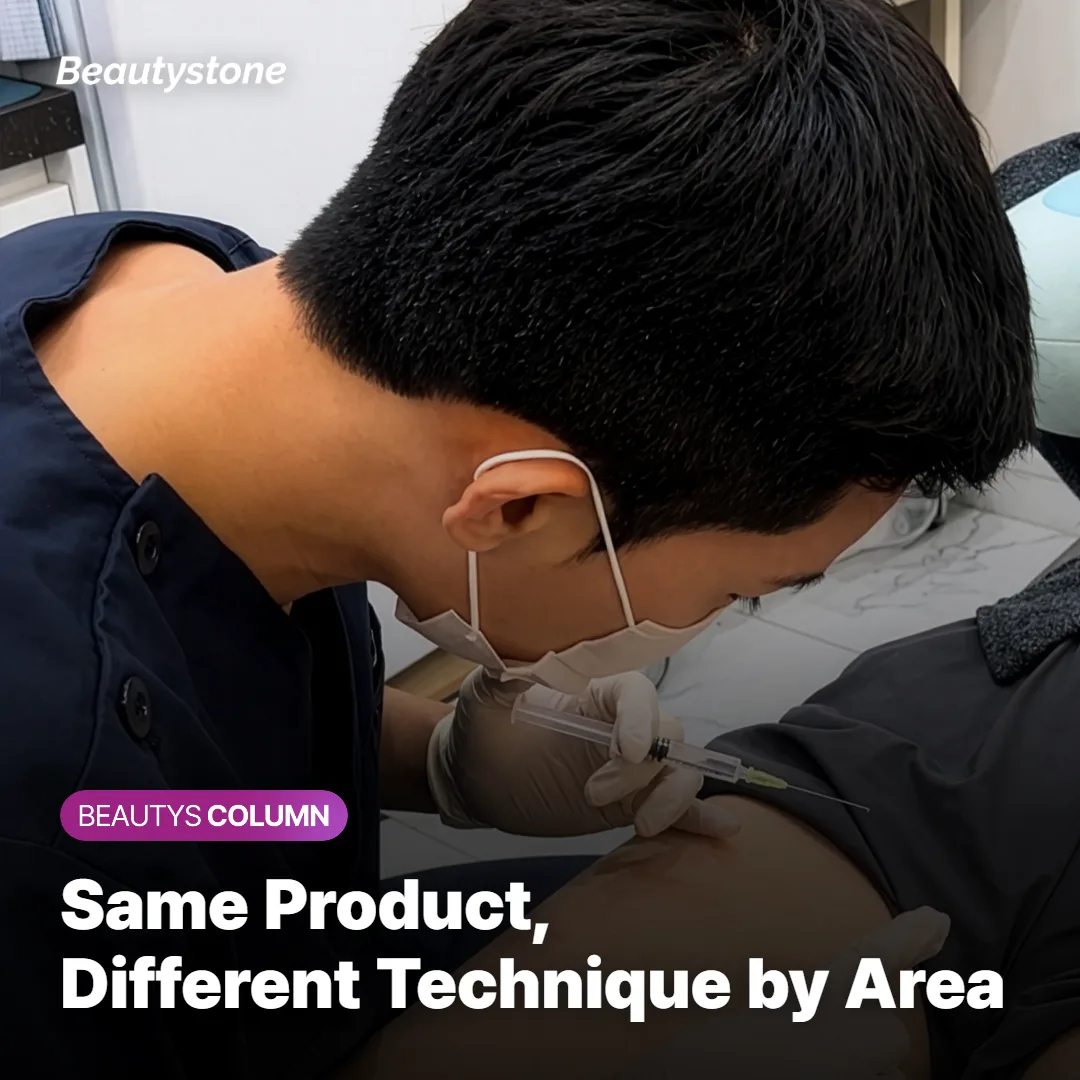
A common aftercare guideline is the 5-5-5 rule — massaging each treated area gently for about five minutes, five times a day, for the first five days.
The reason is straightforward. If particles settle in one concentrated spot right after injection, collagen can build up unevenly in that one area, which is more likely to feel like a small firm bump under the skin. Massaging in the days after treatment helps disperse the particles more evenly, so collagen builds across a broader surface instead.
One caveat: more pressure isn't better here. Firm massage tends to prolong bruising rather than improve results. Think of the pressure you'd use applying moisturizer — a gentle, circular motion, not a deep press.

What's the Timeline? When Will You Actually See a Difference?
This is where a lot of people get discouraged too early. It's genuinely common to feel like "nothing happened" the day after treatment — and that's expected, not a red flag.
- Day of treatment: The area may look slightly fuller than usual — that's the injected fluid, not new collagen.
- Days 2–3: That fluid resolves, and the area can look close to how it did before treatment. This is the point where most people assume it didn't work.
- Around week 4: Real collagen-driven change typically starts to show.
- Weeks 6–8: This is usually when people notice it themselves — often while looking in the mirror, not because someone else mentioned it.
If you're comparing photos from day one to week two and seeing no difference, that's actually consistent with how Juvelook is supposed to work. The real comparison is week one versus week eight.
How Many Sessions Do You Need, and How Long Do Results Last?
This varies by case, but a few patterns hold up across most patients.
- First time trying Juvelook: Most providers recommend two to three sessions, spaced about four weeks apart.
- Already have some collagen base: Two sessions is often enough.
- Thinner skin or more visible sagging: Three sessions tends to be where results become noticeable.
As for how long it lasts, most people see results hold for around twelve to eighteen months. That said, heavy sun exposure and significant weight fluctuation both tend to speed up how quickly collagen breaks back down — so skincare and sun protection aren't just general skin-health advice here, they're part of protecting your results.
Side Effects & Risks: What About Bumps and Nodules?
Nodules — small, firm bumps under the skin — are the main risk worth knowing about. They're not common, but they're not zero, either, and they show up more often in thin, high-movement areas like the forehead and around the mouth.
There are generally two causes: the injection was placed too shallow, or particles clumped together in one spot instead of dispersing evenly. This is exactly why the massage protocol matters so much in the first five days.
If you notice a small firm bump anywhere from four to eight weeks after treatment, contact your provider and get it checked rather than waiting it out. Caught early, most of these resolve with in-office care. If you notice spreading redness, fever, or worsening pain at any point, seek medical care right away.
Individual results and risk vary — your skin thickness, the treatment area, and how closely you follow aftercare instructions all play a role.
The Bottom Line
Juvelook doesn't look natural because of what it is — it looks natural because of when it shows up. A few things worth remembering:
- Results build over roughly four to twelve weeks instead of appearing instantly.
- Technique — depth, dilution, and placement — changes meaningfully by area.
- The 5-5-5 massage routine in the first five days plays a real role in how smooth your results feel.
- Most people need two to three sessions, with results lasting around twelve to eighteen months.
Like any procedure, it comes with trade-offs — namely, patience. Ultimately, the choice between filler and Juvelook depends on your skin, your timeline, and how you feel about waiting for a gradual change versus an immediate one.
If you're considering Juvelook, a consultation is the best way to find out what fits your skin and your goals. Beautystone is a dermatology clinic in Seoul's Hapjeong neighborhood — see current offers at /en/promotion.
Frequently Asked Questions
Q1. Does Juvelook hurt?
Most people describe it as pressure or mild discomfort rather than sharp pain, especially with topical numbing beforehand. That said, sensitivity varies from person to person, and thinner areas like the forehead tend to feel more than areas like the cheeks.
Q2. How long do Juvelook results last?
Most people see results hold for around twelve to eighteen months, though heavy sun exposure and significant weight changes can shorten that window.
Q3. How much does Juvelook cost?
Pricing depends on the treatment area, how many sessions your provider recommends, and the clinic itself, so it's hard to give a single number. Ask for a personalized quote during a consultation, or check current offers at /en/promotion.
Q4. When can I wear makeup after Juvelook?
Most providers suggest waiting at least a few hours after treatment, and some recommend the following day, especially if there's any visible swelling at the injection sites. Your provider will give you guidance specific to your treatment.