Male vs. Female Filler: CC & Depth Differ?
For men, structural contouring comes before lifting. We start with 0.5cc at the temples and jawline.


Planning a trip to Seoul?
Male Filler vs. Female Filler — Where Do Lifting CC & Depth Actually Differ?
Before You Read — Quick Answers First
Q. Do men need more CC of Filler to get a Lifting effect, just like women?
A. Actually, it's the opposite. Men have thicker Dermis, so using the same volume tends to create a puffy, over-filled look.
Q. So where do you start, and how does it work?
A. We begin with structural lines like the temples and jawline — not the Nasolabial Folds or cheeks. Volume is distributed in 0.5cc increments.
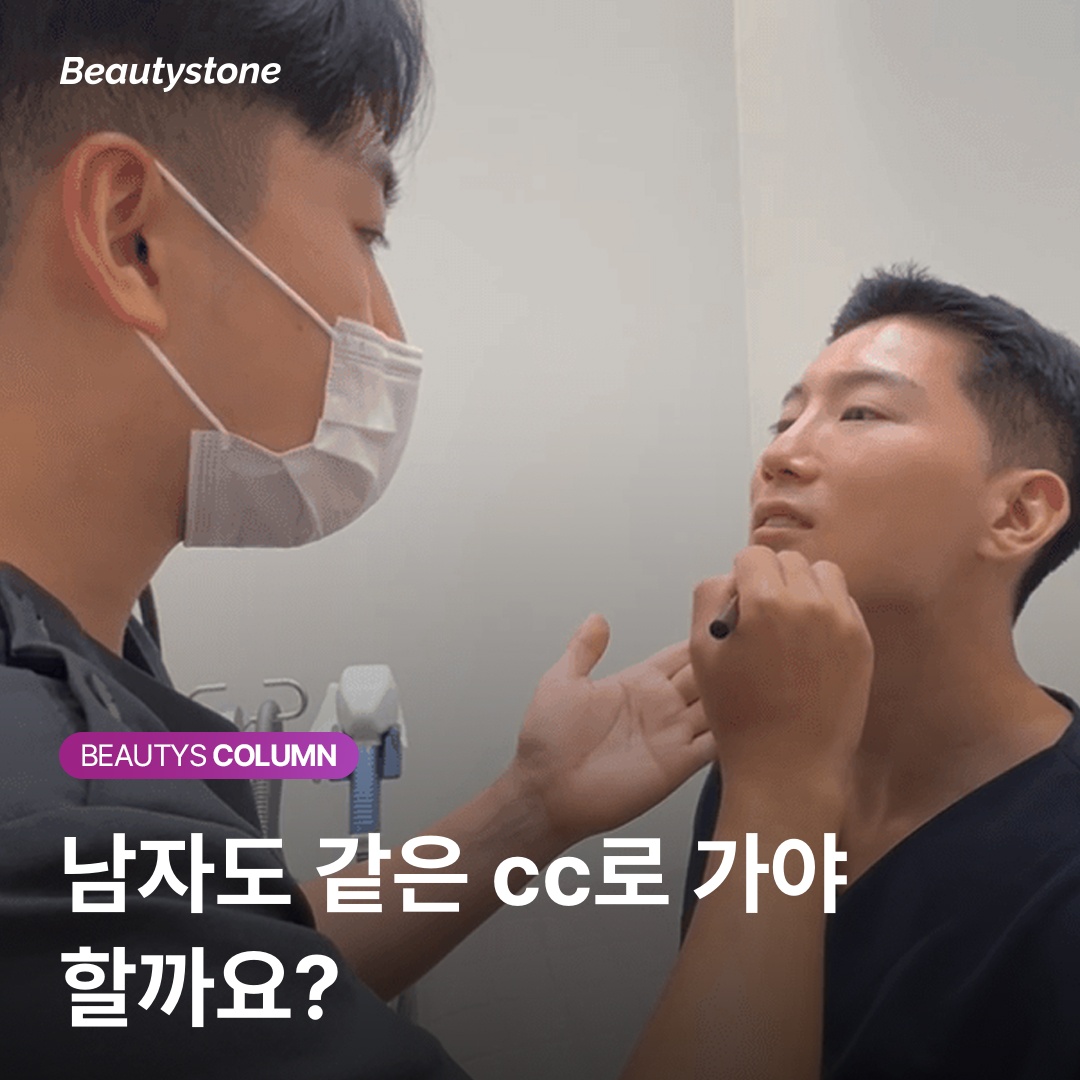
Is Male Filler Lifting Really the Same Procedure as Female Filler?
Male Filler Lifting involves injecting hyaluronic acid into the Dermis, subcutaneous tissue, or supraperiosteal plane
to restore support to sagging facial contours.
On a fundamental level, the principle is the same as female Filler.
However, even when using the same product and the same needle,
the volume, placement, and sequence differ considerably between men and women.
When the exact same approach used for female patients is applied to men,
the result is often a rounder, softer face with a less defined appearance.
Why Does a Thicker Dermis Change the Order of the Procedure?
Key Takeaway
Male skin has a Dermis that is 20–30% thicker than female skin on average, which means sagging tends to appear later. As a result, the MD code for men is more often focused on "structural contouring" rather than "Lifting,"
with Filler distributed at the temples and jawline in 0.5cc increments.
Think of the difference between a thick leather sofa and a thin fabric sofa.
Place the same cushion on both — on the leather one, you'll barely notice a difference,
while the fabric one takes shape almost immediately.
Filler works on a similar principle.
Male skin has a Dermis that is, on average, 20–30% thicker than female skin.
Collagen bundles are denser, and the density of sebaceous glands and hair follicles is higher.
This means that even at the same age, sagging tends to develop more slowly in men.
What this means for procedure planning is that
a strategy of "using more CC for Lifting purposes"
simply doesn't work as well for men.
Because there is less sagging to lift, there is less to correct in that regard —
and it's far more natural to instead reinforce the areas where Facial Contour has softened,
such as temple hollowing and jawline definition loss.
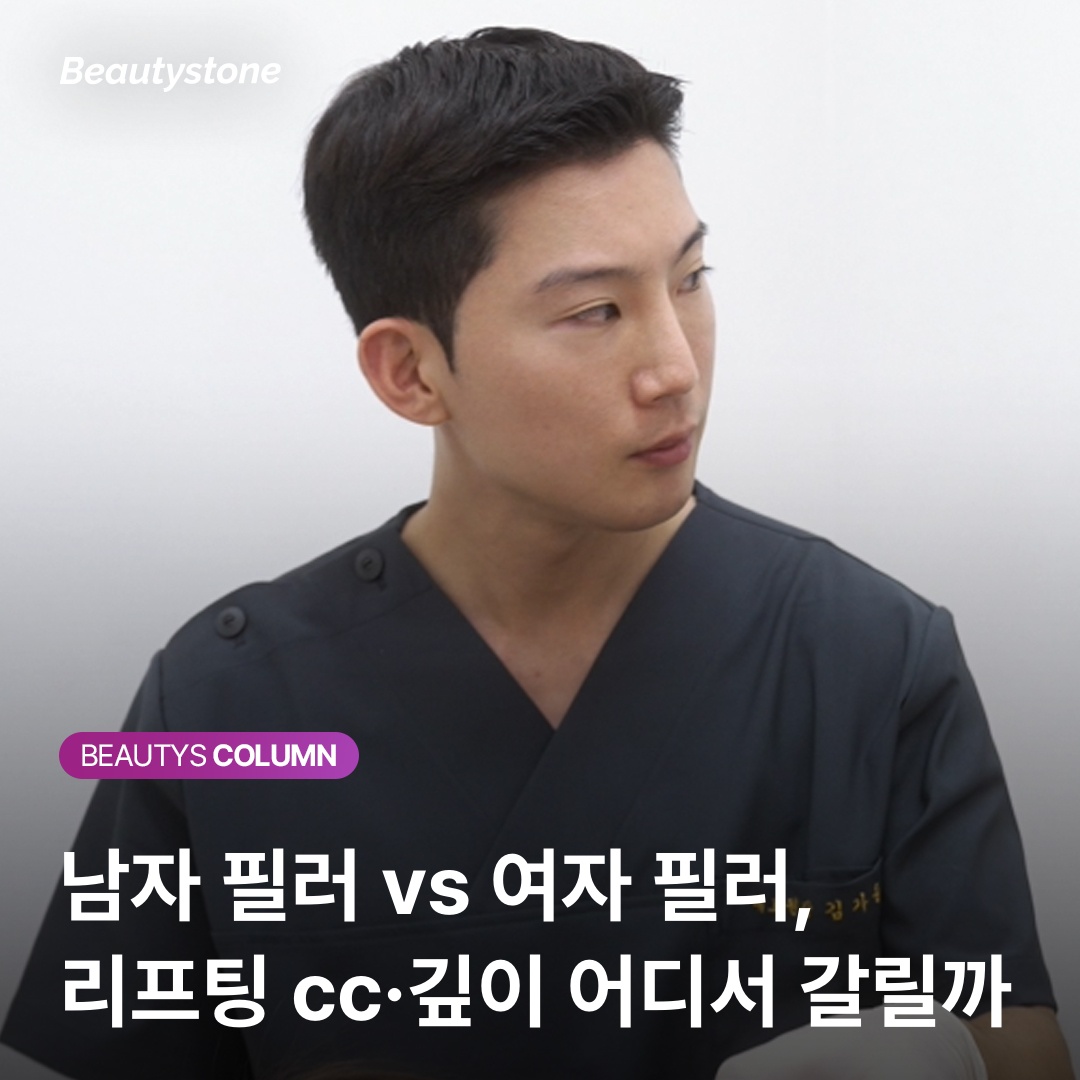
That's why when I design the MD code for male patients,
I distribute volume across the temple and jawline in 0.5cc increments.
This is quite different from the typical female pattern of placing 1cc at a single point.
The injection depth also differs.
For men, going deeper to the supraperiosteal plane
ensures that the surface stays smooth while only the bone structure is enhanced.
There's one more important point — the sequence of procedures.
For patients combining a Lifting device (such as InMode or Ultherapy) with Filler,
I generally recommend doing the Lifting procedure first, then waiting 2–3 weeks before injecting Filler.
The idea is to first tighten the sagging SMAS Layer with thermal energy,
then fill only the remaining volume deficit with Filler.
Reversing the order can cause the Filler to absorb faster due to heat exposure,
or result in a misalignment of the overall design.

For male patients, Filler is fundamentally about structural contouring — not volume lifting.
Distribute in 0.5cc increments at the temples and jawline, injecting at the supraperiosteal depth.
When combining with a Lifting device, always do the device procedure first, then Filler 2–3 weeks later.
Male Filler by Zone — How I Approach the Temples, Jawline, and Nasolabial Folds
I had a very similar case in the clinic just today.
A 31-year-old man came in accompanying his girlfriend for her procedure,
and ended up becoming far more enthusiastic than her — walking out with a full consultation.
He initially came in saying he wanted to "soften his Nasolabial Folds,"
but as we reviewed his photos together, I pointed something out:
"Your temples are actually more hollow than your Nasolabial Folds —
if we address those first, your overall appearance will immediately look more refreshed."
In reality, more than 80% of male patients come in primarily concerned about
their Nasolabial Folds or cheek sagging —
but when we look at their photos, it's often the temples, forehead, and jawline that have lost definition.
When those areas lose structure, the Nasolabial Folds appear even deeper as a result.
Take a look at the table below to find your case.
There's one thing I always make a point to mention:
trying to fill everything in a single session for male patients almost always looks unnatural.
Starting with a lighter touch at the temples and jawline first,
then reassessing in front of the mirror 2–3 weeks later and adding only where needed —
this is the approach that consistently produces the highest satisfaction in my clinic.
I understand this can feel slow for patients who want to get everything done at once.
But when the results look natural, you can go back to your daily life
without anyone asking, "What did you have done?" —
and that's exactly why I recommend a staged approach.

3 Common Questions About Male Filler — Answered
Q1. Will Filler make me look too feminine?
A. Honestly, in my clinical experience, that's a design issue — not a Filler issue.
If you apply a female contouring pattern (rounded forehead, V-line chin) to a male face,
it will naturally look feminine.
For men, the approach needs to go in the opposite direction.
A flatter forehead, a slightly more angular chin,
and temples that are only filled enough to correct hollowing when viewed from the side.
This design sensibility varies significantly from practitioner to practitioner,
so it's important to seek out a clinic with substantial experience treating male patients.
There's another question that goes hand in hand with this one.
Q2. Is the cost and longevity of male Filler different from female Filler?
A. In my clinic, the per-unit price is essentially the same — the product costs the same per CC regardless of gender.
However, because men typically require fewer CCs overall,
the total cost often comes out 30–40% lower than for female patients.
Longevity varies by product, but as a general guideline:
areas with minimal movement, like the temples and jawline, typically last 12–18 months,
while areas with more frequent expression, like the perioral region and Nasolabial Folds, last around 8–12 months.
Because men tend to have stronger facial muscles,
Filler around the mouth area may dissolve slightly faster than in female patients.
And the last question I get asked most often is this one.
Q3. Is it safe to shave over areas where Filler has been injected?
A. I initially wondered whether shaving could affect the Filler, but in practice, it's almost entirely unrelated.
Filler is placed deep in the tissue — below the Dermis or at the supraperiosteal plane —
while shaving occurs at the surface of the epidermis,
so the two simply don't come into contact.
That said, for the first 2–3 days after the procedure, there may be some Bruising and Swelling,
which can make the sensation of a razor blade feel more irritating than usual.
During that period, I recommend switching to an electric razor
or simply skipping shaving for a day or two.
In terms of side effects, there is very little difference between men and women,
though Bruising may appear slightly more pronounced in male patients.
Male skin is thicker, which can slow the absorption of Bruising a little,
so I advise scheduling the procedure at least 1–2 weeks before any important event.
If there's one thing to take away from today — male Filler isn't about stacking volume. It's about using 0.5cc increments to redraw the structural lines of the face.
In the next post, I'll be covering the exact timing for combining male Filler with InMode or Ultherapy. I'll walk through real cases showing how results can differ between a 2-week and a 4-week interval with the same patient. This has been Dr. Wi Young-jin.
Further Reading
- "Does Thermage Actually Work?" — An Honest Look at Lifting from Inside the Clinic (Seoul Thermage)
- The Truth About Ultherapy Pain: "Toughing It Out Doesn't Mean Better Lifting Results"
- Seoul Filler: "Who Performs the Procedure Matters More Than the Price" (Why Doctor-Performed Injections Make a Difference)