Ultherapy After 60: Is It Safe in Seoul?
With Ultherapy after 60, laxity matters more than age. What's realistic, and what to ask in Korea.

You're in your early sixties, planning a trip to Seoul with your daughter, and somewhere between the palace tour and the skincare shops, someone mentions Ultherapy — a "non-surgical facelift" that uses ultrasound instead of a scalpel. No cutting, little downtime. It sounds almost too convenient, and after this many years you've learned to be a little skeptical of "too convenient."
Here's the honest answer first: Ultherapy is an FDA-cleared ultrasound device, and age by itself is not a reason to rule it out at 60. But "generally safe" and "right for you" are two different questions. After 60, results tend to vary more than the polished before-and-after photos suggest, and for some people a surgical lift is genuinely the better fit. This is meant to help you ask sharper questions, not to talk you into anything.
What you'll learn

  · You'll learn what Ultherapy is actually cleared to do
  · You'll learn why results after 60 vary so much
  · You'll learn how to tell if you're a candidate or better off with surgery
  · You'll learn price ballparks to sanity-check any quote you're given
What actually changes in skin after 60
Skin doesn't just "get looser" with age — several things shift at once. Collagen and elastin, the fibers that keep skin springy, are produced more slowly, and the fat pads and bone that support the face lose a little volume underneath. That's why the jawline and neck often soften first.
None of this is a flaw to be alarmed about; it's ordinary anatomy. But it explains why a treatment that nudges your body to make new collagen behaves differently at 60 than at 40 — there's simply a bit less raw material, and it responds more slowly. Knowing that up front is the surest way to avoid being oversold.
SMAS*: the deep support layer beneath the skin that a surgical facelift physically tightens. Energy-based lifting aims to heat this layer to stimulate collagen, not to cut or reposition it.
What Ultherapy is cleared to do — and what it isn't
Ultherapy uses microfocused ultrasound* to deliver heat to specific depths, including that deeper SMAS* layer, so the body reads it as tissue to repair and lays down new collagen over the following weeks. It's helpful to know exactly what regulators have signed off on, because that's where honest expectations start.
According to the manufacturer's own device information, Ultherapy is FDA-cleared to lift the brow, to lift lax skin under the chin and on the neck, and to smooth lines and wrinkles on the décolleté. "Cleared" is the correct word for a device (a drug like Botox is "approved") — the distinction matters when you're judging whether a clinic is speaking precisely.
| Cleared area | What the ultrasound targets | A realistic aim |
|---|---|---|
| Brow | deeper support tissue | a subtle lift of the brow line |
| Under-chin and neck | SMAS and deep tissue | firming loose skin, not removing it |
| Décolleté | the dermis | softening the look of lines |
Notice what's missing: it is not cleared to "erase" wrinkles or replace a facelift. If a consultation promises a dramatic, permanent result, that's your cue to slow down. Individual results vary.
Microfocused ultrasound*: focused sound-wave energy concentrated at set depths to create tiny points of controlled heat, which prompt collagen renewal over time.
Are you a good candidate after 60?
This is where the "safe for everyone" language falls apart, and where it's worth being honest with yourself. The best-studied outcomes come from a fairly specific group.
A systematic review of microfocused ultrasound found it works most reliably on mild-to-moderate skin laxity, while people with more advanced sagging tend to see less change and are often better served by a surgical option. The same review noted that transient redness and swelling are common right after treatment, while serious effects are rare. So the real question isn't your age on paper — it's how much laxity you have and how your skin is likely to respond.
A few things genuinely affect the picture after 60, and a careful provider will ask about them: how loose the skin already is, whether you take blood thinners or other medications, and your own comfort with the heat during treatment (settings can be dialed down). If your skin is only mildly to moderately lax, Ultherapy is a reasonable non-surgical route to consider. If there's significant, hanging laxity, it's fair — and safer for your expectations — to hear the case for surgery too, and then decide without pressure.
To see the trade-off in one glance:
| Ultherapy | Surgical facelift | |
|---|---|---|
| How invasive | Non-surgical; focused ultrasound, no incisions | Surgery, with incisions and anesthesia |
| Downtime | Minimal — routine usually resumes right away | Typically weeks of visible recovery |
| Nature of result | Gradual, subtle firming as collagen rebuilds | Structural repositioning; more pronounced change |
| How long it's discussed to last | Often discussed in the ~1-year range; varies | Often discussed in years; varies by person |
| Laxity it tends to suit | Mild to moderate | More advanced, hanging laxity |
Neither path is automatically "the answer" — the table is a conversation starter, not a verdict.
Why where you have it done still matters
This information comes from Beautystone, a small skin clinic in the Hapjeong–Hongdae area of Seoul, so take the closing thought as a bias toward caution rather than a sales pitch. What matters most at 60 isn't the brand name on the machine — it's whether someone actually assesses your skin, reviews your medications, and adjusts the settings for you before treating.
A clinic worth trusting will tell you plainly when you're a candidate and when you're not, and won't push a package on your first visit. That kind of unhurried, one-to-one consult is easier to get at a small practice than at a high-volume one, which is worth weighing when you're choosing where to go.
A price ballpark belongs in the same self-defense kit. In the US, the American Society of Plastic Surgeons lists the 2023 average physician fee for noninvasive skin tightening — the category that includes Ultherapy — at $2,326; full-face quotes often run higher. In Seoul, Ultherapy is commonly listed in the ₩1–3 million range depending on shot count — menus vary, so treat both as ballparks, not promises. If a quote lands far outside these ranges in either direction, ask the clinic to walk you through why before agreeing to anything.
From the consult to flying home
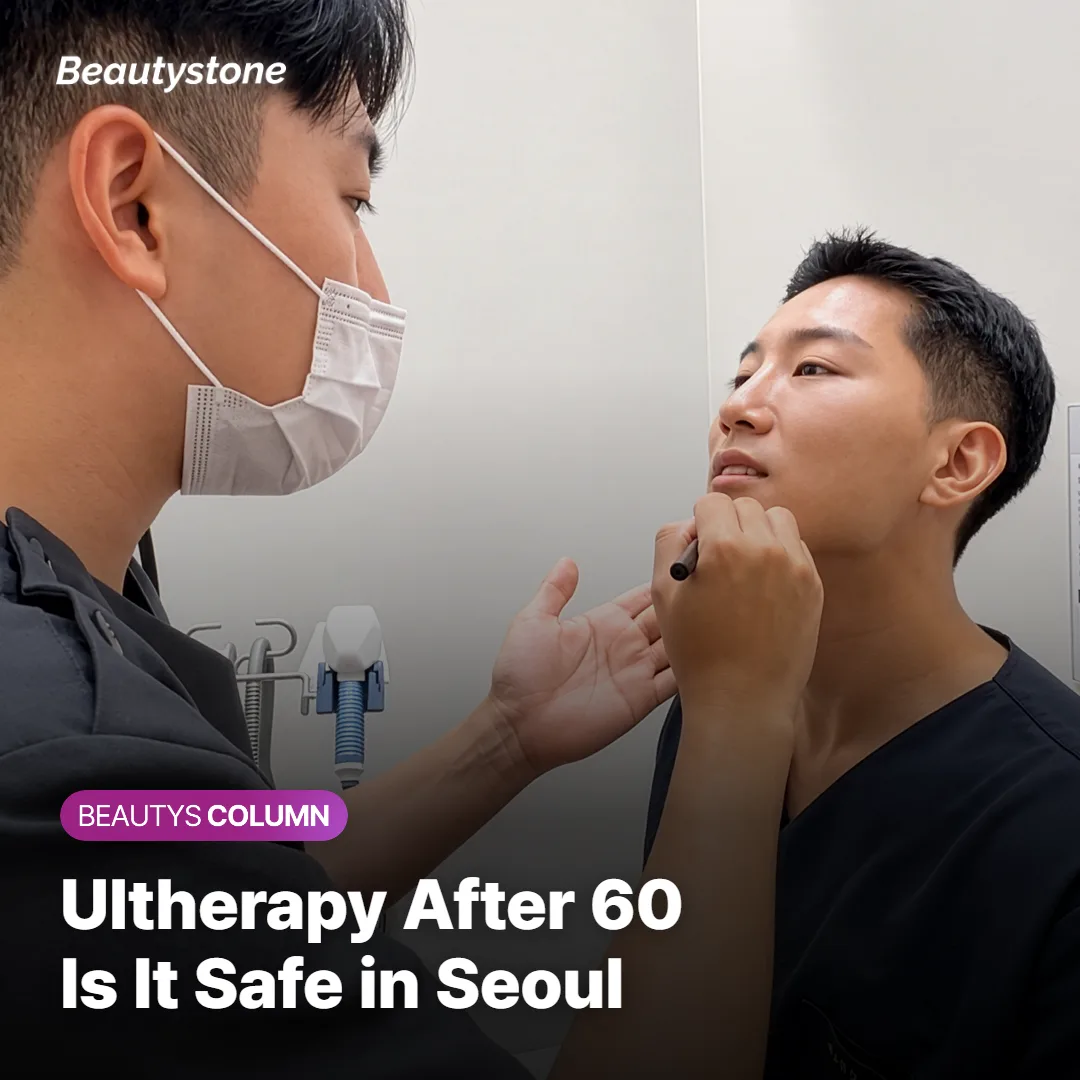
Because you're fitting this into a trip, the timeline deserves plain talk. A typical visit runs: a consultation that assesses your laxity and reviews medications, then the treatment itself, which can bring a warm or prickly sensation that varies from person to person. Right afterward, mild redness or slight swelling is a normal, short-lived reaction.
The full arc is slower than brochures imply: the collagen response builds over roughly the first three months, and in the systematic review above, gains were still measurable at one year — longer-term data aren't available. Duration is often discussed in the ~1-year range and varies, so a sensible plan is a re-assessment around that mark rather than pre-paying for repeat sessions.
Before you book, it's fair to ask:
- What am I realistically likely to see at my age, and when?
- Would you tell me if surgery were a better fit for me?
- Can my daughter — or another companion — sit in on the consultation with me?
- Here is my full medication list; does anything need reviewing before treatment?
- If the heat is hard to tolerate, what are my options for managing it?
- What are the warning signs after treatment, and who do I contact?
- How do you handle follow-up once I've flown home?
That last question is the one travelers forget. Ultherapy is low-downtime, so flying home a day or two later is usually reasonable — confirm timing with your provider before a long-haul flight. And if a delayed reaction shows up after you're back in the US, you'll need local follow-up care; the Seoul clinic can only support you from a distance, so ask how they'd handle that before you decide.
And to be clear about red flags: fever, spreading redness, or severe or worsening pain are not part of normal recovery — contact your provider right away or seek urgent care. For anything routine, book a follow-up with the clinic that treated you and check in as your skin settles.
Frequently asked questions
Q. Is Ultherapy safe for a 60-year-old?
A. Yes, age alone isn't a barrier — the more useful question is how much skin laxity you have. It's an FDA-cleared ultrasound device, and serious side effects are uncommon, with temporary redness or swelling being the usual reactions. What varies at 60 is the result, since collagen renews more slowly, so a provider should assess your skin and medications first. Individual results vary, and a careful consult is the real safety step.
Q. Will one Ultherapy session in Korea give me a facelift result?
A. No — it's a gradual, collagen-stimulating treatment, not a surgical facelift, and it isn't cleared to remove wrinkles. Most people notice change over about two to three months rather than immediately — the timeline the systematic review linked above documents for collagen remodeling — and the degree of lift differs a lot from person to person. If you have significant, hanging laxity, it's worth hearing the case for surgery too. Anyone promising a dramatic, permanent result is overselling it.
Q. How soon after Ultherapy in Seoul can I fly home to the US?
A. Because downtime is minimal, flying home a day or two later is usually reasonable, but confirm the timing with your own provider before a long-haul flight. Plan the treatment early in your trip rather than the night before departure, so any short-lived redness or swelling can settle. If a delayed reaction appears once you're back home, you'll need local follow-up care, so ask the clinic how they manage remote follow-up.
Q. What should I ask so I'm not being oversold?
A. Ask three things directly: what result is realistic for your age and skin, whether surgery would actually be a better fit for you, and how the clinic handles follow-up after you fly home. A trustworthy provider will name the limits of the treatment and tell you plainly if you're not a good candidate, rather than steering you into a package on the first visit. Precise language — "FDA-cleared," "results vary" — is a good sign; guarantees are not.