Sculptra or Juvelook: Which Fits Your Goals?
The right choice between Sculptra and Juvelook isn't about cost — it's about your facial design goals.

If you searched for a Sculptra vs. Juvelook recommendation
and landed here, your biggest question is probably: "Which one is actually right for my face?"
So many patients tell me, "I don't want to look hollow — but I definitely don't want to look overfilled either."
The short answer. Choosing between Sculptra and Juvelook comes down to your facial design intent.
The key deciding factor. You need to look at the size of the volume loss and your skin thickness first.
What we'll cover today. We'll also go over re-treatment timing and cases where neither may be the right fit.
In this post
The facial design criteria that separates Sculptra from Juvelook.
Why assessing re-treatment between weeks 8–12 is so important.
What to watch out for if you have a thin or slender face.
Sculptra vs. Juvelook — What's Actually the Difference?
When the volume goals differ, the answer changes too.
Sculptra is a collagen booster made with PLLA that stimulates collagen production to fill broader, deeper areas of volume loss.
Juvelook combines PDLLA and hyaluronic acid, targeting Skin Texture refinement and a gentle, natural-looking lift — also a collagen booster.
Unlike Sculptra, Juvelook tends to feel less intimidating for patients who worry about their face looking larger or puffier.
Sculptra, on the other hand, is more often considered when the area of volume loss is significant
and when the underlying facial structure needs to be rebuilt.
Honestly, neither one is universally better than the other.
I get this same question in consultations every day,
and my approach is always to look at "what direction your face needs to go" — not "which one costs more."
Online, you'll often see prices like 800,000 won vs. 600,000 won and naturally start comparing.
But here's the thing that actually matters:
the price difference doesn't determine the outcome.
What comes first is deciding whether your face needs firm, structural volume —
or refined Skin Texture with a soft, natural lift.
When Should You Schedule a Sculptra Re-Treatment?
In most cases, I recommend assessing the response at the 8–12 week mark.
The key takeaway from this post
If you have significant sagging and volume loss and want firm structural definition, Sculptra is the direction to consider.
If your goal is Skin Texture refinement and a natural, subtle lift, Juvelook tends to be the more comfortable choice. The decision shouldn't be driven by price (800K vs. 600K) — it should be driven by your facial design intent.
Sculptra is not a procedure where you walk out immediately noticing a transformation.
In the early days, the injectable solution may create a temporary plumped appearance — but within a few days, it can look like it's faded again.
Booking a re-treatment too soon during this phase means making a judgment call before the actual Collagen response has had a chance to develop.
PLLA particles work by stimulating fibroblasts to produce new Collagen.
That response typically becomes noticeable around the 6-week mark,
and between weeks 8–12, many patients begin to see a visible change in their facial volume lines.
That's why I prefer to time re-treatments based on how the response is progressing —
not simply because "it doesn't seem to be working yet."
I see this pattern often enough that it's worth sharing a few real examples.
Last year, a 27-year-old patient started with Juvelook.
Her concern was Skin Texture and fine surface irregularities. At week 2, she told me, "Honestly, I'm not really seeing it yet."
But when she came back at week 9, she mentioned that the faint shadows along the front of her cheeks had softened,
and her makeup wasn't creasing as much throughout the day.
On the other hand, a 45-year-old patient I followed up with last week was a clear Sculptra case.
She had both sagging and volume loss together, and at day 10 she was close to dissatisfied.
By week 11, the hollowing along her Nasolabial Folds and the shadow on her anterior cheek had visibly reduced — and her satisfaction level went up significantly.
"Good things take time" isn't just something we say casually in this context.

The reason re-treatment timing matters so much with Sculptra is the risk of overcorrection.
If the early response seems mild and you accumulate too quickly,
your face may feel unexpectedly firm and full two to three months later.
This is especially true in areas where light shifts with expression — like the anterior cheek and the sides of the Nasolabial Folds.
Juvelook, by contrast, tends to attract patients with mixed expectations around Skin Texture and Fine Lines.
So if you have deep hollowing with visible shadowing, Juvelook alone may leave you wanting more —
and if volume feels like too much, Sculptra may feel excessive.
Dr. Wi Young-jin's Key Summary
If you have significant sagging and volume loss and want firm structural definition, I lean toward Sculptra.
If your goal is Skin Texture refinement and a natural, subtle lift, Juvelook tends to be the more comfortable fit.
Before looking at the price tag, the more important question is: what direction do you want to take your face?
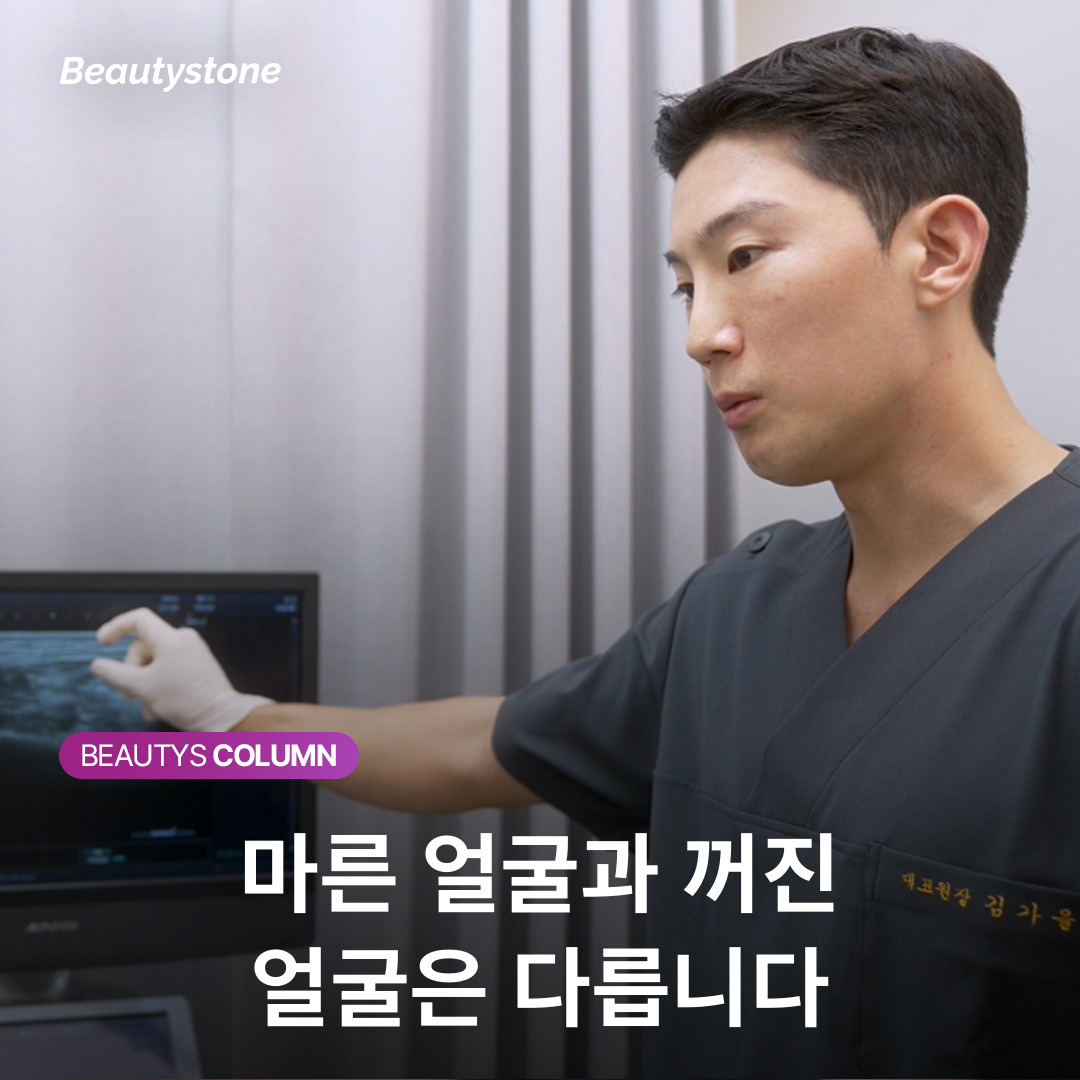
Why Is Sculptra or Juvelook Not Always Recommended for Slender Faces?
Thin skin needs to avoid excessive stimulation.
That said, this isn't a blanket rule.
Sculptra has real advantages when it comes to filling larger areas of volume loss —
but on slender faces or faces with thin skin, the edges can appear more defined and visible than intended.
Just because the area below the cheekbones looks hollow
doesn't mean adding significant volume is always the right answer — it can sometimes make the face look longer and more fatigued.
The criteria I use when making this call generally fall into five areas:
Whether the volume loss is broad and diffuse, or localized and superficial.
Whether the skin is thin enough that surface changes will be visibly apparent.
Whether sagging is also present, making the lower face look heavier.
Whether the desired result is firm structural volume or natural Skin Texture refinement.
Whether the patient's schedule allows for an 8–12 week wait.
There's one thing I really want to emphasize:
for slender patients, "more Sculptra because there's less volume" is not always the right answer.
When subcutaneous fat is minimal and the Dermis is thin, even the same amount of product can show more visibly at the surface.
That said, for patients with broader volume loss and adequate skin thickness, it remains an excellent option.
So how do you figure out which category you fall into?
For first-time patients, I first check for the risk of the face appearing larger than desired.
For those considering a re-treatment, I assess whether the response from the previous procedure is still developing.
When both factors are in play, the right call can shift — even with the same product.
3 Real Questions Before Choosing Sculptra or Juvelook
Q1. Which lasts longer — Sculptra or Juvelook?
A. This is worth addressing directly, because overlooking it can lead to regret.
In general terms, Sculptra is often described as having a longer duration.
But in my practice, two or three patients a week remind me that "lasting longer" matters far less than "not being too much for my face."
Choosing based on longevity alone doesn't guarantee satisfaction.
And after hearing that, there's usually one more question that comes up naturally.
Q2. Is it okay to choose based on price?
A. This one takes a bit more to unpack.
When you see numbers like 800,000 vs. 600,000 won, the higher price can feel like the stronger, more effective choice.
But in actual consultations, roughly four out of ten patients end up going in a different direction based on skin thickness — not price.
If the volume loss is broad, Sculptra may be the right fit. If Skin Texture refinement is the goal, Juvelook may be the more comfortable choice.
It's less about spending less money, and more about investing in a different kind of result.
One more thing I want to address before we wrap up.
Q3. Why should slender faces be more cautious with Sculptra?
A. Simply put — on thin skin, visible edges are more likely to appear.
Slender faces have less subcutaneous fat cushioning, so even standard amounts of product can show at the surface.
Clinically, this doesn't happen frequently — but for the patients it does affect, it's a genuinely significant concern.
That's why for slender patients, I focus on placement depth over volume, and facial design intent over product selection.
If there's one thing to take away from today — look at the direction you want your face to go before you look at the price.
In my next post, I'll break down whether to assess Sculptra re-treatment at week 8 or week 12.
We'll go through how to distinguish cases where waiting leads to improvement versus cases that need earlier correction. This is Dr. Wi Young-jin signing off.