

Sculptra Timeline: When Do Results Show Up?
Sculptra doesn't add volume the moment it's injected — it triggers your own collagen production over weeks. Here's what to expect and how long results actually last.

If you're staring in the mirror three days after your Sculptra appointment wondering why nothing looks different, you're not alone. It's one of the most common messages patients send their injector in the first week — and it usually comes from comparing Sculptra to a dermal filler, which plumps skin the moment it's injected.
Sculptra doesn't work that way. It's a poly-L-lactic acid (PLLA) biostimulator, which means it nudges your own skin into producing new collagen rather than adding volume directly. That difference changes everything about the timeline — when you'll actually see results, how long they'll stick around, and what's normal to notice (or not notice) along the way. In this article, we'll cover why the effect builds slowly, what to expect week by week, how long results typically last, and what to watch for as your skin adjusts.
Why Sculptra Results Don't Show Up Right Away
Most injectables fall into one of two categories: fillers that add volume on contact, and biostimulators that trigger your body to build its own structure. Sculptra is firmly in the second camp. Each vial contains microscopic PLLA particles suspended in a solution; once injected, that solution gets absorbed within a day or two, leaving the PLLA particles behind in the deeper layers of your skin.
Those particles don't do anything dramatic on their own. Instead, they act as a mild irritant that signals your body to send in fibroblasts — the cells responsible for producing collagen. A review of poly-L-lactic acid's mechanism found that this collagen-building process unfolds gradually as the particles are absorbed, which is exactly why the visible effect takes weeks rather than minutes to show up.
It's worth knowing this going in, because the first few days after treatment can be a little confusing. Mild swelling from the injection itself can temporarily make the area look fuller, and once that settles, it's common to feel like you're back to square one. You're not — your skin is just getting started.
How Sculptra Works Under Your Skin
To understand the timeline, it helps to picture what's actually happening layer by layer. Sculptra is injected into the deep dermis or the subcutaneous plane, well below the surface, where there's more room for new collagen to form without looking lumpy or uneven.
Once there, the PLLA particles gradually break down over several months. As they do, fibroblasts lay down type I collagen around and between them, thickening the dermis from the inside out. This is a slower, more structural kind of change than what you'd get from hyaluronic acid filler, which is why providers typically space Sculptra sessions weeks apart — it gives your skin time to respond to each round before adding more.
This is also why Sculptra tends to look natural rather than "done." Because the volume comes from your own collagen rather than an injected gel, the change tends to follow the contours of your face rather than sitting on top of them.
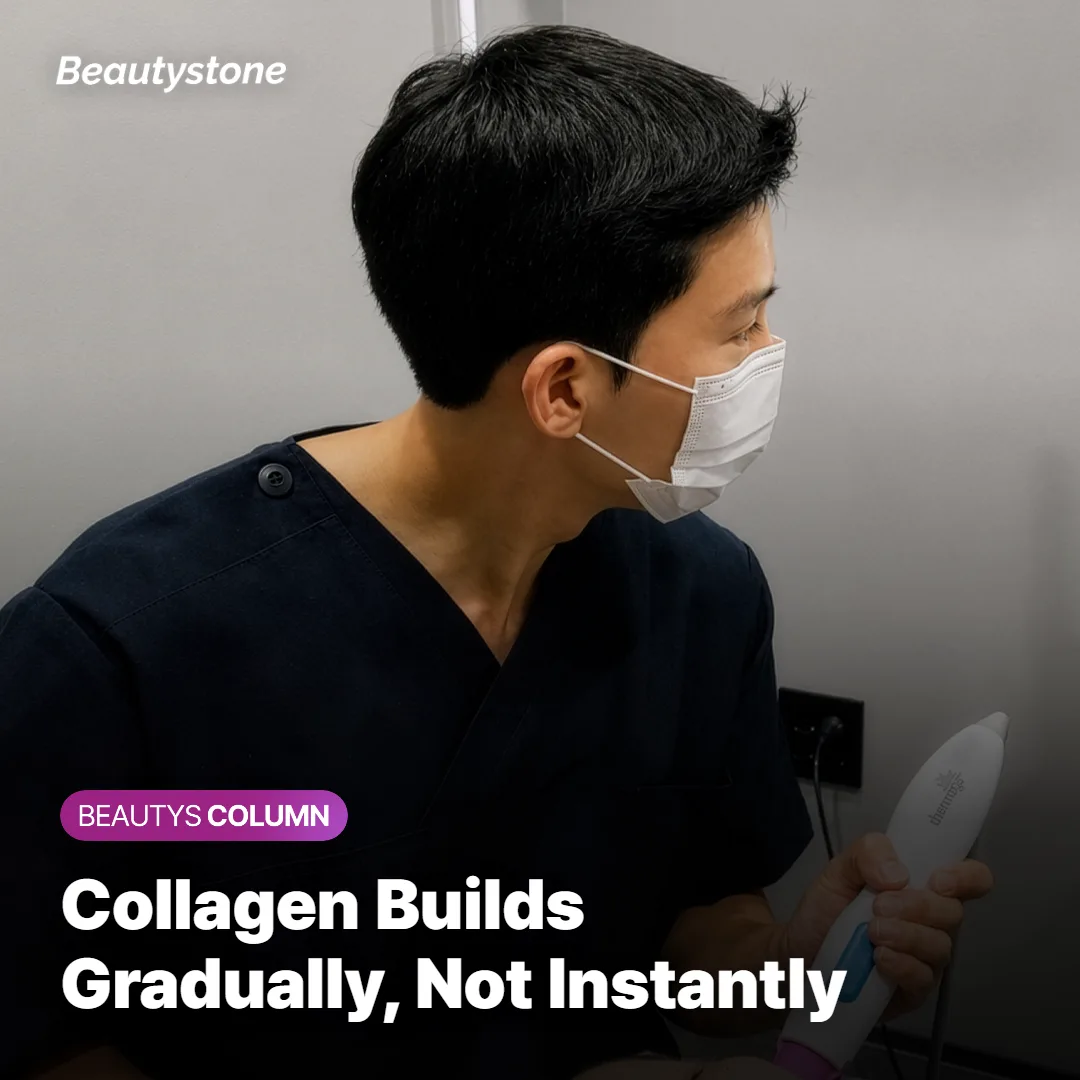
Your Sculptra Timeline: Week by Week
Every face responds a little differently, but most patients follow a broadly similar arc. Here's a rough guide to what tends to happen and when:
| Timeframe | What You'll Likely Notice | What's Happening |
|---|---|---|
| Day 1–3 | Mild swelling, some tenderness at injection sites | Fluid is being absorbed; no real collagen yet |
| Week 1–2 | Swelling resolves; skin often looks about the same as before | Fibroblasts are just beginning to activate |
| Week 3–4 | Subtle firmness or texture change | Early collagen fibers start forming |
| Week 6–8 | Volume and lift become noticeable | Collagen buildup accelerates |
| 3 months+ | Results reach their fuller expression | Collagen matrix matures and stabilizes |
Because the change is gradual, most providers recommend judging your results at the two-to-three-month mark rather than the two-week mark. If you're getting a series of sessions — which is common with Sculptra — your provider will typically want to see how you've responded to one round before scheduling the next.

How Long Do Sculptra Results Actually Last?
This is where Sculptra's slow start pays off. Because the results come from collagen your body actually built, rather than a gel that will eventually be metabolized, the effect tends to last longer than traditional hyaluronic acid filler — commonly cited in the two-year range for many patients, though individual results vary quite a bit based on age, skin quality, treatment area, and how many sessions you had initially.
A few things tend to help results last as long as possible: giving your skin the full window to build collagen before judging it (or adding more product), staying consistent with sunscreen, and keeping up with the recommended session schedule rather than trying to stretch treatments further apart than your provider suggests.
When results do start to fade, it's usually a gradual softening rather than a sudden drop-off, which gives you time to plan a touch-up session before you feel like you're starting from zero again.

Side Effects & Risks: What's Normal Early On
Swelling, mild redness, bruising, and tenderness at the injection sites are common in the first few days and usually settle on their own within a week. Small bumps under the skin right after injection are also typical and tend to resolve as the fluid is absorbed.
Less commonly, some patients develop small nodules weeks or months after treatment. These are usually manageable with massage or, if needed, a follow-up visit with your provider — but they're a good reason to follow post-treatment instructions closely, especially the massage protocol many clinics recommend in the days after injection. If you notice swelling that worsens instead of improving, spreading redness, or fever, contact your provider right away rather than waiting it out.
Sculptra isn't the right fit for everyone. People with active skin infections in the treatment area, certain autoimmune conditions, or a history of keloid scarring should talk through the risks with their provider before moving forward.
How Much Does Sculptra Cost in Seoul?
Sculptra pricing varies by clinic, by how many vials your treatment plan calls for, and by how many sessions you and your provider decide on together, so it's hard to quote a single number that applies across the board. What tends to move the price most is vial count, since most treatment plans use more than one vial per session and often involve two to three sessions spaced weeks apart.
Rather than guessing at a figure that may not reflect current rates, the most reliable way to get an accurate estimate is a consultation, where a provider can look at your skin and map out a plan. Beautystone, a clinic in Seoul's Hapjeong neighborhood, lists current pricing and any active offers at /en/promotion and /en/price.
Is Sculptra Right for You?
Sculptra tends to suit people who are noticing gradual volume loss — thinning cheeks, hollowing temples, a softer jawline — rather than looking to fix a single deep line or add dramatic volume overnight. Because it works with your own collagen, it's often a good fit for people who want a natural-looking change that builds over time rather than an immediate, dramatic shift.
It also asks something of you as a patient: patience through the first couple of months, and a willingness to commit to more than one session if your provider recommends it. If you're hoping for same-day results, a hyaluronic acid filler will likely serve you better in the short term, even if it doesn't last as long.
A consultation is really the best way to figure out whether Sculptra fits your goals, your face, and your timeline — someone with the right training can look at where you're losing volume and tell you honestly whether a biostimulator or a filler makes more sense for you.
The Bottom Line
Sculptra takes the scenic route to results, but for a lot of patients, it's worth the wait. Here's the short version.
- Don't judge results early: the real change shows up around six to eight weeks in, with fuller results by three months.
- Some swelling right after injection is normal and isn't a preview of your final results.
- Results tend to last longer than traditional filler because they're built from your own collagen.
- Most treatment plans involve more than one session, spaced weeks apart.
Like any procedure, it comes with trade-offs — namely, patience and a longer runway before you see the payoff. Ultimately, the choice depends on your skin, your goals, and how long you're willing to wait to see the change.
If you're considering Sculptra, a consultation is the best way to find out what fits you. Beautystone is a dermatology clinic in Seoul's Hapjeong area — see current offers at /en/promotion.
Frequently Asked Questions
Q1. How soon will I see results after Sculptra?
Most patients start noticing subtle changes around three to four weeks after treatment, with fuller results showing up by six to eight weeks. Full results typically take about three months to develop completely, since Sculptra works by gradually stimulating your own collagen rather than adding volume instantly.
Q2. Does Sculptra hurt?
Most patients describe Sculptra injections as more of a pressure or pinching sensation than sharp pain, especially since providers typically mix the solution with a local anesthetic or apply topical numbing beforehand. Some tenderness and mild bruising at the injection sites for a few days afterward is common.
Q3. How long do Sculptra results last?
Results commonly last around two years for many patients, though this varies based on your skin, how many sessions you had, and lifestyle factors like sun exposure. Because the volume comes from your own collagen, the fade tends to be gradual rather than sudden.
Q4. When can I wear makeup after Sculptra?
Most providers say it's fine to apply makeup the day after your appointment, as long as the injection sites aren't visibly irritated and you apply it gently. If you notice swelling or bruising, waiting a day or two longer and using a light touch can help avoid extra irritation.