

Rejuran Eye vs. Regular: 3 Differences That Change Your Session Plan
Concentration, texture, and injection depth are all dialed back for the eye area - and each one changes how deep the needle goes and what your course looks like.


Planning a trip to Seoul?

Here is the short answer first: they are different products, and the difference is not branding. Rejuran Eye is a separate formulation of the same PN technology, with a lower concentration, a thinner texture, and a shallower injection depth - because the skin under your eye is only about 0.5mm thick.
Most comparisons stop at that list. What you need is what those differences do to your booking, so each is paired below with the decision it drives. Background first: Rejuran is not FDA-approved in the United States and is used under MFDS authorization where we practice - context, not a selling point. Individual results vary.
Difference 1: Injection Depth Sets the Ceiling for Everything Else
Start with the number that drives the rest. Under-eye skin is roughly 0.5mm thick. Regular Rejuran is typically placed at about 1 to 2mm; Rejuran Eye at roughly 0.3 to 0.5mm, in the upper dermis. That gap is the whole reason a second formula exists.
Depth is also a safety boundary. Going 1 to 2mm deep under the eye starts to approach the orbital septum, the membrane that helps hold fat in place around the eye socket. Rejuran Eye stays shallow on purpose, and that only works because the formula was changed to behave at that level. So the decisions run backwards:
- The zone fixes the depth band first. For under-eye skin the working range is roughly 0.3 to 0.5mm.
- The depth band rules out formulas not built for it. A product meant for 1 to 2mm is not just used more carefully at half a millimetre.
- What is left is the product on your chart. By the time a formula is named, the depth call is already made.
Difference 2: Concentration and Texture Decide Whether It Spreads
Rejuran is built around PN - polynucleotides derived from salmon DNA, injected to encourage the dermis to regenerate and produce its own collagen. In the regular formula that PN sits at around 2%, in a thicker texture suited to thicker skin. The eye version lowers the concentration and thins the viscosity so it spreads evenly higher up.
| Comparing | Regular Rejuran | Rejuran Eye |
|---|---|---|
| PN concentration | Around 2% | Lower, for thin skin |
| Viscosity | Thicker | Thinner, spreads evenly |
| Typical depth | About 1 to 2mm | About 0.3 to 0.5mm |
| Built for | Cheeks, forehead, general facial skin | The under-eye area |
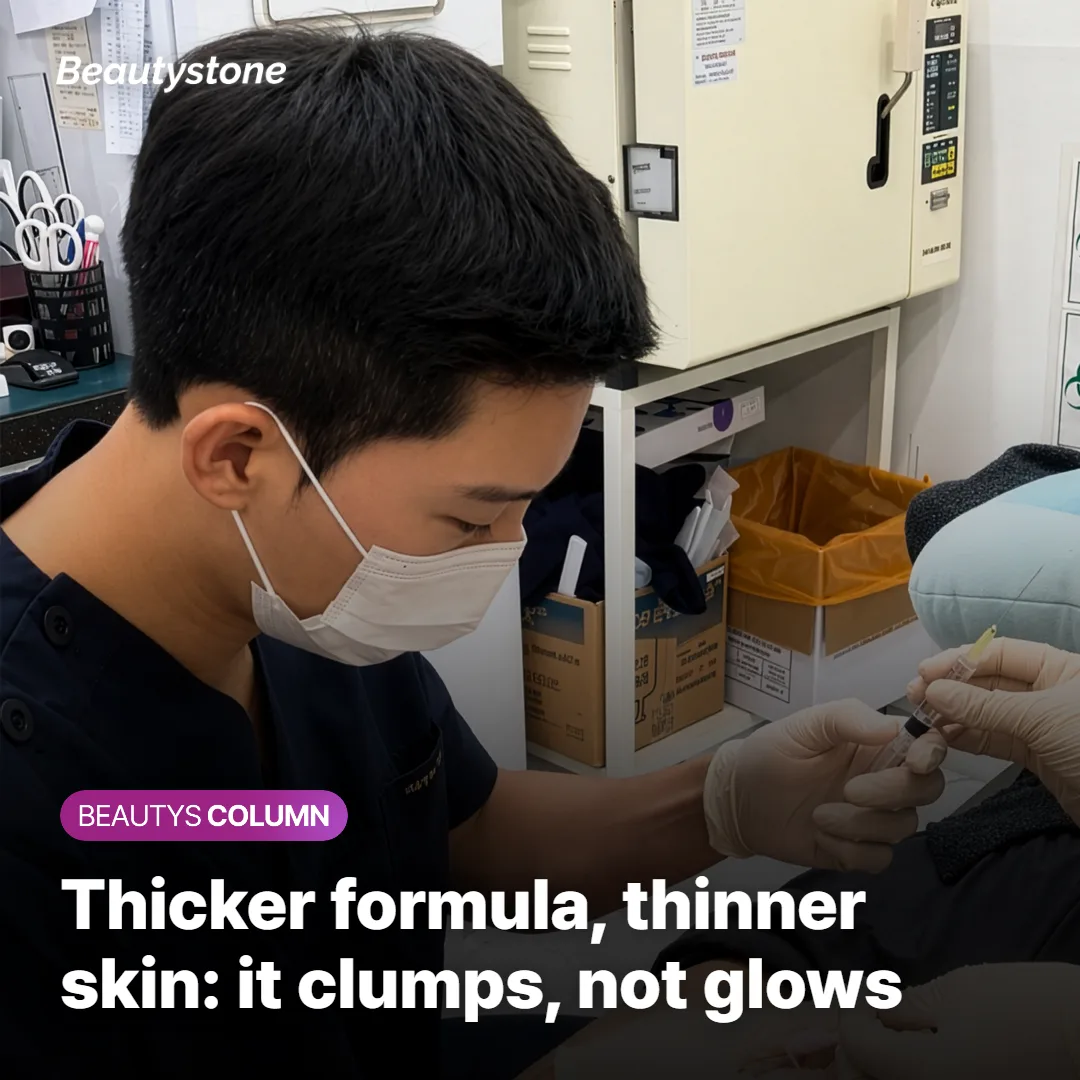
What happens when the thicker formula goes into thin skin is predictable. A patient in her early 40s came to us after having regular Rejuran placed under her eyes at another clinic. Two weeks later the bumps at each injection point still had not gone down: the PN had not dispersed, it had clumped. That also explains a complaint you may have read online - when someone says Rejuran "did not do much" under their eyes, there is a good chance they got the regular formula.
Difference 3: Each Formula Is Built for a Different Complaint
The third difference sounds like price-list copy but decides whether you are a candidate at all. Regular Rejuran is used across the cheeks, forehead, and general facial skin. Rejuran Eye is for the under-eye area, and it makes the most sense in the early stages of under-eye aging:
- Fine lines that show up when you smile, rather than lines sitting there at rest.
- Crepey or dry-looking skin that stays that way however much eye cream you layer on.
- A general loss of bounce - a texture-and-elasticity complaint, not a volume one.
Who should skip it: if your concern is deep, static folds visible even at rest, Rejuran Eye alone is unlikely to flatten them. It is a texture-and-elasticity treatment, not a wrinkle eraser. That work usually belongs to Botox or filler, sometimes layered alongside Rejuran Eye rather than instead of it. Book it expecting a fold to disappear and you will call it a failure where it was never the right tool.
How the 3 Differences Add Up to Your Session Plan
Put the three together and the course almost writes itself: a thinner, lower-concentration product placed shallow in one small zone means repetition and short recovery windows, not one dramatic appointment. Most courses run three sessions, three to four weeks apart.
- The first few hours. Small raised bumps and mild puffiness at the injection points, usually settling within two to four hours - closer to a day if your skin runs sensitive.
- The next day. Skin looks normal again, and it is fine to wear makeup as usual.
- Across the three sessions. Texture and tone improve gradually rather than all at once, which is why it is spaced this way.
- Longer term. Many people notice their dark circle tone looks a little better alongside smoother texture, and results tend to hold for roughly six months.
The one thing to schedule around is bruising. The under-eye area is full of small blood vessels, so roughly 20% to 30% of patients develop a small bruise that can last about a week. With an event coming, book at least two weeks ahead of it.
Where expected becomes urgent: spreading redness, pain getting worse instead of better, or swelling not improving after a few days. Contact your provider right away or seek urgent care. Treated away from home, plan that follow-up before you book.

5 Questions That Pin Down Which Formula You Are Booking
You should not have to decide this from a screen. Bring these five and you leave with a plan rather than a product name.
- What depth are you treating my under-eye area at? The answer should be specific, and in the shallow band.
- Which formula is that depth intended for? This catches a mismatch before it becomes two weeks of bumps.
- Is my main issue fine lines and texture, or a static fold? That decides whether this fits at all.
- How will we judge progress, and at which session? Agreeing in advance stops you quitting after one.
- If I bruise, how long should it last and when do I come back? You want that threshold before you need it.
On cost: at our clinic, Rejuran Eye typically runs around 200,000 to 250,000 KRW per session, and most patients book the full three-session package. Pricing is subject to change and varies by clinic; see /en/promotion and /en/price.
For context on who is answering: Beautystone is a dermatology clinic in the Hapjeong area of Seoul, a small practice rather than a high-volume one. That matters for one reason here - depth and formula choice under the eye go better when the same person remembers what was used last time.
Frequently Asked Questions
What injection depth is used for Rejuran Eye, and why does it stop there?
Roughly 0.3 to 0.5mm, in the upper dermis. It stops there because of anatomy: under-eye skin is only about 0.5mm thick, and the 1 to 2mm depth used for regular Rejuran starts to approach the orbital septum, the membrane holding fat in place around the eye socket. Staying shallow is also why the thinner formula is needed.
I had regular Rejuran under my eyes and saw little change. Was that the wrong formula?
It is a common explanation. The regular formula is thicker and more concentrated, and it is typically injected deeper than under-eye skin allows, so it can clump rather than spread and leave bumps that take weeks to settle. That is less the treatment failing than a version built for thicker skin being used where it does not belong.
The price list only shows a shortened Rejuran name. How do I know which one it is?
Ask rather than assume, because shorthand on a menu does not tell you what is in the syringe. Two questions settle it: which formula is this line item, and what depth is it injected at in my case? A shallow under-eye band points to the eye version; the deeper range used for cheeks and forehead points to the regular one.
How long do results last, and when would a second course start?
Results tend to hold for roughly six months after a completed course, though that varies from person to person. Because improvement builds gradually across the three sessions rather than arriving at once, the moment to raise a repeat is when texture starts drifting back, not a calendar date.