

532nm vs. 1064nm: Which Fits Your Spots?
A 532nm laser's shallow reach isn't a weakness — it's exactly why it's the sharper tool for freckles, sunspots, and red ink sitting near the surface, while 1064nm takes over once pigment sits deeper.

If your provider mentioned a 532nm laser for your freckles when you expected the usual toning laser, you're not the first patient to raise an eyebrow. It sounds backward: 532nm barely reaches past the surface of your skin, while 1064nm travels much deeper. So why would the laser with less reach be the first choice for anything?
The answer comes down to where your pigment actually sits, not which laser goes in deeper. A freckle or sunspot lives right at the surface, and a laser built to stop there, rather than travel past it, ends up being the more precise tool for the job. In this article, we'll cover what a 532nm laser is actually built to do, why its shallow reach works in its favor for surface pigment, when your provider will switch you to 1064nm instead, and why that same 532nm wavelength is also the better pick for red tattoo ink and visible blood vessels.
What Is a 532nm Laser, and How Does It Work?
A 532nm laser is created by passing the beam from a 1064nm Nd:YAG laser through a KTP crystal (potassium titanyl phosphate), which splits the wavelength in half. What comes out the other side is visible green light instead of invisible infrared, and that shift changes everything about what the laser can do.
Color and light absorption work opposite each other on the color wheel. Green light is absorbed strongly by the colors that sit across from it: red and brown or black. That's why a 532nm laser has two natural targets: melanin (the pigment behind freckles, sunspots, and dark tattoo ink) and hemoglobin or red ink (visible blood vessels and red tattoo pigment). A 1064nm laser, by contrast, is infrared, absorbs far less into melanin, and travels deeper into skin before it gives up its energy.
Why Shallow Penetration Makes 532nm the Right Call for Freckles and Sunspots
532nm light only travels about 0.1 to 0.5mm into skin before it's absorbed. On paper, that sounds like a limitation. In practice, it lines up almost exactly with where freckles and solar lentigines (sunspots caused by sun exposure) actually sit: the basal layer, the deepest part of the epidermis, just above the dermis.
Because the laser's energy gets absorbed right where the pigment is instead of scattering past it, treatment ends up more targeted, with less energy wasted heating skin the pigment isn't even in. That precision is the whole advantage. It's not that 532nm is a weaker laser; it's that its limited depth happens to match the depth of the problem it's usually treating.
Where 532nm spot treatment is typically aimed:
- Freckles: small, well-defined brown spots concentrated at the epidermis's basal layer.
- Solar lentigines (sunspots): flat, sun-related pigmented patches sitting at roughly the same depth.
- Isolated dark spots: individual lesions your provider treats one at a time, rather than the whole area at once.
A common scenario: someone comes in after several rounds of 1064nm toning with little visible change in a handful of stubborn spots. Once you look closely, those spots often turn out to be small, well-defined epidermal lesions, not the more diffuse pigment 1064nm toning is designed to fade. Switching to 532nm spot treatment, targeting each lesion individually, is usually what actually moves the needle.
When 1064nm Takes Over Instead
532nm isn't the answer for every kind of pigment, and that's by design. Once color sits deeper than the basal layer, the laser's short reach becomes a real limitation instead of an advantage.
- Melasma or deeper dermal pigment: often sits at or below the epidermal-dermal junction, out of 532nm's reach, and is addressed with 1064nm toning, frequently alongside other treatments.
- Darker skin tones: 1064nm's weaker melanin absorption lowers the risk of affecting the pigment in surrounding skin, which is part of why it's the more common toning wavelength overall.
- Larger or deeply set tattoo ink: most non-red inks sit deeper in the dermis, where 1064nm (or a longer wavelength, like 755nm) reaches more effectively.
This is also why 1064nm toning tends to be the broader, area-wide treatment while 532nm is usually reserved for spot treatment. They're not competing options; they're built for different depths.
It's Not Just Brown Spots: Red Ink and Visible Blood Vessels
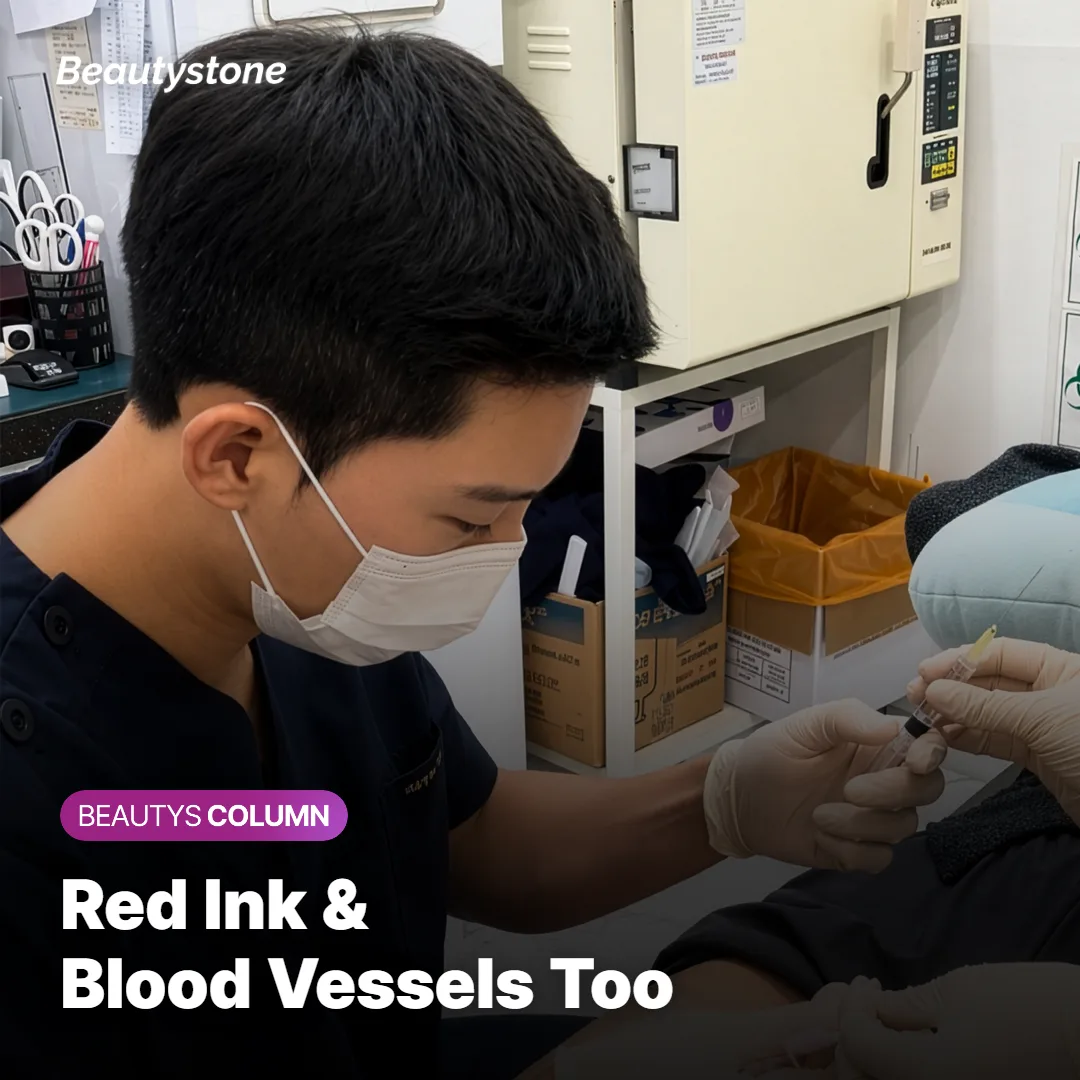
532nm's strong absorption isn't limited to brown or black. Hemoglobin, the protein that carries oxygen in blood, and red tattoo ink both sit close enough to red on the color wheel that they absorb green light just as readily as melanin does.
That makes 532nm, not 1064nm, the go-to for visible blood vessels near the skin's surface and for red-ink tattoos specifically. Infrared light at 1064nm largely passes through red ink without breaking it down, no matter how far up the setting is pushed. If a red tattoo needs treatment, 532nm is typically the only wavelength that will actually do the job.
532nm vs. 1064nm at a Glance
| Target | Typical Depth | Recommended Wavelength |
|---|---|---|
| Freckles & sunspots | Epidermal basal layer | 532nm spot treatment |
| Visible blood vessels | Superficial dermis | 532nm |
| Red tattoo ink | Dermis | 532nm (preferred over 1064nm) |
| Melasma / deeper dermal pigment | Epidermal-dermal junction and below | 1064nm toning, often combined |
| Dark or deeply set tattoo ink | Deeper dermis | 1064nm or a longer wavelength (e.g., 755nm) |
If you've been told your spots weren't responding to toning, this is usually why. The two wavelengths aren't a stronger option and a weaker one; they're built for different depths and different targets.
What to Expect: Sessions, Downtime & Side Effects
532nm spot treatment is generally quick, but it's rarely a single visit. Most people need two or more sessions spaced a few weeks apart before their spots are fully cleared, since pigment depth and density vary from person to person.
- Days 1-7: small scabs or crusts form over each treated spot; avoid picking at them so they can heal on their own.
- Weeks 2-8: temporary post-inflammatory pigment (PIH) can appear at treated spots and usually fades on its own with consistent sunscreen use.
- Sun protection: non-negotiable during healing, since UV exposure on a healing spot can prolong or worsen PIH.
If a treated spot develops spreading redness, swelling that gets worse instead of better, or you run a fever, contact your provider or seek medical care right away rather than waiting to see if it settles.
How Much Does It Cost?
Pricing for 532nm spot treatment usually depends on how many individual lesions are treated and how many sessions your provider recommends, so it varies from person to person rather than following a flat rate.
A consultation is the most reliable way to get an actual number, since a provider needs to look at your spots directly to estimate session count. If you want a sense of current offers, they're listed at /en/promotion.
The Bottom Line
532nm and 1064nm aren't a stronger option and a weaker one; they're matched to different depths. 532nm's shallow reach is exactly what makes it precise for freckles, sunspots, red ink, and visible blood vessels sitting near the surface. 1064nm's deeper reach takes over once pigment sits further down, or when treating darker skin tones more broadly.
Like most laser treatments, individual results vary, and how many sessions you'll need depends on your specific pigment, not a general timeline. Ultimately, the right wavelength for your spots depends on where that pigment actually sits, and that's something a provider can only really assess in person.
If you're not sure which category your spots fall into, a consultation is the best way to find out. Beautystone is a clinic in Seoul's Hapjeong area, and current offers are listed at /en/promotion.
Frequently Asked Questions
Q1. Will one 532nm session clear my freckles completely?
Usually not in a single visit. Most people need two or more spot-treatment sessions spaced a few weeks apart before their freckles or sunspots are fully cleared, since pigment depth and density vary from person to person. Individual results vary, and your provider can give you a closer estimate after seeing your spots directly.
Q2. Isn't 1064nm always the stronger or safer choice since it goes deeper?
Not necessarily. "Deeper" isn't the same as "stronger" — it just means the laser is built for a different depth. Freckles and sunspots sit right at the surface, so a shorter-reaching wavelength like 532nm is often the more precise option there. 1064nm becomes the better call once pigment sits deeper, such as with melasma, or when treating darker skin tones more broadly.
Q3. Can 532nm treat a red tattoo, or do I need 1064nm for that?
532nm is typically the right wavelength for red ink, not 1064nm. Infrared light at 1064nm largely passes through red pigment without breaking it down, no matter how high the setting is pushed, while 532nm's green light is absorbed strongly by red tones.
Q4. How long is downtime after 532nm spot treatment?
Small scabs or crusts typically form over each treated spot and clear up within about 5 to 7 days. Some temporary post-inflammatory pigment can follow and take one to two months to fade fully, so it's worth leaving at least a couple of weeks before any event where you want your skin looking its best.