GentleMax Pro: 755 or 1064 nm, and What Sets Your Power
Three dials get chosen before the first pulse, and your skin tone only decides the first one

Wi Young-jin
Chief Director & CEO, Myeongdong
What you'll learn

  · 755 nm alexandrite reacts strongly with melanin; 1064 nm Nd:YAG goes deeper and picks up less surface pigment
  · Wavelength follows skin tone and hair color, while power and cooling follow how your skin responded last time
  · Every area gets its own settings, because skin thickness and hair density differ across the body
  · Recent tanning, waxing or plucking changes what can safely be done, so say so before the appointment
GentleMax Pro is a dual-wavelength platform, which means the interesting question isn't whether the device is good. It's which of its two lasers your provider reaches for, and at what power.
Both wavelengths work on the same principle: light is absorbed by melanin, the pigment in hair and skin, and that energy becomes heat that damages the follicle. Because melanin also sits in your skin, the contrast between your skin tone and hair color changes how the laser behaves. We'll cover how the wavelength is chosen, what actually sets the power, why each area is dialed separately, and what to do in the weeks either side of a session. Beautystone is a dermatology clinic in Seoul's Hapjeong area, and this is general information rather than advice for your skin.
755 or 1064 nm: Which One Your Skin Tone Points To
Dr. Kim Kaeul (Medical Director) sorts this before anything else, because the wavelength decision comes from who you are rather than from what you want. The two lasers behave differently on purpose.
- 755 nm alexandrite: reacts strongly with melanin, which makes it efficient on darker, coarser hair. That same sensitivity means it picks up more of the surrounding skin pigment.
- 1064 nm Nd:YAG: penetrates deeper and interacts less with surface pigment, which is why it's generally considered the safer option on deeper skin tones.
| Skin tone (Fitzpatrick) | Wavelength typically used | What is going on | What to watch for |
|---|---|---|---|
| Type I to II | 755 nm alexandrite, usually preferred | High contrast keeps energy focused on the follicle | Relatively straightforward for most people |
| Type III to IV | Either wavelength, adjusted case by case | Moderate contrast between skin and hair pigment | Power and cooling choices matter more here |
| Type V to VI | 1064 nm Nd:YAG, usually preferred | More melanin in the skin competing for energy | Burns or pigment change if settings are not matched |
| Light hair, any tone | Varies by case | Less melanin in the hair to absorb energy | Weaker response, often more sessions |
Skin tone is classified on the Fitzpatrick scale, from Type I, which always burns, to Type VI, which never does. Dermatology guidance notes that laser hair removal works best on lighter skin with darker hair, since that pairing gives the clearest target. Deeper tones aren't excluded; they're treated more cautiously, because there's more pigment in the skin itself competing for the same energy.
Power Isn't a Number You Ask For: Here's What Sets It
Once the wavelength is chosen, power is the dial that decides whether the session does anything, and it's set against your skin rather than against your schedule. Too little and the heat never reaches the follicle properly. Too much and burns or pigment changes become the likelier outcome.
Three things push that number around. How much melanin sits in your skin relative to your hair, how recently you've been in the sun, and how your skin actually responded to the previous session. The third one is why a provider who kept notes can move faster than one starting fresh each visit.
| Dial | What it governs | What moves it |
|---|---|---|
| Wavelength | Whether the energy reaches hair rather than skin | Skin tone and hair color |
| Power | Whether the follicle receives enough heat | Contrast, recent sun exposure, last session's response |
| Cooling | How much the skin tolerates in the process | Area sensitivity and the power being used |
Asking for maximum power is the request that sounds efficient and isn't. Pushing beyond what your skin and hair call for raises the risk of burns and pigment change without reliably shortening the course, and on deeper skin tones the sensible plan is deliberately more conservative, which means results build gradually rather than dramatically.
Light or fine hair sits at the other end of the same problem. Blonde, gray or faint vellus hair simply has less melanin to absorb the energy, so the response tends to be weaker and slower regardless of skin tone. It can still be treated; the honest version is a longer timeline and more modest results than coarse dark hair would give.
Why Every Area Gets Its Own Settings
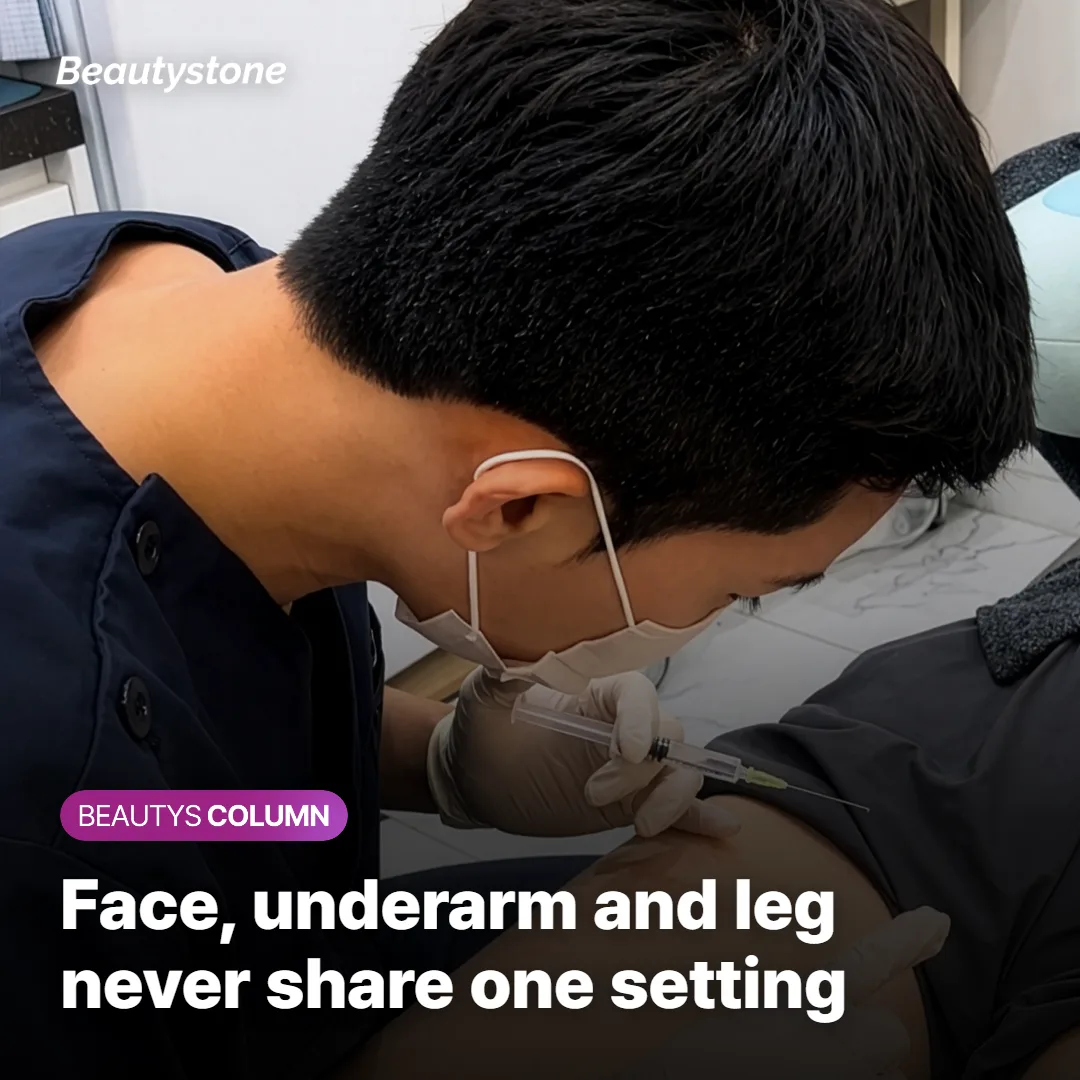
One body doesn't get one setting. Skin thickness and hair density differ from the face to the underarm to the leg, so each area is dialed separately even within a single appointment, which is also why treating several areas in one visit lengthens the session.
Areas where the skin is thinner or naturally more pigmented, such as the bikini line and intimate areas, are judged on their own terms rather than borrowed from a leg protocol. The same logic that sends deeper skin tones toward the 1064 nm wavelength applies locally: more pigment in the skin means tighter control over the energy.
Hair cycle length varies by area too. Smaller areas such as the face and underarms tend to respond on a shorter interval, while larger areas like the legs or back usually call for more sessions overall. Planning both together, rather than area by area as you think of them, gives a schedule that actually holds.
So tell the clinic upfront which areas you're considering, even the ones you're undecided about. It changes appointment length, the order in which areas are treated, and sometimes which wavelength is loaded first.
The 2-Week and 4-Week Rules Either Side of a Session
Most of what goes wrong is decided before you arrive. The margin for error narrows the further your skin sits from the light-skin, dark-hair ideal, and dermatology guidance is blunt that inexperienced treatment can lead to burns, pigment change or scarring.
| When | What to do | Why |
|---|---|---|
| Two weeks before | Be strict with sunscreen | Tanned skin has more melanin competing with your hair for the energy |
| Four to six weeks before | No waxing, plucking or hair-removal creams | The laser needs an intact root in the follicle to work on |
| Day of and day after | Skip hot showers, baths and saunas | Added heat on freshly treated skin makes irritation worse |
| First one to two days after | Keep sun exposure minimal | Skin is more reactive, so pigment change is likelier |
Shaving is the exception in that list, since it leaves the root in place. Anything that pulls hair out from the root removes the very thing the laser is aiming at, which is why a wax two weeks before an appointment can quietly waste the session you paid for.
Afterward, mild redness or a warm, stinging sensation is common and usually settles within one to three days. If redness, blistering or swelling lasts longer than a few days, or you notice oozing, significant swelling or worsening pain, contact your provider right away rather than waiting it out. Treatment is also avoided on skin that's currently sunburned or freshly tanned, so be upfront about recent sun at the consultation.
The Bottom Line: Your Skin Tone Picks the Wavelength, Not the Menu
Start with the arithmetic everyone quotes, then put it in order. A single session typically produces roughly a 10 to 25 percent reduction, and most people need somewhere between two and six sessions spaced about four to six weeks apart before the result is meaningful. That is when a result becomes visible, not when a course ends: density tends to halve nearer six to ten sessions on most areas, and a coarse, dense zone such as a beard runs well past that. Deeper skin tones and lighter hair both sit toward the higher end at every one of those milestones.
Price then follows the area treated, the number of sessions your plan includes and your particular skin and hair combination, which is why a single number quoted before anyone has looked at you means very little. It's more useful to think in terms of a plan than a per-visit rate.
There's a fourth factor that never appears on a price list, and on a device with two wavelengths it carries more weight than usual. Which one was fired, at what power, with what cooling, and whether your skin went pink for an hour or for a day are all variables that improve only with a written history. Without that chart, a careful clinic has to repeat a conservative default rather than move up, and treating at a conservative default for six visits costs more than treating correctly for four.
That's the practical reason the cheapest session and the lowest total are often different purchases. Like any laser treatment this one has trade-offs, individual results vary, and no plan survives contact with an unusual response, but a documented course adapts faster than an undocumented one.
If you're weighing treatment, a consultation is the most reliable way to find out what your skin tone and hair type mean for wavelength, power and session count, and current offers are listed at /en/promotion.
Frequently Asked Questions
Can I ask for a higher power setting to finish in fewer sessions?
It's not the shortcut it looks like. Power beyond what your skin tone and hair thickness call for raises the risk of burns and pigment change without reliably shortening the course, and on deeper skin tones conservative settings are the safer plan by design. Speed comes from consistent spacing and well-matched settings, not from the top of the dial.
Which wavelength is used for the bikini line or intimate areas?
It depends on the skin there rather than on the area's name. Where skin is thinner or more pigmented, the same reasoning that favors 1064 nm on deeper skin tones applies locally, and power is set more conservatively. These areas are assessed on their own rather than inheriting the settings used on a leg.
Does a recent tan or a sunny holiday change my appointment?
Yes, and it's worth saying before you arrive rather than at the door. Tanned or sun-darkened skin carries more melanin competing for the laser's energy, and treatment is avoided altogether on skin that's currently sunburned or freshly tanned. Two weeks of strict sunscreen beforehand is the usual advice.
How much difference should I expect after one session?
Roughly a 10 to 25 percent reduction is the usual figure for a single session, which is why two to six sessions spaced four to six weeks apart is the common range. If your hair is light or your skin tone deeper, expect the count to sit at the higher end and the change to appear more gradually.