Filler 1cc Price: How Many cc Per Area?
Filler is priced per 1cc syringe, but US approval studies used a median of 2.4 mL for the chin, 6.6 mL for the midface, and 1.0 mL per side under the eyes. Here's how area, product, and touch-ups turn into your total.

Wi Young-jin
Chief Director, Myeongdong
When you compare filler prices, look at how many cc your area needs before you look at the price of 1cc. In US approval studies of hyaluronic acid (HA) filler, the median amount per person was 2.4 mL for the chin and 6.6 mL for the midface, so the amount varied severalfold from one area to the next. That's why two clinics with the same 1cc price can still give you very different totals once the area, the product, and any touch-up are added in.
In this article, we'll cover what a 1cc price really measures, how many cc studies used for the chin, cheeks, and under-eyes, how product type and touch-ups change the total, which side effects pass on their own, and how to plan filler around a trip to Korea.
Key points
- Decide the area and the amount first. Only then can two filler prices be compared fairly.
- Amounts in studies: the median was 2.4 mL for the chin, 6.6 mL for the midface, and 1.0 mL per side under the eyes.
- In the chin study, 45.8% of people had a touch-up about a month after the first session.
- HA filler usually lasts 4 to 12 months, so it's worth thinking about a yearly total too.
Filler 1cc Price: Why Doesn't It Tell You the Total?
A 1cc price is the price of one syringe, and your total is that price multiplied by the number of syringes you need. In filler, 1cc and 1 mL are the same amount. Many HA fillers come in 1 mL syringes. Juvederm Voluma XC, for example, is packed as 1 mL of gel per syringe*.
*Based on the product's US FDA approval summary.
So without an answer to "How many syringes will my area take?", a 1cc price can't tell you what you'll actually pay. Four things decide the total. Check which ones apply to you before you ask for a price, and the conversation gets much shorter.
| What sets the total | What to look at | What to ask when comparing |
|---|---|---|
| Area | Chin, cheeks, under-eyes, and nose each cover a different size | How many cc for each area you want treated |
| Product | A firmer gel placed deep, or a softer gel placed near the surface | The exact product name behind the 1cc price |
| Touch-up | A second, smaller session after the first | Whether the touch-up is included in the price |
| Old filler | Filler from a past treatment that's still there | Whether the plan changes because of it |
Once all four rows match, two prices finally describe the same plan. If even one row is different, a lower number may simply mean less product or a different gel.

How Many cc of Filler for the Chin, Cheeks, and Under-Eyes?
If your goal is a wide area like the midface, the number of cc changes your total the most, so the amount gets set first. The chin is different. It's often treated at more than one point: the tip that projects forward, the lower edge, and the small hollow next to the jawline on each side.
In the US approval study for chin filler, the median total was 2.4 mL, but it ranged from 0.7 mL to 4.0 mL. Here's how that median broke down by point (right and left combined).
| Point on the chin | Median amount |
|---|---|
| Tip of the chin (front) | 1.0 mL |
| Lower edge of the chin | 0.5 mL |
| Hollow beside the jawline | 1.0 mL |
| Total, first session plus touch-up | 2.4 mL |
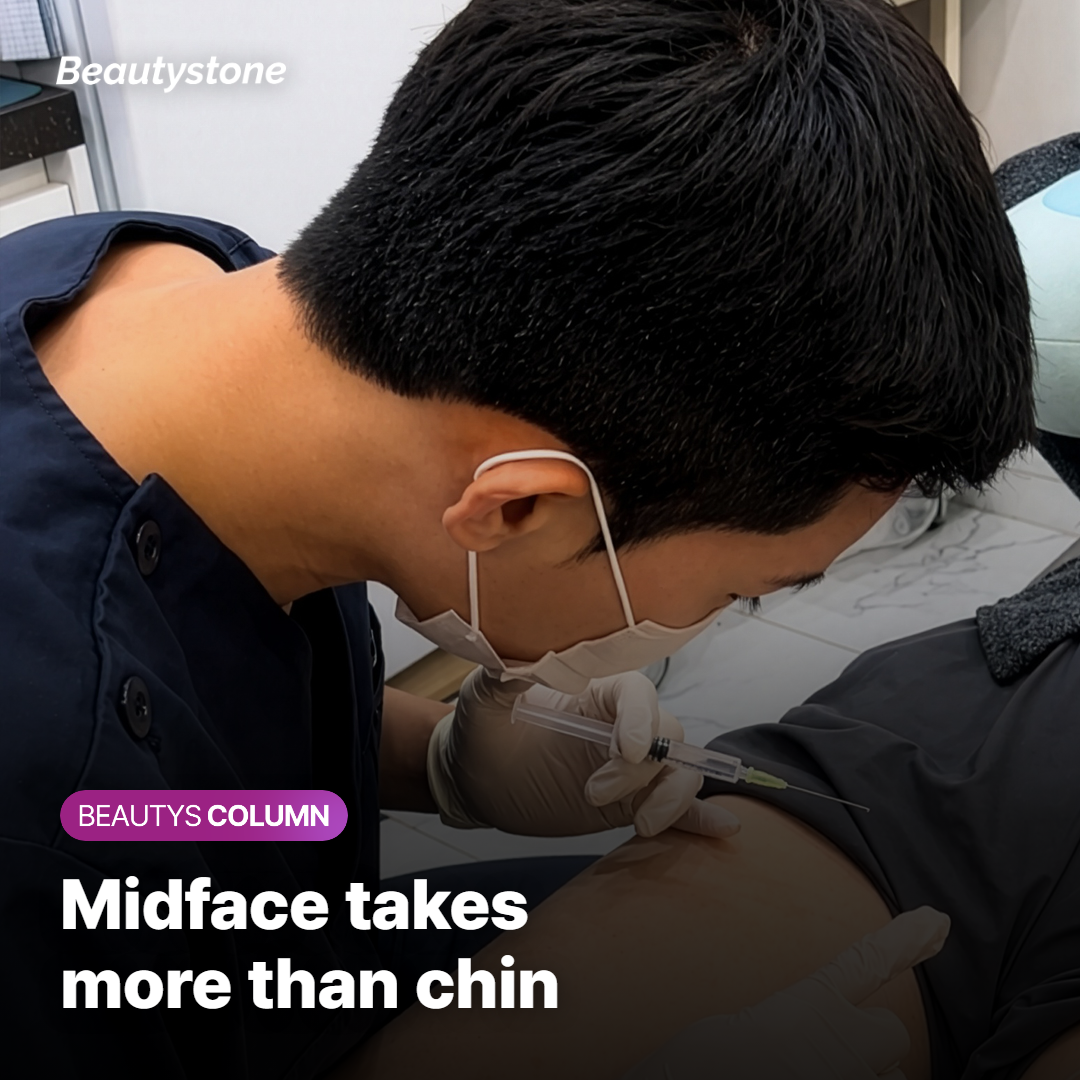
The midface, the wide area below the cheekbones, took the most of the three areas. The median there was 6.6 mL across a first session and up to one touch-up. Hollow under-eyes go the other way: a small amount is placed thinly, with a median of 1.0 mL per side. That's about 2 mL for both eyes.
Keep in mind that each number comes from US studies of one product line. It doesn't mean your face will take the same amount, and results differ from person to person. If your nose bridge is low and you want more height, nose filler is usually looked at first. The nose wasn't part of these studies, so its amount is set by how much height and how long a stretch of the bridge you want to change.
How Do Product Type and Touch-Ups Change the Filler Cost?
On the same chin, a firm gel placed deep near the bone and a soft gel placed close to the surface are different products with different prices. For areas that build shape, like the chin and cheeks, a firmer product meant for deeper layers comes first. For thin skin, like under the eyes, a softer product comes first. The US under-eye study, for instance, used a softer gel from the same family (Juvederm Volbella XC) rather than the one used for the chin and midface.
That's why a 1cc price from one clinic and a 1cc price from another only line up when the product name matches too.
If you're worried the new shape will feel unfamiliar, starting with less and adjusting at a touch-up is worth considering. In the chin study, 45.8% of people came back for a touch-up about a month later. The median touch-up amount was 1.0 mL, about half the 2.0 mL median at the first session.
| Area in US studies | First session (median) | Touch-up (median) |
|---|---|---|
| Chin | 2.0 mL | 1.0 mL, in 45.8% of people |
| Under-eyes, per side | 0.7 mL | 0.5 mL |
If you only budget for the first session, the touch-up can show up as a separate charge. Ask whether it's included before you compare totals.
If filler from an earlier treatment is still in place, that spot gets checked before anything new goes in. How much is left, and where it sits, changes how much you'll need this time.

Filler Side Effects: What Passes and When to Get Help
Redness, swelling, tenderness, and occasional bruising tend to clear within 7 to 14 days*. Don't judge the final shape, or decide on more filler, until that swelling has gone down.
*Based on American Academy of Dermatology patient guidance.
In the midface study, side effects showed up more often in people who received more than 9 mL and in people over 60. That's one more reason a large total is often split across sessions instead of placed all at once.
It's better to postpone treatment in these cases:
- Inflamed or infected skin where the filler would go
- A bleeding disorder
- Severe allergies, or a history of anaphylaxis
- Pregnancy, breastfeeding, or being under 22 (safety isn't known)
Filler accidentally getting into a blood vessel is reported rarely, but when it happens it can lead to tissue damage, blindness, or stroke. If you notice any of the following, get care right away, no matter how many days it's been since treatment*.
*Based on US FDA guidance on dermal fillers.
- Unusual pain, or skin near the injection site turning white, gray, or blue: see a doctor right away
- Changes in your vision: go to the nearest emergency room
- Sudden difficulty speaking, numbness or weakness in your face, arms, or legs, difficulty walking, or face drooping: go to the nearest emergency room
- Severe headache, dizziness, or confusion: go to the nearest emergency room
Sending a message to the clinic doesn't replace being seen in person.

Getting Filler During a Trip to Korea
First, flying. Unless you had sedation that day, there's no need to postpone your flight home because of filler.
Next, what one visit can do. Filler is one of the treatments that changes your shape the same day. Still, the chin study scheduled any touch-up about a month after the first session. If your stay is short, ask at the start whether the plan assumes a touch-up and how that would fit around your next visit.
Finally, after you get home. If swelling or bruising worries you, you can send photos to the clinic through the consultation button on this page. If symptoms are severe, see a doctor near you first.

The Bottom Line: Match the cc, the Product, and the Touch-Up
When you're given a filler price, check three things before comparing: the cc for each area, the product name, and whether a touch-up is included. Only when those match are two prices measuring the same thing.
At the first visit, the doctor looks at your face from the front and from the side, then decides within the balance of your whole face how many cc each area should get. HA filler usually lasts 4 to 12 months, depending on the area and the product, so whether you'll repeat it within a year changes your yearly total too. Individual results vary.
Before you decide, ask one question: "How many cc would you plan for my chin, and when would a touch-up happen?" Beautystone is a clinic in Seoul's Hapjeong area, and the consultation button on this page is a good place to start.
References
- US approval record for an HA filler used in the midface (US FDA, 2013)
- US approval record extending the same filler to the chin (US FDA, 2020)
- US approval record for an HA filler used for hollow under-eyes (US FDA, 2021)
- How long each filler type lasts and what to expect afterward (American Academy of Dermatology)
- Common reactions and blood vessel warning signs after dermal fillers (US FDA)
Frequently Asked Questions
Q. Is 1cc of filler the same as 1 mL?
A. Yes, 1cc of filler is the same amount as 1 mL. Many HA fillers come in 1 mL syringes, so a "1cc price" usually means the price of one syringe. Some products come in other syringe sizes, so check the product name along with the price.
Q. How much filler is used for the nose?
A. The amount of nose filler depends on how much height you want and how long a stretch of the bridge is treated, so there isn't one typical number. The US studies on chin, midface, and under-eye filler didn't include the nose. If the skin on your nose bridge is thin or old filler is still there, the amount is usually planned more conservatively.
Q. Does getting more filler at once mean more swelling?
A. Getting more filler at once can mean more side effects. In the US midface study, side effects showed up more often in people who received more than 9 mL. That's one reason a first session is often kept on the lighter side and adjusted at a touch-up.
Q. How long does chin filler last?
A. Chin filler made of HA usually lasts somewhere in the 4 to 12 month range that applies to HA fillers in general. How long yours lasts depends on the product and on you. Instead of repeating it on a fixed date, compare photos taken in the same light with your first ones to decide when to top it up.
Q. If I still have filler from before, will I need fewer cc this time?
A. If filler from a past treatment is still in place, its amount and shape get checked first, and the new amount is set from there. If it's spread evenly, you may need less. If it has shifted to one side, that shape may need attention first, so this session's cc alone may not settle it.
Q. Does chin filler hurt?
A. Chin filler is given with a needle, so expect a sting and some pressure, and the deeper chin points can feel heavier. Numbing cream is one option, and how you're numbed is decided with you at the consultation, depending on the area and how sensitive you are.
Q. Is under-eye filler cheaper because it uses less?
A. Under-eye filler often uses fewer cc, so the total can come out lower if you only count cc. In the US under-eye study, the median was 1.0 mL per side. The skin there is thin, though, so a softer product is used and a touch-up may be part of the plan. Check the product name and whether the touch-up is included.
Q. Before cheek filler after weight loss, how is skin elasticity checked?
A. Skin elasticity before cheek filler after weight loss is checked with a pinch test, where the skin is gently gathered and lifted a little. If it doesn't stretch easily under that light pull and feels somewhat firm, and then springs back to its original contour quickly and smoothly when released, elasticity is read as fairly well kept. This test on its own doesn't decide whether filler suits you or how it will work.