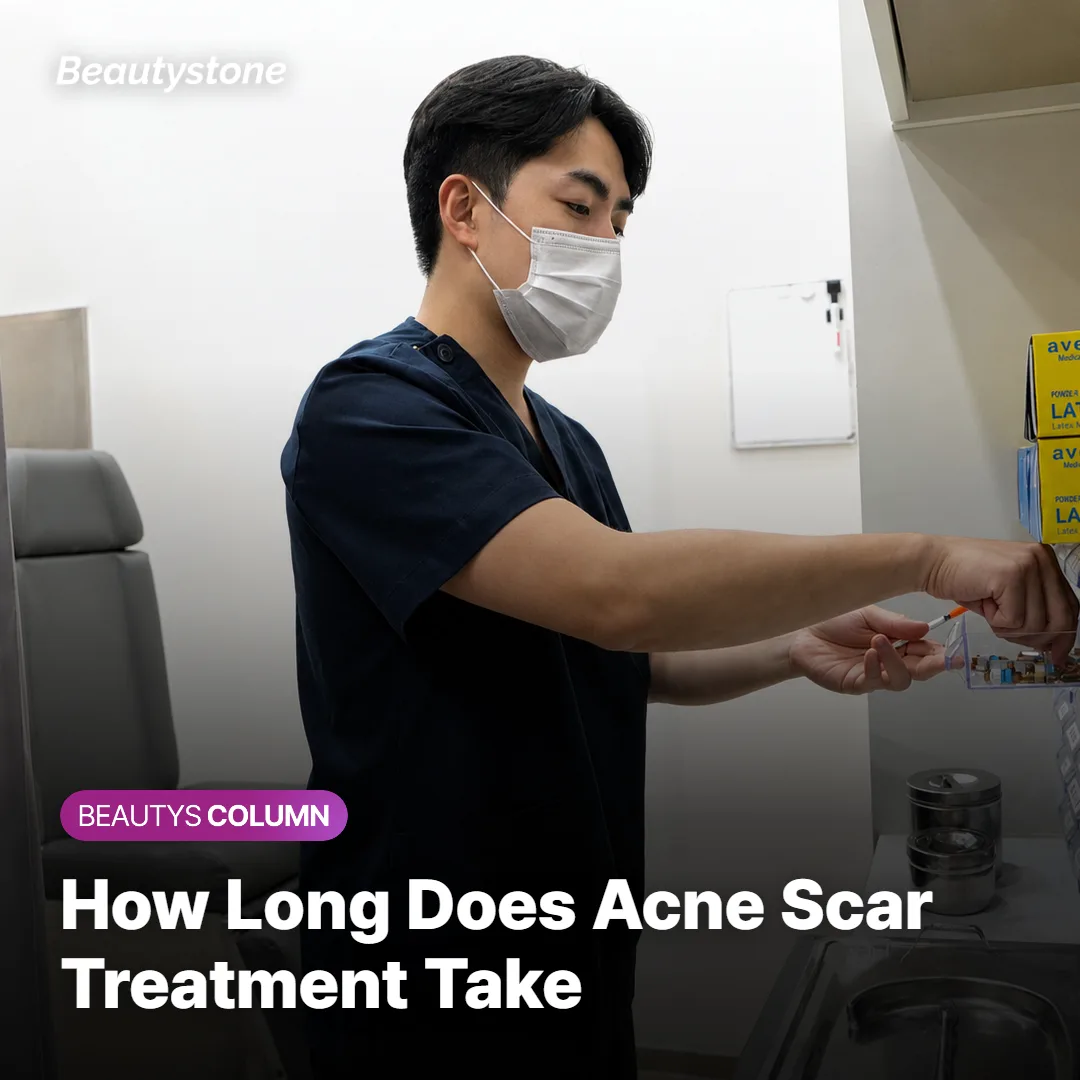
How Long Does Acne Scar Treatment Take?
Acne scarring is measured in months, not appointments. Here's how long each type of scar typically takes to improve, and how to set a goal you can actually reach.

If your skin looks fine in the bathroom mirror but every dent and shadow shows up the moment you step outside, you're not alone. Scarring is one of the most common reasons people book a dermatology consultation, and it's also one of the most misunderstood — mostly because of how long it actually takes to improve. The honest version is that scar treatment is measured in months, not in appointments, and the number of months depends almost entirely on what kind of scar you have. In this article, we'll cover the main types of acne scars, how long each one typically takes to treat, what the healing timeline looks like after a single session, and how to build a plan you can realistically stick to.
What Kind of Acne Scar Do You Have?
This is the first question worth answering, because "acne scar" is really three different problems sharing one name — and they don't respond to the same treatment or the same schedule. Two of them are marks left behind by inflammation. Only one involves actual damage to the structure of the skin, and that difference drives everything about your timeline.
- Red marks: The pink or red patches that linger after a breakout has settled. They come from dilated blood vessels near the surface rather than lost tissue, so the skin itself is still intact.
- Brown marks: Flat tan or brown spots left by pigment after inflammation. Repeated sun exposure makes them darker and slower to fade, and they show up more often in skin that pigments easily.
- Indented scars: Genuine loss of collagen and tissue beneath the surface. These are what most people mean when they say "scars," and they take by far the longest to improve.
Indented scars are usually sorted into three shapes. Icepick scars are narrow and deep, a little like a needle puncture. Boxcar scars are wider, with sharp squared-off edges. Rolling scars are shallow, wave-like dips with soft borders. Most people have a mix of all three on the same cheek, which is a big part of why one device rarely handles everything on its own.
How Long Does Each Scar Type Take to Treat?
Anywhere from a few months to well over a year, depending on which of the three you're dealing with. Marks tend to move quickly because there's nothing structural to rebuild. Indentations move slowly because your own collagen has to fill the gap. Here's roughly how the timelines compare:
| Scar type | Common approach | Typical sessions | Rough timeframe |
|---|---|---|---|
| Red marks | Vascular laser, IPL | 2–4 | 3–5 months |
| Brown marks | Pigment laser, laser toning | 3–6 | 3–6 months |
| Shallow indented scars | Fractional laser, RF microneedling | 4–6 | 6–9 months |
| Deep indented scars | Combination approach | 6 or more | A year or longer |
Treat those ranges as a planning tool rather than a promise. Individual results vary with your skin type, how deep the scarring goes, how your skin responds to energy-based devices, and how consistently you protect the area between sessions.

What Does the Healing Timeline Look Like?
Results don't arrive in one dramatic reveal. Collagen remodeling is slow biology, and most of the visible change from a single session shows up one to three months later — long after the treatment day itself is a memory. A typical session tends to unfold like this:
- Treatment day to 2 weeks: The recovery window. Expect redness, some flaking as the surface turns over, and mild swelling in the first day or two.
- 2 weeks to 1 month: Texture starts to settle. Skin looks calmer, and the roughness that follows resurfacing gradually smooths out.
- 1 to 3 months: The collagen response peaks. This is where the most noticeable improvement in depth and shadow typically happens.
- After 3 months: The result stabilizes, which makes it a sensible checkpoint for deciding whether another session is worth it.
Spacing matters as much as the number of sessions. Fractional resurfacing is usually scheduled around four to six weeks apart, and RF microneedling generally at least four weeks apart. Booking closer together than that doesn't speed anything up — it mostly adds irritation to skin that's still in the middle of rebuilding, which is the opposite of what you want.

Why Deep Scars Need More Than One Treatment
Because a deep indented scar isn't one problem — it's a tethered base, a lost volume, and a rough surface stacked on top of each other. Resurfacing alone can polish the surface, but it can't release a scar that's anchored down from underneath. That's why providers often combine approaches rather than repeating the same device six times:
- Subcision: Releasing the fibrous bands tethering the scar floor so the skin can lift back toward the surrounding level.
- Filler: Adding support to a depression that has lost volume, so the shadow it casts is less obvious.
- Fractional laser or RF microneedling: Refining the surface texture and prompting the collagen response that keeps the improvement going.
It's also worth being blunt about the goal. For deep indented scars, a realistic target is meaningful improvement rather than a blank slate — many providers frame it as somewhere in the range of 70 to 80 percent better, and results vary from person to person. Mark-type scarring is a different story: red and brown marks often fade to the point where they're hard to spot. Knowing which conversation you're in from the start saves a lot of disappointment later.
Side Effects and Risks to Know About
Every treatment that prompts your skin to rebuild also asks it to recover first. The trade-offs are usually mild and short-lived, but they're real, and they're worth planning around before you book.
- Redness and swelling: Common in the first few days and typically settling on their own.
- Flaking and dryness: Expected after resurfacing. Never pick at scabs or peeling skin — that's how a treatment turns into a new mark.
- Post-inflammatory pigmentation: The main risk in skin that pigments easily, especially without sun protection. Sunscreen is non-negotiable during a treatment course.
- Active breakouts: Running a resurfacing device over inflamed acne can irritate it further, which is why most providers stabilize the acne first.
Most of this settles within a week. If you develop a fever, redness that keeps spreading, increasing pain, or discharge from a treated area, contact your provider or seek medical care right away — those aren't part of normal healing.
How Much Does Acne Scar Treatment Cost?
There isn't one number, and any clinic that gives you one before looking at your skin is guessing. Cost tracks with the variables that also drive your timeline: which devices your scar type calls for, how many sessions the plan realistically needs, how large the treated area is, and whether procedures like subcision or filler are part of the approach. A course aimed at red or brown marks generally lands in a very different bracket than a year-long plan for deep indented scars.
The practical move is to price the plan rather than the appointment: ask what a full course would cost, not just the first session, so you're comparing like with like. Beautystone is a dermatology clinic in Seoul's Hapjeong neighborhood, and current offers are listed at /en/promotion.
The Bottom Line
If you take one thing away, make it this: the calendar matters more than the device.
- Marks and indentations are different problems — marks often improve within three to six months, while indented scars are a six-month to multi-year project.
- Most of the change from a single session shows up one to three months later, so judging results at two weeks tells you almost nothing.
- Deep scars usually need combined approaches, and the honest goal is substantial improvement rather than erasure.
- Sun protection and sensible spacing between sessions do as much for the outcome as the equipment does.
Like any procedure, scar treatment comes with trade-offs, and individual results vary. Ultimately, the choice depends on your skin, your goals, and your budget — and on whether the timeline in front of you is one you're willing to commit to. If you're considering acne scar treatment, a consultation is the best way to find out what fits you.