Sculptra Side Effects: Why Nodules Happen
Most Sculptra nodules aren't a flaw in the product — they trace back to dilution, injection technique, and aftercare. Here's why they form, who's more at risk, and what actually prevents them.

If the phrase "Sculptra nodules" has you Googling at midnight, you're not alone. The good news is that most of these firm little bumps trace back to how the treatment was done — not a flaw in the product itself. In this article, we'll cover why nodules form, who's more likely to get one, the massage routine that prevents most cases, and what actually helps if one does show up.
What Is Sculptra?
Sculptra is a poly-L-lactic acid (PLLA) injectable — a collagen biostimulator, not a traditional dermal filler. That distinction matters more than most people realize.
Hyaluronic acid (HA) fillers work by adding volume right where they're placed. What goes in is roughly what you see, and the effect shows up almost immediately. Sculptra works differently. The PLLA microparticles create a gentle, controlled response in the tissue, and your own body reacts by building new collagen around them over the following weeks. Think of it less like filling a pothole and more like planting seeds — the seed itself isn't the flower; it's what triggers the flower to grow.
That mechanism is exactly why Sculptra needs to be diluted and spread carefully. If it isn't, the "seeds" end up clustered instead of scattered — and that's usually where nodules start.
Why Do Sculptra Nodules Form?
Here's the short answer: nodules form when PLLA particles end up concentrated in one spot instead of spread evenly through the tissue.
That usually comes down to one, or a combination, of a few technique variables:
- Dilution: Too little fluid mixed with the PLLA powder means the particles are more concentrated at each injection point.
- Injection pattern: Depositing too much product in a single spot rather than fanning it across a wider area.
- Aftercare massage: Skipping or rushing the post-treatment massage lets particles settle before they have a chance to disperse.
When those variables line up wrong, your body still does what it's designed to do — build collagen around the PLLA. The problem is where it builds it. Instead of a smooth, even response, you get a localized cluster: a nodule.
It's worth repeating: this isn't a defect in Sculptra as a product. It's a technique-dependent treatment, and the technique is what determines whether you get smooth, gradual volume or a lump you can feel under your skin.
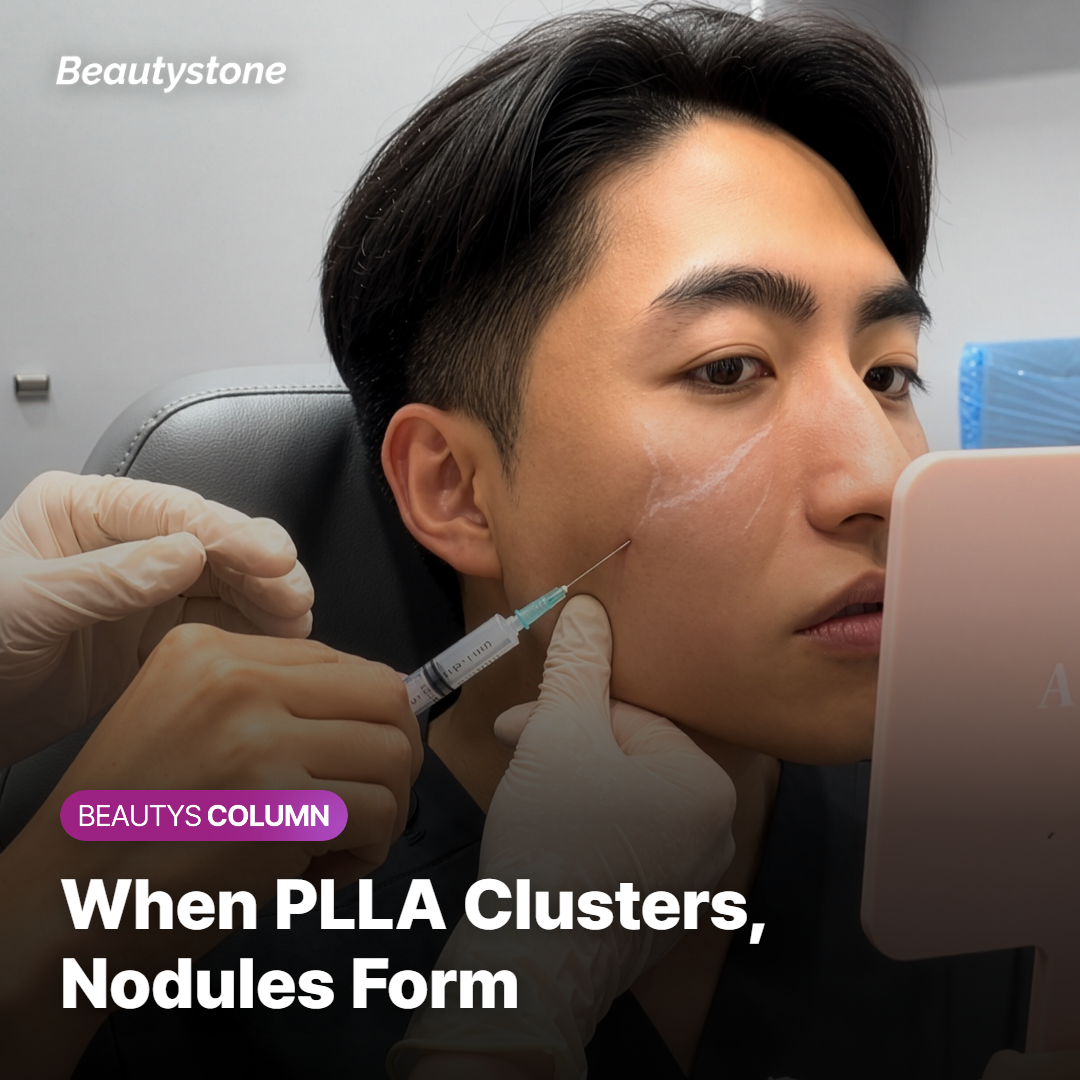
Who's More Likely to Get a Nodule?
Nodule risk isn't random. A few factors tend to raise it:
- Thin skin with little underlying muscle: There's less margin for error on injection depth. Too shallow, and you risk surface irregularities; too deep, and the effect is blunted.
- Previous filler in the same area: Existing filler can change how PLLA particles disperse once injected, so the injector has to be more deliberate about placement.
- Difficulty keeping up with the aftercare massage: If life gets in the way of the massage schedule, particles are more likely to stay clustered instead of spreading out.
None of this means Sculptra is off the table if you fall into one of these categories — it just means your provider needs to adjust dilution, depth, or follow-up accordingly.
The Rule of Fives: The Massage Routine That Prevents Most Cases
Sculptra's aftercare isn't a suggestion — it's part of the treatment. The routine your provider will likely walk you through is often called the rule of fives: massage the treated area for 5 minutes, 5 times a day, for 5 days after injection.
The point of all that rubbing isn't comfort — it's distribution. Massage helps spread the PLLA particles evenly through the tissue instead of letting them settle into one spot. Skip it, or do it half-heartedly, and you're working against the mechanism that makes Sculptra look natural in the first place.
Set a phone reminder if you have to. Five days is a small commitment for a treatment that keeps working for months.

Common Side Effects and Risks After Sculptra
Beyond nodules, Sculptra comes with the same short-term reactions as most injectables.
- Swelling: Common right after injection, and usually the most noticeable reaction in the first day or two.
- Redness: Typically mild and settles on its own.
- Injection-site marks or mild bruising: Can happen at each needle point.
These reactions are usually a sign your skin is responding, and they tend to settle within a few days. If you have an event coming up, it's worth planning your treatment timing around that window. That said, if swelling spreads, worsens instead of improving, or comes with fever, contact your provider or seek medical care right away.
What Happens If a Nodule Does Form?
If you've read about hyaluronidase — the enzyme used to dissolve HA filler — you might assume it works on Sculptra nodules too. It doesn't. Hyaluronidase only breaks down hyaluronic acid, and Sculptra is PLLA, a completely different material.
So what actually helps? It depends on the nodule. Early on, massage and warm compresses can help some nodules soften and resolve on their own. In other cases, a provider might use a localized steroid injection, or a steroid combined with 5-FU.
The important part: not every nodule should be treated the same way. This is one of those situations where "it depends" is the honest answer — a provider needs to actually examine it in person before deciding on an approach.
How Many Sculptra Sessions Will You Need?
Here's the honest answer: don't expect a dramatic change after a single session.
Most treatment plans call for 2 to 3 sessions, spaced weeks apart, and that's by design rather than an upsell. Because Sculptra works by triggering collagen production gradually, spreading the process across multiple sessions tends to produce a smoother, more natural-looking result than trying to pack it all into one visit.
Cost varies depending on how many vials and sessions your treatment plan calls for, so it's hard to put a single number on it here. A consultation is the best way to get an accurate plan and pricing — current offers are listed at /en/promotion.
Individual results vary, and your provider should tailor the number of sessions to your skin and goals rather than a fixed formula.
The Bottom Line
Most Sculptra nodules aren't about the product — they're about dilution, injection technique, and whether the aftercare massage actually happened.
- Nodules form when PLLA clusters instead of spreading evenly through the tissue.
- Thin skin, prior filler in the area, and inconsistent aftercare all raise the odds.
- The rule-of-fives massage routine is one of the simplest ways to lower your risk.
- Most treatment plans call for 2 to 3 sessions rather than one.
Like any injectable, Sculptra comes with trade-offs, and results depend on your skin and your provider's technique as much as the product itself. Ultimately, the choice — and the provider you choose — depends on your goals, your skin, and your comfort with the aftercare routine.
If you're considering Sculptra, a consultation is the best way to find out what fits you. Beautystone is a dermatology clinic in Seoul's Hapjeong area — see current offers at /en/promotion.