Rejuran Bruise on Day 3: 2 More Days, or a Clinic Visit?
A day-by-day read of the recovery curve, and the two signals that mean you stop waiting

Wi Young-jin
Chief Director, Myeongdong
What you'll learn

  · Bruising is most visible around day 2 to 3 and usually fades between day 3 and day 5
  · Direction beats shade: a mark that is settling is ordinary, one that keeps worsening is not
  · A small nodule softens over two to three weeks; one still firm at a month needs the clinic
  · Whether you bruise or bump tracks injection depth and needle choice more than skin type
If you're on day 3 after Rejuran and the bruise looks worse than it did yesterday, the timing is the most ordinary part of the story. Bruising after a polynucleotide injection tends to peak around day 2 or 3, which is exactly when people start searching to find out whether something went wrong.
The useful question isn't whether a mark is normal in isolation, but which way it's heading. We'll walk the recovery curve day by day, sort the signals that separate a normal reaction from a call to your provider, explain why one person bruises and the next gets a bump, and cover what to change before the next session.
Day 3 With a Bruise: Where That Sits on the Normal Curve
Day 3 is usually the peak, not the problem. Bruising after Rejuran tends to be most visible around day 2 or 3, and for most people it fades between day 3 and day 5. A heavier bruise can take closer to a week to clear, and individual results vary.
| When | What you're likely to see | What it asks of you |
|---|---|---|
| Day 0 to 1 | Tiny needle marks and mild redness | Makeup usually covers them; otherwise leave it alone |
| Day 2 to 3 | Bruising at its most visible, some swelling | Nothing new. This is the peak, not a setback |
| Day 3 to 5 | Bruising and swelling start to fade | Watch the direction rather than the shade |
| Week 2 to 3 | Any small nodule softens and flattens | Warm compresses and gentle massage, not pressure |
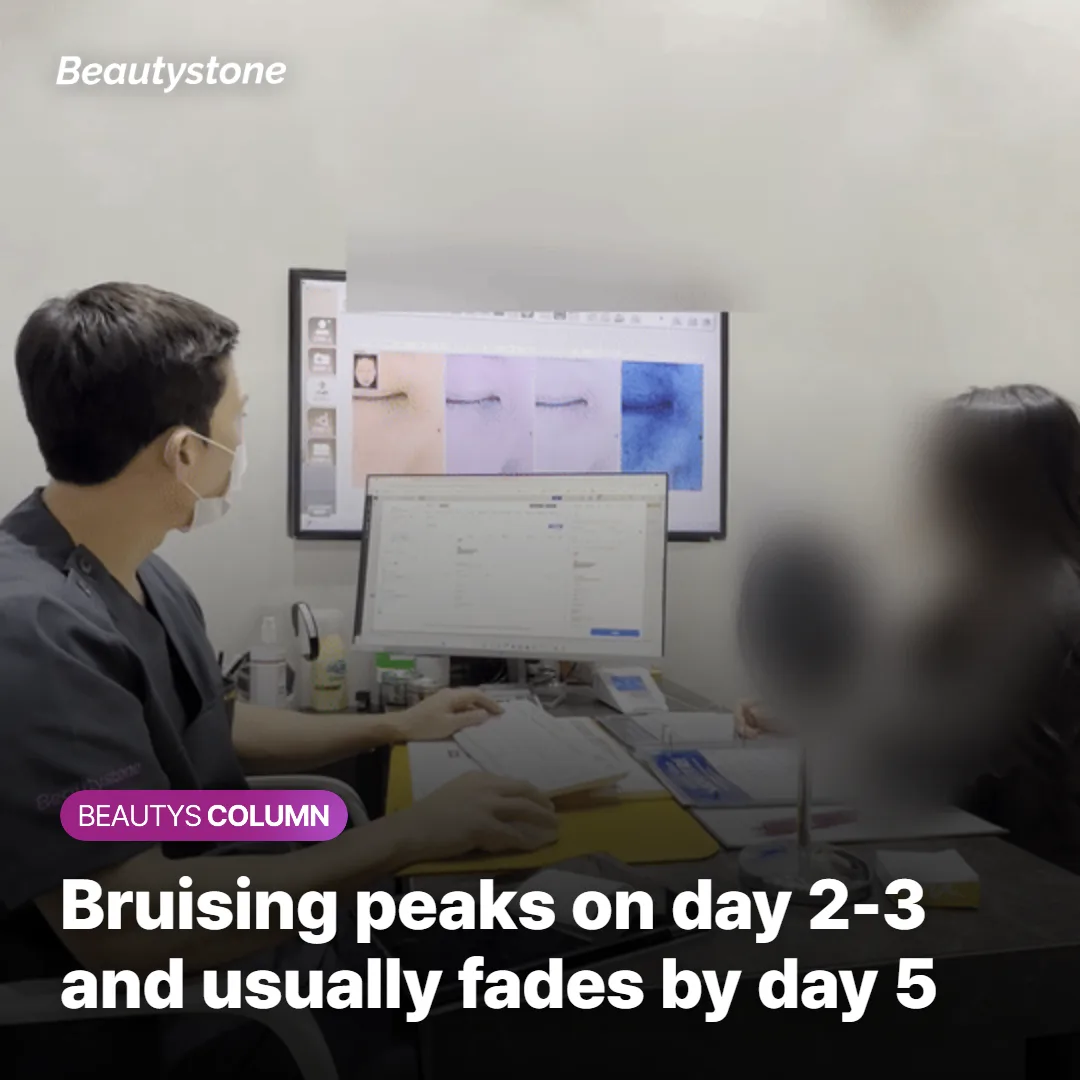
Swelling follows a similar path and settles inside the same window. What matters is that it's settling at all; swelling that keeps building past the first few days is reading differently from the curve above.
Reading the days in that order is the point. Where you sit on the curve tells you more than how dark the mark looks today, because a bruise darkening on day 2 and a bruise darkening on day 6 are two different conversations. If you're inside the window and the mark is settling, watching it is a reasonable plan.
Normal Reaction or a Call? The Two Pairs That Sort It
The split isn't how bad a mark looks on a single morning. It's the direction it's moving, and almost everything sorts into two pairs.
| What you're looking at | Usually a normal reaction | Worth a call to your provider |
|---|---|---|
| A bruise or needle mark | Darkens through day 2 to 3, then fades from day 3 to 5 | Redness, warmth or pain that keeps getting worse instead of better |
| A firm bump | Softens over two to three weeks with warm compresses and gentle massage | Still firm after a month, or massaged for months with no change |
If you notice spreading redness, fever, or pain that's getting worse rather than better, seek medical care right away. That combination isn't the bruising and swelling described above, and it shouldn't be filed under normal healing.
The one-month mark on a nodule matters more than it sounds. Left alone too long, a bump can harden into a fibrotic lump that's harder to resolve, so the clock is doing something even when the bump looks unchanged. (If yours is at three weeks and softening, that's progress.)
Why One Person Bruises and the Next Gets a Firm Bump
It usually comes down to depth, not skin type and not how sensitive you are. PN needs to land in the mid-dermis, roughly 1.5 to 2 millimeters below the surface, and the two common misses go in opposite directions.
| Where the needle lands | What tends to show up afterward |
|---|---|
| Too shallow | Product pools near the surface as a small, firm bump |
| In the mid-dermis | Settles into tissue, and marks fade on the usual curve |
| Too deep | More likely to nick a tiny vessel, which surfaces as a bruise |
Across about 47 consultations followed up over a single month at the clinic, 7 people had noticeable bruising and 3 had a nodule that lingered more than a week. Those proportions move a good deal from provider to provider, largely because injection technique isn't standardized across clinics.
One patient in her late thirties came in frustrated that a row of small, grain-like bumps along her cheek hadn't gone away a month after her third session at another clinic. On exam, the bumps followed the exact line of the injection pattern, which points to product placed too shallow rather than settling into the dermis. A pattern that traces the injection line is a technique story, not a skin-type story.
What to Change Before the Next Session, Not After
The fix for a bruise you already have is mostly time. The fix for bruises you keep getting is the plan for the next session, and that's a conversation to have before the needle comes out.
- Needle or cannula: Around thin under-eye and lip-line skin, where vessels sit close to the surface, a cannula is often gentler and lowers bruising odds.
- Dose splitting: If you've had a nodule before, spreading the dose across two sessions about two weeks apart can lower the risk of a repeat.
- Passes per area: Several passes over one spot in a single visit add to the odds, so fewer, better-placed entries are worth asking about.
- What you're taking: Blood thinners, supplements such as fish oil or vitamin E, and an alcohol-heavy week all raise the chance of bruising. Never stop a prescribed medication on your own.
- Timing around events: Book at least five days ahead, and earlier if you bruise easily.
Spacing follows the same logic. Most plans run three sessions three to four weeks apart, because PN encourages gradual repair rather than an immediate change. A single session is rarely enough to judge, and people who felt one or two sessions did nothing often notice a texture change only after a full series.
If the last round bruised more than you'd like, that's information for the next appointment, not a reason to stretch the interval on your own. (If the marks were heavy, ask whether a cannula for the thin zones is on the table next time.)
The Bottom Line: When a Month-Old Bump Goes Back to the Clinic
There's one practical reason not to wait a stubborn bump out. Because Rejuran isn't a hyaluronic acid filler, hyaluronidase, the enzyme that dissolves HA fillers, doesn't work on it. A lingering nodule needs a different approach, which is why home massage past a point stops helping.
In clinic, a bump still firm at a month may be handled with a saline dilution injection or a micro-dose of steroid rather than more waiting. That's a judgment made on exam, and it's the reason the one-month line sits where it does.
Going back to the clinic that treated you has a plain advantage: the record. Depth, needle versus cannula and where the entries sat are in the chart, so the next plan starts from what happened rather than a guess.
On cost, pricing varies by clinic, by formula such as Rejuran Healer versus Rejuran HB, and by how many sessions are recommended, so a plan is usually quoted as a series rather than a visit. Current offers are listed at /en/promotion.
The short version: marks fading between day 3 and day 5 are ordinary, a bump softening over two to three weeks is ordinary, and anything moving the other way is worth a call. Like any injectable, Rejuran has trade-offs and results build gradually. If a mark sits outside that window, bringing it in beats giving it more time.
Frequently Asked Questions
How long does swelling after Rejuran usually last?
For most people it settles in the same window as bruising, fading from around day 3 to day 5, with a heavier reaction closer to a week. Direction matters more than amount: swelling that keeps building past the first few days, or comes with warmth and worsening pain, is worth a call.
Does the under-eye area bruise more than the rest of the face?
It can. Skin under the eyes and along the lip line is thinner and vessels sit closer to the surface, which raises the odds of a visible bruise. That's also why a cannula is often chosen there instead of a fine needle. If your last session there bruised more than expected, ask about that option.
Can I speed up a Rejuran bruise with massage or a warm compress?
Warm compresses and gentle massage are the tools for a small nodule, which usually softens over two to three weeks. A bruise mostly needs time, so rubbing it hard doesn't help. If a bump is still firm after a month of that routine, stop massaging and have it looked at.
How far ahead of an event should I book a session?
At least five days, and earlier if you bruise easily, since bruising peaks around day 2 to 3 and fades between day 3 and day 5 for most people. If the event really matters, a full week leaves room for a heavier bruise.