Juvelook Eye: Can Regular Juvelook Work Too?
The question is not which Juvelook to ask for. It is which layer your under-eye problem sits in, because a collagen booster reaches only one.

Wi Young-jin
Chief Director & CEO, Myeongdong
Here is the short answer. If what bothers you under your eyes is a bulge, a pouch that puffs out and casts its own shadow, Juvelook is not the treatment for it. A bulge sits below the skin. Juvelook works inside it.
That is one type out of four, and the other three are close to what this treatment was built for. So this guide sorts under-eye complaints by the layer they live in. If you are reading from the US: Juvelook is not FDA-approved there, and is used in Korea under MFDS authorization. Individual results vary.
Which Layer Is Your Under-Eye Problem Actually In?
Under-eye complaints sound alike, but they come from different depths, and depth is the only sorting that matters. Juvelook Eye is a collagen booster based on PDLLA, poly-D,L-lactic acid, injected into the skin, where it stimulates your own collagen. It is a stimulant, not a filler, so whatever it changes has to be a property of the skin.
Draw the skin under your eye taut with a fingertip. Four things can happen:
- Lines flatten while the skin is stretched. A skin-quality problem, and this treatment's home ground.
- A bluish network reads through. Still a skin problem: the fix is a less transparent layer.
- A shallow dip softens when you smile. A mild volume problem, partly reachable.
- A pouch stays a pouch however you stretch. Structure underneath, which nothing inside the skin moves.
Juvelook Eye is formulated for eye-area skin, with particle size and viscosity adjusted for it. But formulation decides how safely it sits in thin skin, not which of those four types it reaches.
Type 1: Crepey Lines and Skin That Lost Its Spring
This is what Juvelook Eye is genuinely built for. Collagen under the eye thins with time and the skin creases into fine lines visible at rest. Because PDLLA induces collagen synthesis in the dermis, mechanism and problem line up here. You are probably in this type if:
- The lines show in daylight and in photos, but soften while you hold the skin taut.
- The area reads thin and papery rather than puffy or shadowed.
- Creams and laser sessions improved the surface without changing that crepey quality.
Many patients notice improved texture after two to three sessions, not after the first and not in the first week. Collagen is built rather than injected, so two to four weeks is the earliest honest checkpoint. Individual results vary.

Types 2 and 3: See-Through Skin and Shallow Hollows
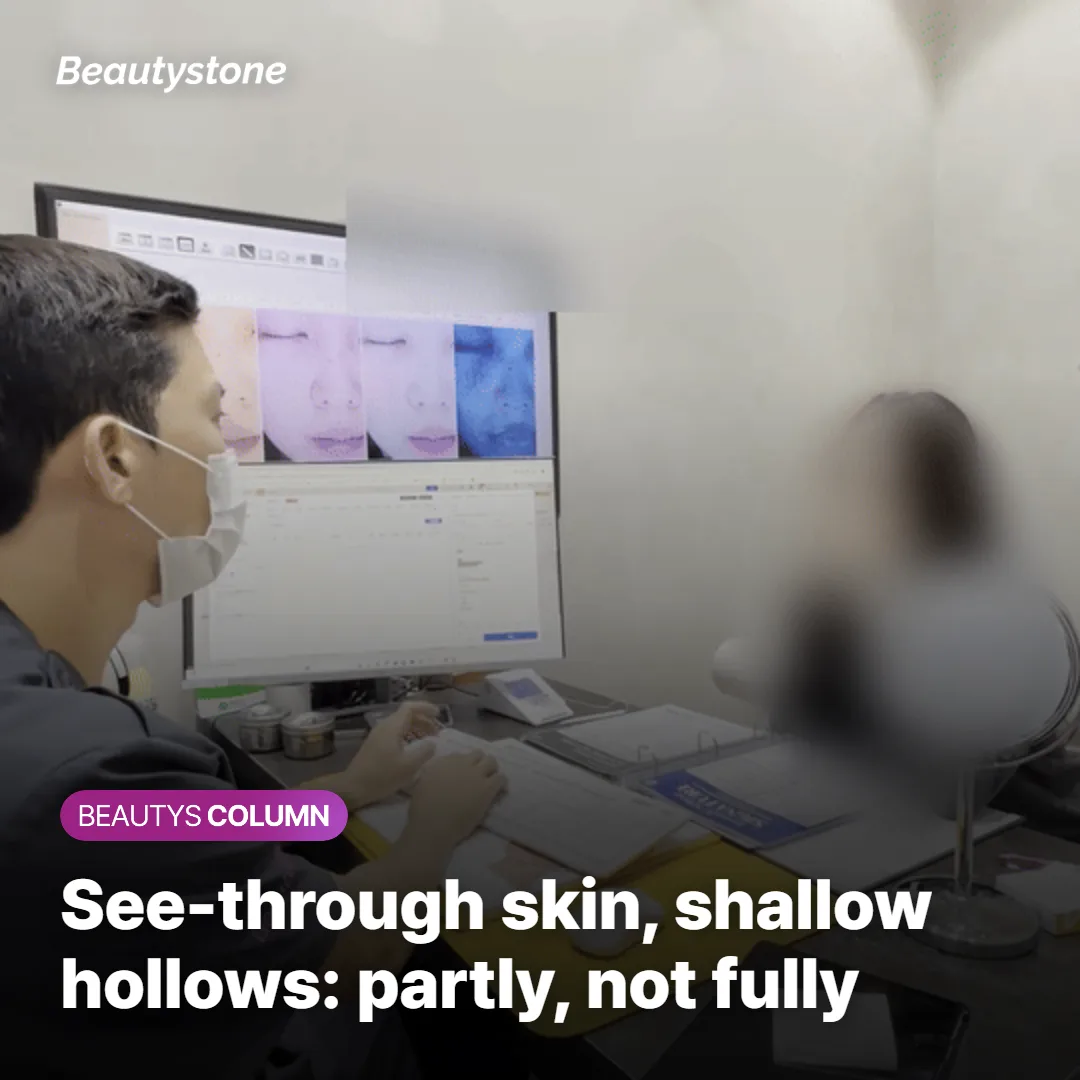
Type 2 is transparency. When the skin is thin enough, the vascular network beneath reads through as a bluish cast, and collagen filling in the dermis can reduce how much shows. The limit: discoloration from pigment deposits needs pigment-directed treatment first.
Type 3 is a shallow hollow between the lower lid and the cheek. Juvelook Eye works by gradual filling, so mild hollowing can soften as collagen accumulates. It does not replace volume on the spot, and a deep groove is more realistically a hyaluronic acid filler job.
| Under-eye type | What you see | What is realistic |
|---|---|---|
| Crepey lines | Fine lines at rest, papery texture | Best fit; improves over 2-3 sessions |
| See-through skin | A bluish network showing through | Can lessen as collagen fills in |
| Shallow hollow | A dip that shadows overhead | Gradual softening; deep grooves suit filler |
| Bulging pouch | A pad that stays when you stretch | Not reachable from inside the skin |
The One It Will Not Fix: True Eye Bags
A true eye bag is a pouch of tissue sitting under the skin; the skin over it is a passenger, not the cause. So asking whether the treatment is contraindicated for eye bags is the wrong question. It is aimed at a layer where your problem is not.
There is a second reason not to push it. The skin under your eye is the thinnest on the face, roughly 0.3 to 0.5mm against about 1.5 to 2mm on the cheek. Particles sized for a cheek are fine in thick skin, but in a layer that thin they can clump, showing through or leaving bumpy texture. Nodules have been reported when regular Juvelook was injected under the eyes, associated with too much product or placement that sits too shallow.
Even when the type is right, the eye area is rich in blood vessels, so bruising risk is never zero, though it usually settles in three to five days. Not ordinary: pain worsening after the first few days, spreading redness, or fever. Contact your provider or seek urgent care.
If you are treated away from home, arrange the follow-up before you book. A complication needs someone who can see your face in person.
What It Costs, and 5 Questions That Pin Down Your Type
Cost is easier to plan once you accept this is a series, not one appointment. Clinics in Seoul commonly list around 100,000 to 200,000 KRW per session for eye-area collagen boosting, very roughly US$70 to $150, though exchange rates and pricing move. Two to three sessions make one set, three to four weeks apart.
- Day 0. Micro injection points. Keep cosmetics off them that day; light makeup is fine the next day.
- Days 1 to 5. Swelling or bruising generally fades in three to five days. Build that into travel dates.
- Weeks 2 to 4. The earliest you can judge anything, since the change is collagen your skin is building.
- Six months to a year. Generated collagen typically lasts that long; many patients return near six months.
Bring these five questions and you leave with a type, not a product name:
- Is this skin quality, thin skin, hollowing, or a bulge? Everything follows from that answer.
- If part of it is a bulge, what share is that? Mixed pictures are the norm; ask for the proportion.
- How many sessions before we judge this, and by what? A checkpoint stops you quitting at week one.
- What depth and how much product for skin this thin? Amount and shallow placement are what nodules track with.
- If I bruise, how long should it last? Get that threshold while you are calm.
For reference, Beautystone is a skin clinic in the Hapjeong area of Seoul, and a small practice rather than a high-volume one. That matters in one way here: depth, amount, and how you responded last time decide the next session, and that record only helps if the same person reads it.
Frequently Asked Questions
Is Juvelook contraindicated for eye bags?
Contraindicated is not quite the right word. A bag is a pouch of tissue beneath the skin, while the product works inside the skin and stimulates collagen there, so it is aimed at a layer where the problem is not. A provider examining you can say how much of your under-eye picture is bulge and how much is skin.
What if I have more than one under-eye type at once?
That is the normal case. Thin skin, fine lines, and a shallow hollow often show up together, and a bulge can sit alongside all three. The useful question is proportion, not a yes or no.
How do I tell a hollow from a bag on my own face?
The stretch test gets you close, though it is not a diagnosis. Draw the skin outward gently: a hollow tends to flatten, while a pouch stays a pouch.
How long before I know whether it worked for my type?
Two to four weeks at the earliest, and realistically after two to three sessions three to four weeks apart. Nothing is placed under your skin that shows the day you leave, so a week-one check tells you about swelling rather than results.