
Forehead Botox Units: How 8 to 16 Get Mapped, and What Goes Wrong
Unit count is a planning decision, not a price line. Here is how the dose gets spread across the frontalis, which mistakes cause a heavy lid or an arched brow, and what to settle before the first injection.

What you'll learn

  · Many providers work in the range of 8 to 16 units, split across four to six points
  · The forehead has one lifting muscle, so an uneven map shows up quickly
  · Units clustered near the brow line invite a heavy lid; sparse outer edges invite an arched brow
  · Botox cannot be dissolved, so the plan matters more than any correction afterward
The most common question about forehead Botox is a number: how many units. The straight answer is that many providers work somewhere in the range of 8 to 16 units, split across four to six injection points and spread in a fan rather than clustered in one spot. The exact figure follows your forehead size and brow position, so treat that range as a planning frame rather than a quote.
The more useful answer is that unit count and unit placement are the same decision. The forehead is not a flat surface to be dosed evenly; it is one fan-shaped muscle doing one job, and where the dose lands across it is what people actually feel afterward as a heavy eyelid, an arched brow tail, or nothing unusual at all. This is how that map gets planned, what tends to go wrong, and what to confirm before you book. Individual results vary with anatomy and dose planning.
How Many Units Does a Forehead Actually Need?
Start with what the number is for. Forehead Botox targets the frontalis, the thin fan-shaped muscle that stretches across your forehead and does one specific job: lifting your eyebrows. Nowhere else on the face does a single muscle carry that much responsibility alone. That is what separates this area from the glabella, the frown lines between the brows, or the masseter along the jaw.
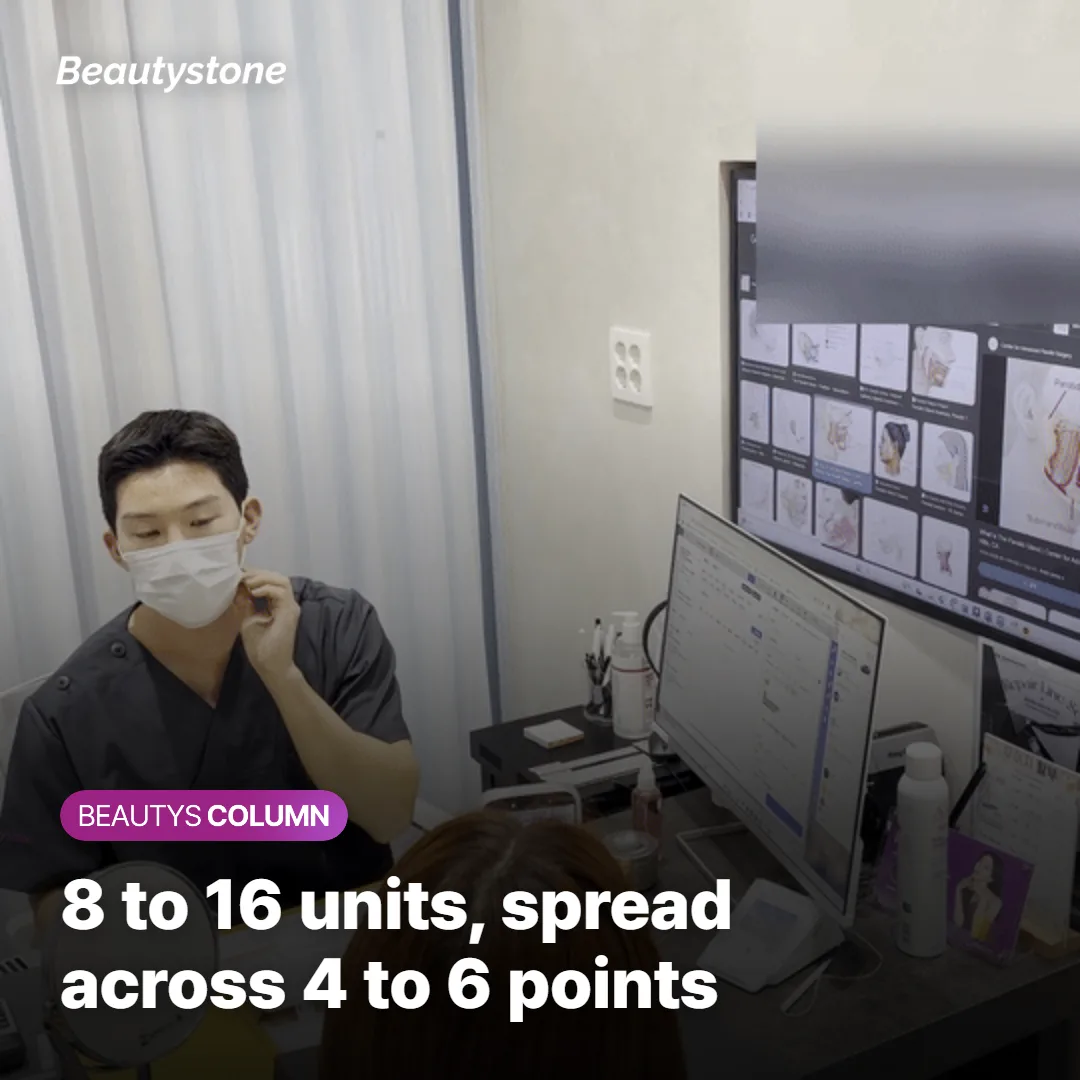
Because there is no backup muscle to pick up the slack, the plan is built as a map before it is built as a dose. In practice that means three decisions in order, and only the last one is a number.
- Where the lifting work has to stay: the brow line, which is why units sit away from it rather than on it.
- How wide the treated field runs: the center and the outer edges near the brow tail both count as part of the forehead.
- How many points the dose is split across: commonly four to six, so the effect blends instead of sitting in one pocket.
- How many units in total: often somewhere from 8 to 16, adjusted to forehead size, brow position and how strongly the muscle moves.
Two people can receive the same total units and get different results because the fan pattern was drawn differently. That is why comparing quotes by unit count alone tells you very little about what you are buying.
Why the Map Matters More Than the Injection Depth
Much of the safety conversation around forehead Botox centers on depth: inject shallowly and you are safe. The logic is reasonable in theory, and it holds up less well on the forehead specifically.
Forehead skin is thin, typically somewhere around 1.5 to 2 millimeters. Even a genuinely shallow injection can still reach the frontalis underneath, simply because there is not much tissue between the surface and the muscle. Depth alone is not a reliable safety line here the way it might be in a thicker-skinned area.
What separates a smooth result from a lopsided one is where the units go and how they are spread across the muscle. Provider experience points to a consistent pattern: when units are clustered too close to the brow line, or the outer edges are left mostly untreated while the center takes most of the dose, that uneven map is what shows up later as a visible problem.
So when a plan is described to you, listen for the shape of it. Where does the treated field start and stop, how many points is the dose divided into, and what is deliberately left alone near the brow? Those answers tell you more than the depth of the needle.
Two Ways the Map Goes Wrong: Heavy Lid and Arched Brow
Two side effects come up more than any others with forehead Botox, and they trace back to opposite distribution mistakes. Knowing both makes the plan easier to discuss, because they are not fixed the same way.

Brow or eyelid ptosis, that heavy drooping lid, tends to happen when units sit too close to the brow line in too concentrated a dose. The product can migrate downward into the muscle that lifts the eyelid itself, weakening it right along with the frontalis above.
The arched, uneven lift at the outer corner of the eyebrow, often called a Spock brow, happens the opposite way. If the center of the forehead is well treated while the outer edges near the brow tail are barely touched, the untreated portion keeps pulling upward on its own while the treated center stays still. The imbalance reads as a lopsided or overly arched brow.
Neither outcome is really about how deep the injection went. Both come down to how evenly the dose was mapped across the width of the forehead, which is also why the corrections differ: one is a matter of waiting and monitoring, the other is usually a small, targeted touch-up above the outer brow.
What to Expect Week by Week, and Which Reactions Are Common
Not every reaction after forehead Botox is a complication, and the timeline tells you which is which. Distribution problems, if they are going to appear, tend to become visible in the same window every time.
- Day of treatment: mild redness or small bumps at the injection sites, usually settling within a few hours.
- First 48 hours: bruising or tenderness, especially near the hairline, as part of normal healing.
- 1 to 2 weeks: the frontalis gradually weakens, and this is when a heavy lid or an arched brow becomes noticeable if it is going to.
- 2 to 4 weeks: the full effect is usually in place, and an asymmetry that has not resolved by now generally needs a touch-up rather than more time.
- 3 to 4 months: the effect gradually wears off as the nerve connection to the muscle reopens.
| Side effect | How common | What helps | Recovery time |
|---|---|---|---|
| Bruising, swelling, tenderness | 10 to 15% of cases | Cold compress, avoiding blood thinners beforehand | 3 to 7 days |
| Arched outer brow | 3 to 5% of cases | Targeted touch-up above the outer brow | Usually 2 to 3 weeks after correction |
| Brow or eyelid ptosis | 1 to 2% of cases | Provider-recommended eye drops, monitoring | 4 to 12 weeks |
| Flat or unnatural forehead | 5 to 8% of cases | Adjusting dose and distribution next session | 3 to 4 months |
One point is worth knowing before you decide. Botox cannot be reversed or dissolved once it is injected. If a distribution issue appears, the options are waiting for it to wear off or adding a small, targeted correction to rebalance the map. There is no undo, which is precisely why the first plan carries so much weight.
Some signs are not a wait-and-see situation. If swelling spreads well beyond the treated area, worsens instead of improving, or comes with vision changes, contact your provider promptly rather than waiting out the two-week mark.
3 Things to Settle Before the Needle, Plus Cost and Aftercare
Because the outcome is mostly decided before treatment, the consultation is where the value sits. Three things are worth pinning down while the plan can still change.
- The map: how many points, how wide the treated field runs, and what is left untreated near the brow line.
- The total: how many units that adds up to for your forehead, and why that number rather than a higher or lower one.
- The follow-up: whether a review visit or touch-up is included, and how soon after treatment it happens.
Cost follows the same three answers. Pricing varies between clinics because it depends on the number of units, how many injection points they are split across, and whether a touch-up is bundled, and unit count is itself a distribution decision as much as a dosage one. Because pricing structures differ and change over time, a consultation is the only way to get an accurate figure for your forehead and your goals.
Aftercare is short but specific, and the window that matters most is the first four hours rather than the following weeks. Do not press or rub your forehead, since massaging the area can push product into muscles it was never mapped for. Stay upright rather than lying down, so the dose stays where it was placed. Skip strenuous exercise, and hold off on facials, saunas and steam rooms for the rest of the day.
Beautystone is a skin clinic in Seoul, and this is the sequence Dr. Wi Young-jin follows for the forehead: read how the brow sits and how strongly the muscle moves, draw the treated field and the untouched brow margin, then let the unit total fall out of that map rather than starting from a number. If you are treated while traveling, arrange in advance who can review the result where you live, since the two-week mark is when a touch-up decision is usually made.
Results vary with anatomy, muscle strength and how the dose is planned, and nothing here replaces an assessment by the clinician who will treat you. If you are already dealing with a heavy lid or an uneven brow from a previous session, ask how your dose was distributed before assuming the fix is simply more product.
Frequently Asked Questions
How long do I need to stay upright after forehead Botox?
The first four hours are the window that matters. Staying upright rather than lying down helps keep the product where it was placed instead of letting it drift toward the brow. In the same window, avoid pressing or rubbing the forehead, since that is one of the more preventable causes of product reaching muscles it was not mapped for.
How long does forehead Botox last before I need it again?
The effect generally wears off over roughly 3 to 4 months as the nerve connection to the muscle reopens, though this varies by person and by how strongly the muscle moves. Rather than fixing a repeat date in advance, most people do better reviewing the result at each visit and adjusting the interval from there.
My eyelid feels heavy after treatment. Will it fix itself?
Ptosis after forehead Botox usually improves as the effect fades, with recovery commonly described in the range of 4 to 12 weeks. It cannot be dissolved, so treatment is supportive: your provider may suggest specific eye drops and monitoring. Tell them what changed and when, because that information shapes how the next map is drawn.
Does forehead Botox hurt, and will I bruise?
Most people describe brief pinches rather than sustained pain, with mild redness or small bumps at the injection sites that settle within a few hours. Bruising and tenderness show up in roughly 10 to 15% of cases, particularly near the hairline, and typically fade in 3 to 7 days. A cold compress helps, and avoiding blood thinners beforehand lowers the risk.