Beard Laser Sessions: Why 6 to 10 Is Halfway
Six to ten sessions is where most beard plans are quoted, and it is also where density is only about halved. Here is what sets the real number, and why two clinics reading the same beard hand you two different counts.

Short answer first: nobody can honestly quote your beard session count before looking at your beard. Density and thickness vary too much between two men of the same age, and the laser only works on hair that happens to be growing that week.
What can be said is where the markers usually fall, what moves them, and why the same face gets quoted six sessions at one clinic and twelve at another. General information from Beautystone, a skin clinic in Seoul; individual results may vary.
Why No One Can Quote Your Session Count Up Front
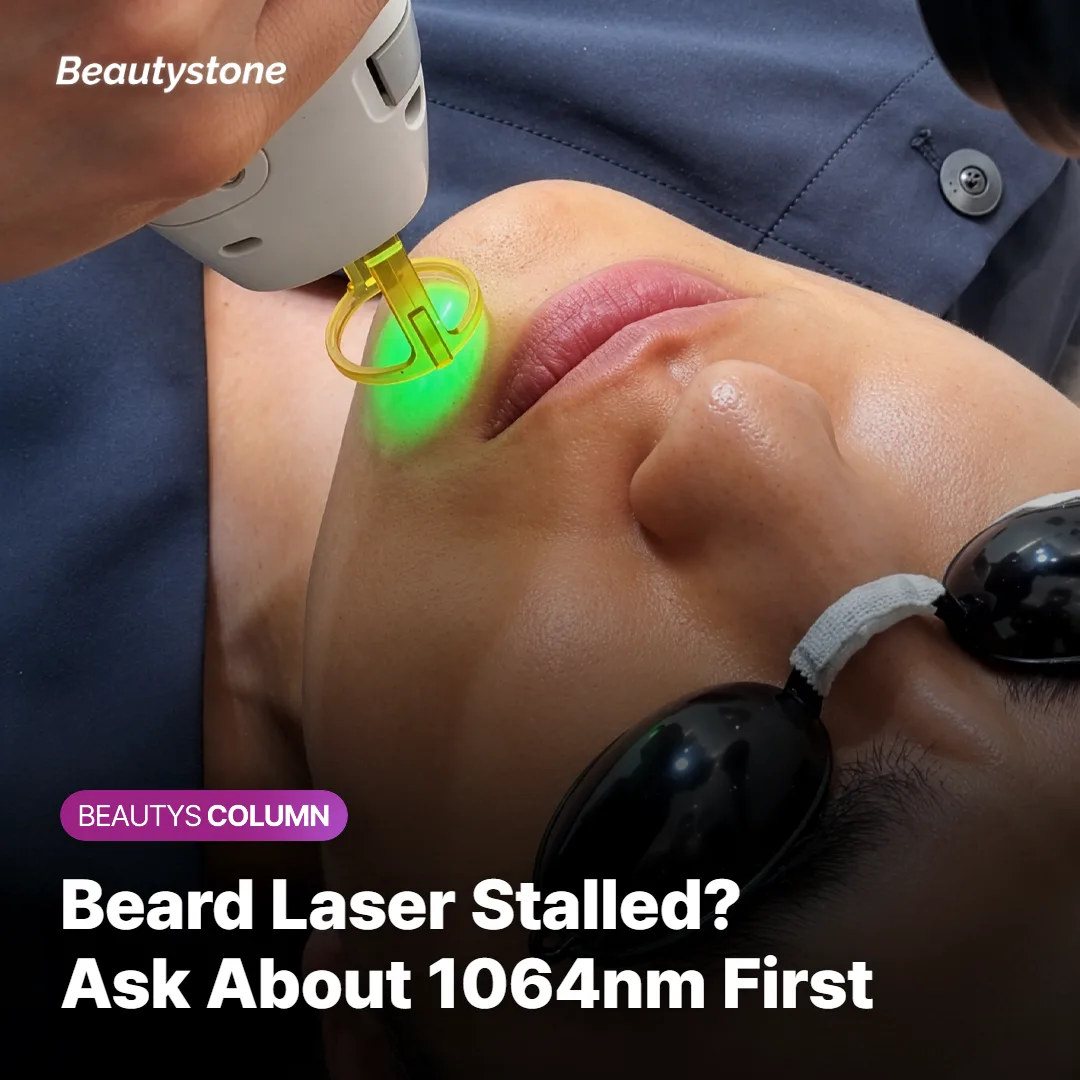
A laser aims concentrated light at the follicle. Melanin, the pigment in hair and skin, absorbs that light and turns it into heat, and the heat is what disables the follicle's ability to keep producing hair. Two conditions have to be true at that moment: pigment has to be present, and the follicle has to be active.
That second condition is the one that stretches a course out. Every follicle cycles through three phases: anagen (active growth), catagen (a short transition), and telogen (resting). Only anagen hairs respond, because that is when the shaft is thickest and most pigmented. Research on facial hair suggests only around 60% to 70% of beard follicles sit in anagen at any one time, so the rest are effectively invisible to the laser that day.
Nothing failed when that happens. It is why sessions sit roughly four to six weeks apart: the gap lets the follicles that were resting last time cycle into growth before the next visit. A beard is not treated once, it is treated across the cycle.
On top of the cycle, five things move your number more than the choice of clinic does. Read this as a range-setter, not a verdict — the same factors can pull in opposite directions on one face.
| Factor | Pulls the count down | Pushes the count up |
|---|---|---|
| Hair color | Dark, dense beard | Light, gray or mixed hairs |
| Skin tone | Fair skin | Deeper tones, where settings need more care |
| Hair thickness | Coarse, wiry hair | Fine, thin hair |
| Hormone levels | Stable androgen levels | Higher androgen activity |
| Spacing | Consistent, every 4 to 6 weeks | Irregular, frequently skipped |
Androgens are the hormones behind beard growth in the first place, and they can switch on follicles that were previously dormant. That is why men often see what looks like new hair appear mid-course. The laser did not miss it; the follicle was not producing hair the first time around. Light and gray hairs are a separate problem entirely: with little melanin to absorb the light, they respond more slowly no matter which device or provider is involved.
The Two Markers Worth Tracking: 6 to 10, and Around 13
Because of all of the above, a fixed number is not something anyone should promise you. What is useful instead is knowing which markers a beard course tends to pass through, so you can tell a normal middle from a stalled plan.
The first marker sits at six to ten sessions. That is commonly where density reads as roughly half of where it started: shaving takes less effort, the jawline looks cleaner by the end of the day, and the growth that returns is finer. It feels like a result, and it is one — but it is a midpoint, not a finish.
The second marker is the end of the course. For a typical man, our director's treatment records put the finish at around thirteen sessions, which is where daily shaving genuinely stops being a routine rather than just getting easier. Plans sold as eight to twelve sessions are not wrong; they are usually describing the point where the beard is noticeably reduced, which arrives earlier than the point where you stop thinking about it.
| Marker | What it usually means |
|---|---|
| First 2 to 3 sessions | Shedding and slower regrowth; density largely unchanged |
| 6 to 10 sessions | Density commonly around half of the starting point |
| Around 13 sessions | Typical finish for a man's course, per our director's records |
| After the course | Fine or hormone-driven regrowth can still appear over time |
The gap between the two markers is where most men quit, and it is worth naming in advance. Progress between session seven and session eleven is real but undramatic — finer hairs, patchier coverage, less shadow — and it does not photograph well. Stopping there is a legitimate choice if the halfway result is enough for you. It is only a problem when someone stops there believing the plan failed.

One more caveat belongs here rather than at the end: none of these numbers is a guarantee, and individual results may vary. A man with dark, dense hair and fair skin may be satisfied below the range. A man with lighter hair, a deeper skin tone or high androgen activity often needs more than it.
Why Two Clinics Quote Different Numbers for the Same Beard
Three variables are obvious once you start comparing consultations: how much area is being treated (neckline only, or the full beard and cheeks), how many sessions the plan includes, and which wavelength the clinic actually has on site.
Wavelength is the one most men have never been asked about. Dual-wavelength platforms such as the GentleMax Pro Plus are common for beard work because the two settings do different jobs: a 1064nm setting reaches deeper and is handled more safely on darker skin tones, while a shorter wavelength targets dense, dark hair more efficiently. A clinic with one wavelength has one answer for every face. A clinic with two has to choose, which is only an advantage if someone is actually choosing.
The fourth variable almost never appears on a price list: how carefully each visit is recorded. If nobody knows which wavelength, which energy level and which skin reaction came out of your last session, the next one starts from a guess. Guessing low wastes a visit. Guessing high leaves marks on jaw and neck skin that is thinner than the cheek.
- Recorded settings mean the next session can step up deliberately instead of repeating a cautious one
- Recorded skin reactions mean a tan, a new medication or an irritated patch changes the plan before the handpiece touches you
- Fewer wasted sessions is the only honest way a beard course gets shorter — the hair cycle itself cannot be rushed
That is also the practical answer on cost. Pricing depends on area, session count and the clinic itself, so there is no universal figure worth quoting here, and you are buying a course rather than a visit. What is within anyone's control is how many of those visits do useful work. At Beautystone the settings and the skin response are logged each visit and carried into the next, and the director assesses the beard rather than selling a fixed package before seeing it.

What You Do Between Sessions Moves the Count
You cannot override your hair color or your hormones. Four habits between visits are genuinely within your control, and they are the difference between a course that lands at the low end of your range and one that drifts past it.
- Shave, do not wax, thread or pluck. Shaving the night before or the morning of a session is fine and expected — the laser still needs a follicle to aim at. Waxing, threading and plucking remove that target entirely, so those hairs skip a cycle and cost you a visit later
- Keep the area out of the sun. A recent tan raises the risk of pigment change and can force your provider to lower the energy for safety, which quietly weakens the session you paid for
- Skip saunas and long hot soaks for a couple of days after treatment. Heat and friction irritate follicles that are already inflamed from the laser
- Hold the schedule. Sessions roughly four to six weeks apart line up with the growth cycle; stretching the gap lets follicles pass through growth and rest untouched, and you make up for it with extra visits
The shaving rule is the one men get wrong most often, usually with good intentions. Turning up with a week of growth does not give the laser more to work with — it scatters the energy into hair above the skin instead of the follicle beneath it, and beard skin sits close enough to the jaw and neck that the extra surface heat is not harmless. A clean shave is the correct preparation, not laziness.
Between sessions, regrowth is not evidence that the plan is failing. Hair that was hit will shed over one to three weeks and can look like it is growing back on the way out. What matters is the trend across visits, not what your jaw looks like on day ten.
Where the Course Stops, and What to Ask Before You Start
The regulatory language matters here, and it is worth hearing before session one rather than after session ten. Lasers used for this are FDA-cleared devices — cleared is the correct term for a device, where a drug such as Botox is approved — and the claim they are cleared for is permanent hair reduction, not permanent removal.
That distinction is the whole expectation. Treated follicles produce dramatically less hair over the long run. Fine, sparse hairs can still surface years later, and because androgens keep influencing follicle activity throughout adulthood, some regrowth over time cannot be ruled out. A man who expects to never see a hair there again will be disappointed by an outcome that is actually normal.
On safety, beard work is considered low-risk when a trained provider matches the settings to your skin, but it is not risk-free.
- Common: mild redness, warmth or slight puffiness around the follicles for a few hours after treatment
- Less common: temporary lightening or darkening of the treated skin, most often when the wavelength was not matched well to the skin tone
- Rare: blistering or burns, usually linked to recent sun exposure or settings that were not dialled in
- Seek urgent care if you see blistering, redness that spreads, or pain that gets worse rather than better over the following day
Flag recent sun exposure, skin conditions and any medication at the consultation, not halfway through the course. And if you are travelling for treatment, plan for the fact that any follow-up may have to happen with a provider where you live — a beard course runs over months, and the clinic that treated you will not be down the road.
Three questions separate a clinic that is reading your beard from one that is reading a price list:
- Which wavelengths do you have on site, and who decides which one my skin gets?
- Are my settings and skin reaction recorded each visit and used to set the next one?
- What should I expect to see by the halfway point, and what changes in the plan if I do not see it?
Beautystone is a skin clinic near Hapjeong Station in Seoul, and a consultation is the point at which a realistic range replaces a quoted number. Bring the questions above to whichever clinic you consider; the answers tell you more than any session count printed on a menu.
Frequently Asked Questions
Is 6 to 10 sessions enough to be done with beard laser?
That range is commonly where density reads as about half of where it started, which is a real result but a midpoint. A typical man's course finishes nearer thirteen sessions in our director's records, and the last stretch is what turns easier shaving into not shaving daily.
Why did another clinic quote me a much lower number?
Lower quotes usually measure a different finish line — noticeably reduced rather than done — and they may assume one wavelength, one area and no missed appointments. Ask what the number is counting before comparing two of them.
Can I shave between sessions, and what about waxing?
Shave freely, including the morning of a session. Waxing, threading and plucking pull the follicle out, so the laser has nothing to target and those hairs skip a cycle, which usually costs you an extra visit later.
Does beard laser hurt more than other areas?
Most men describe a warm snap rather than sharp pain, though the jawline and neck can feel more sensitive because the skin there is thinner. Numbing cream and the device's built-in cooling help, and settings can be adjusted if it feels too intense.