
Xeomin or Botox? 2 Real Differences, and 3 That Aren't
What separates the two products, and what separates the price tags


What you'll learn

  · Xeomin is a botulinum toxin type A made without the accessory complexing proteins that surround the toxin in Botox.
  · Onset, duration and overall results are broadly similar between the two — that's where the differences stop.
  · A toxin only softens dynamic lines from movement. Lines etched in at rest need a different approach.
  · Two clinics can bill the same unit count and deliver different concentrations, depending on how the vial was reconstituted.
Someone who has had the same injection for years gets offered a different name, a different price, and a short explanation that doesn't quite settle anything. The question underneath is simple: is this actually different, or is it the same treatment with new packaging?
It's genuinely different in two ways and genuinely the same in three, and knowing which is which makes the price conversation much easier. We'll cover what's in the vial, what matches between the two, which lines a toxin can reach at all, and what actually moves the number you're quoted.
What Xeomin Is, and What's Missing From the Vial
Xeomin (incobotulinumtoxinA) is an FDA-approved botulinum toxin type A injectable made by Merz Pharmaceuticals. Like Botox, it's used to soften dynamic wrinkles — the lines that form from repeated muscle movement, most often between the eyebrows, the glabellar lines sometimes nicknamed the elevens.
What sets it apart is what isn't in the vial. Botox and Dysport both include accessory complexing proteins that surround the active toxin molecule. Xeomin's manufacturing removes them, leaving what injectors sometimes call a naked toxin.
In theory that means less material for your immune system to respond to, which may lower the odds of building resistance over years of regular treatment. Research on this is still developing, so it belongs in the column marked potential long-term advantage rather than guarantee — a useful distinction if you're being sold it as a reason to switch today.
2 Real Differences, and 3 That Aren't
Laid out honestly, the comparison is narrower than the marketing around it. Two things genuinely differ; three things people expect to differ don't.
| Where they actually differ | Botox | Xeomin |
|---|---|---|
| The protein shell around the toxin | Kept in place | Stripped out during manufacturing |
| How the vial is stored before mixing | Refrigerated | Room temperature |
- Onset: both typically start showing at 3 to 5 days, with the full effect around 1 to 2 weeks.
- Duration: both typically hold for roughly 3 to 4 months before movement returns.
- The result itself: people who have used both usually describe the outcome as broadly similar.
Two rows in a table and three lines in a list is the whole comparison. Neither product is objectively better, and nothing in that list is a reason to pay a premium for one over the other.
So the choice usually comes down to two practical things rather than a ranking — how much experience your injector has with a given product, and how your particular muscles have responded to toxins in the past. If you've had good results with one and no reason to move, that's a legitimate reason to stay.
Which Lines a Toxin Can Actually Reach
Before the price question comes the more expensive mistake: paying to treat the wrong kind of line. A muscle only pulls when the nerve ending above it hands over a signal, and that signal is a molecule called acetylcholine. A botulinum toxin holds up that handover for a few months at the spot where it was placed, so the muscle underneath stops pulling as hard and the skin above it stops being folded into the same crease every time you frown, squint or raise your brows.
That mechanism only reaches lines caused by movement. Lines already etched into the skin at rest — static wrinkles — generally need a different approach, such as a filler or a collagen-stimulating treatment, either alongside a toxin or instead of one.
- Visible only when you move: dynamic lines, which are what a toxin is aimed at.
- Visible with your face completely still: static lines, which usually need volume or collagen stimulation.
- Both at once: the common case, and a sequencing question rather than a choice between products.
This is worth settling in the consultation, because a perfectly performed injection into a muscle that wasn't the problem still leaves you looking at the line that bothered you.
What Actually Moves the Price Between Clinics
Pricing is usually structured per unit or per treatment area, and it varies noticeably between cities and between clinics on the same street. The obvious drivers are the total units your area needs, the injector's experience, the clinic's location, and whether you're booking one session or a maintenance plan. As a reference point, 50 units of Xeomin sits around ₩50,000 to ₩80,000 at typical Seoul market rates, and imported toxins generally run about 5 to 15 percent above domestic products because the cost per vial is higher.
| Area | Usual dose | Typical market range | How long it tends to hold |
|---|---|---|---|
| Glabella and forehead | 20-30 units | ₩30,000-₩50,000 | 3 to 4 months |
| Around the eyes | 10-20 units | ₩30,000-₩40,000 | Around 3 months |
| Masseter, for the jawline | 50-80 units | ₩50,000-₩80,000 | 4 to 6 months |
| Calves | 100-200 units | ₩150,000-₩300,000 | 5 to 7 months |
Read that table as a range rather than a quote, since figures vary by clinic and change over time. It is most useful as a sanity check: an advertised masseter treatment well under ₩40,000 for 50 units is usually either heavily diluted or a first-visit promotion, and it's fair to ask which. Maintenance runs cheaper for a different reason — once a muscle has been treated and has weakened, the repeat dose often drops to around 70 to 80 percent of the first one, so it's worth asking whether maintenance pricing exists before you book the second round.
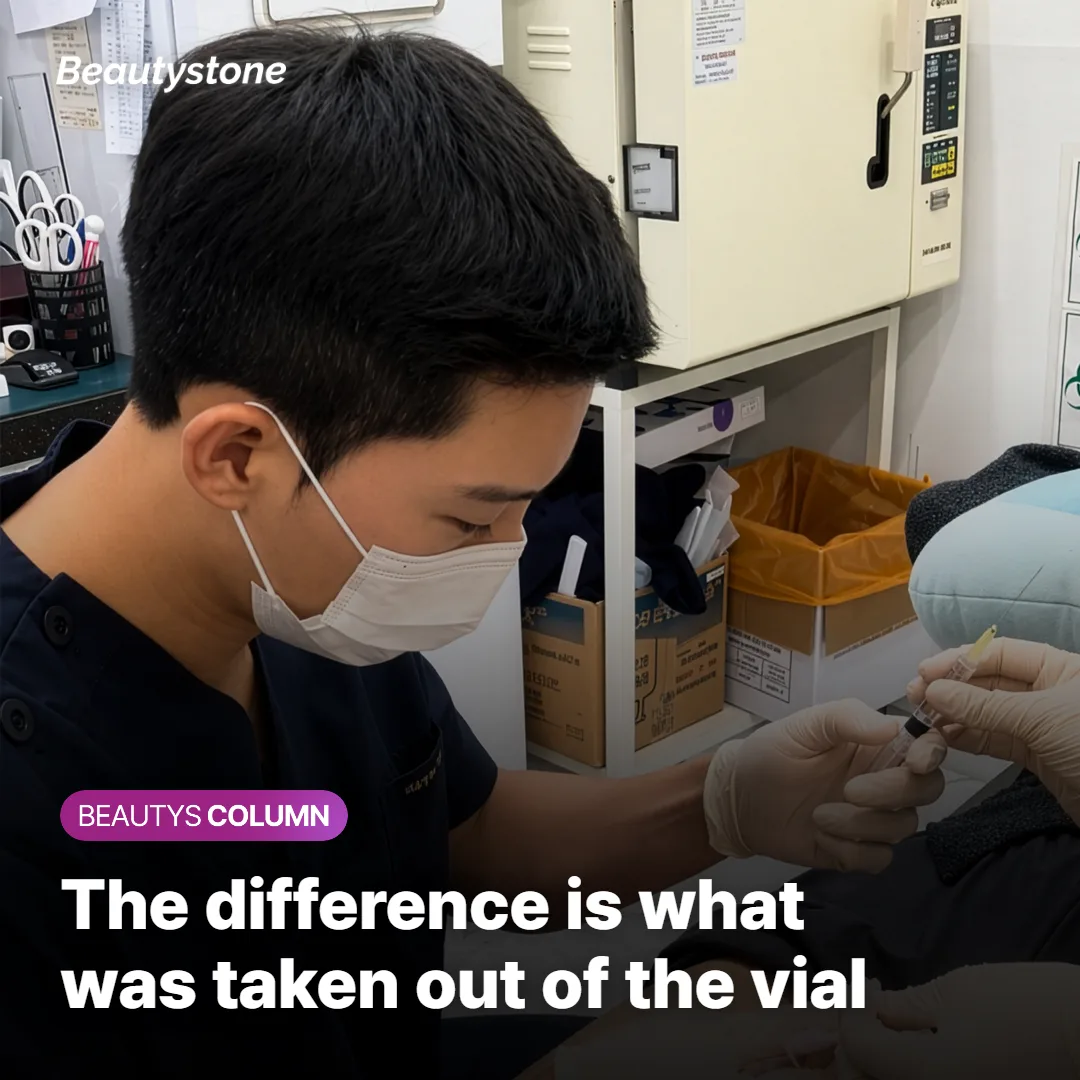
The non-obvious one is dilution, and it's the only variable here that never shows up on a receipt. The product arrives as a freeze-dried powder, and the clinic decides how much saline to add before any of it can be drawn into a syringe. Take a single 100-unit vial: reconstituted in 2.5cc it is twice as concentrated as the same vial reconstituted in 5cc. Both clinics can write 50 units on your chart afterward and mean two different amounts of active product.
In other words, the unit count tells you what was billed, not necessarily how much active product reached the muscle. An unusually low quote at the same unit count may reflect heavier dilution to stretch each vial, which can mean a shorter-lasting or less noticeable result while everything on paper looks identical.
That doesn't make the cheapest option bad or the most expensive one correct. It means price alone isn't a reliable comparison. Asking how a clinic reconstitutes its product is a fair question, and most experienced injectors answer it without hesitation — as is confirming that the product is authentic and properly stored, which matters more than the lowest number on a list. Baseline pricing sits at /en/price and current offers at /en/promotion.

The Bottom Line: The Timeline, and the Signs That Need a Call
The schedule after treatment is predictable enough to plan around. Injections take a few minutes and most people describe a quick pinch rather than pain, with a return to normal activity the same day. For the first 48 hours, avoid rubbing the area, lying flat for long stretches and strenuous exercise; mild redness or a small bump at the injection site is common and settles quickly.
Most people notice the muscle starting to relax at 3 to 5 days, with full effect around 1 to 2 weeks. That's also the point where a provider evaluates whether a touch-up makes sense, rather than earlier. Results then fade gradually over roughly 3 to 4 months as the muscle regains normal function, and your metabolism, the dose used and the strength of the muscle all shift that timeline.
Side effects are usually mild and temporary: bruising, redness or swelling at the site, and occasionally a mild headache in the first day or two. Less commonly, eyelid or brow drooping if product spreads beyond the intended muscle, temporary asymmetry, or a heavy feeling in the area. Rarely but seriously, difficulty swallowing, speaking or breathing can signal spread beyond the injection site.
- Drooping that isn't improving after a few days: contact your provider.
- Any difficulty breathing or swallowing: seek medical care right away.
- Disclose neuromuscular conditions and medications before treatment, not after.
- Ask how the product is prepared, not only what it costs.
Like any procedure it comes with trade-offs, and individual results vary. Which product suits you depends on your goals, your muscle strength and how you've responded to toxins before. Beautystone is a dermatology clinic in the Hapjeong area of Seoul, and current offers are listed at /en/promotion. — Dr. Wi Young-jin (Medical Director)
Frequently Asked Questions
I've had Botox for years. Is there a reason to switch?
Possibly, but not an urgent one. The argument for switching rests on the removed complexing proteins and the idea that less accessory material may mean lower odds of building resistance over long-term use. The research there is still developing, so it's a reasonable consideration for someone treating regularly over many years rather than a fix for a result you're already happy with.
My result faded after about two months. Was the dose wrong?
Not necessarily. Duration shifts with how quickly you metabolize the toxin, the dose used and how strong the treated muscle is, and a strong, frequently used muscle tends to come back sooner. It's still worth mentioning at your next visit, since it's one of the few pieces of information that helps adjust the plan.
It looks uneven. How soon can a touch-up be done?
Usually not before the 1-to-2-week mark, because that's when the full effect has settled. Assessing earlier means judging a result that's still arriving, and adding product to a muscle that hasn't finished relaxing is how a small asymmetry becomes a larger one.
Will this help the lines I can see when my face is completely still?
Not on its own. Lines visible at rest are static, meaning they're etched into the skin rather than produced by movement, and relaxing the muscle underneath doesn't erase them. Those generally call for filler or a collagen-stimulating treatment, sometimes alongside a toxin for the movement component.