

300 Shots or 600? What a Shurink Session Really Buys
Shot count is the number everyone compares, and it is the number that tells you least. What decides whether a Shurink session reaches your jawline is which tip depths those shots were delivered at.


What you'll learn

  · A shot is one pulse of focused ultrasound. The count tells you how many pulses, never at what depth.
  · Tips typically come in 1.5mm, 3.0mm, and 4.5mm depths, and only the 4.5mm tip reaches the SMAS layer that drives visible jawline lifting.
  · 300 shots on a shallow tip is a real treatment, just a different one: it is aimed at texture and fine lines, not contouring.
  · About 30 percent of the change is immediate and the rest builds over roughly four to twelve weeks, so judge a session after a month rather than a week.
If you are comparing a 300-shot Shurink session against a 600-shot one, here is the short answer: the number by itself cannot tell you which is right for you, because it does not say how deep those shots went. Shurink (Ultraformer MPT) is a high-intensity focused ultrasound device, and each pulse of energy it delivers through the handpiece is one shot. The handpiece tips come in different depths, and the depth is what decides which layer of tissue the energy actually reaches.
That is why two quotes for the same shot count can describe genuinely different treatments, and why a session can end with someone feeling that nothing changed along their jawline. Below is how to read the number properly: what each tip depth is for, which one your own concern needs, when 300 is plenty and when it is beside the point, and what a single session can realistically show you before you commit to more. This is general information, not a diagnosis for your face.
What 300 Shots Tells You, and What It Hides
Shurink works by delivering tiny pulses of focused ultrasound energy through a tip pressed against the skin. Each pulse is a shot. Counting them is a fair way to describe how much work was done, in the same way counting brush strokes describes how long someone painted. It says nothing about which wall they were painting.
The tips typically come in three depths, around 1.5mm, 3.0mm, and 4.5mm, and each is aimed at a different layer of tissue. A 300-shot session tells you the volume of pulses. It does not tell you whether they landed on surface texture, in the deeper dermis, or on the support layer underneath, and those are not interchangeable.
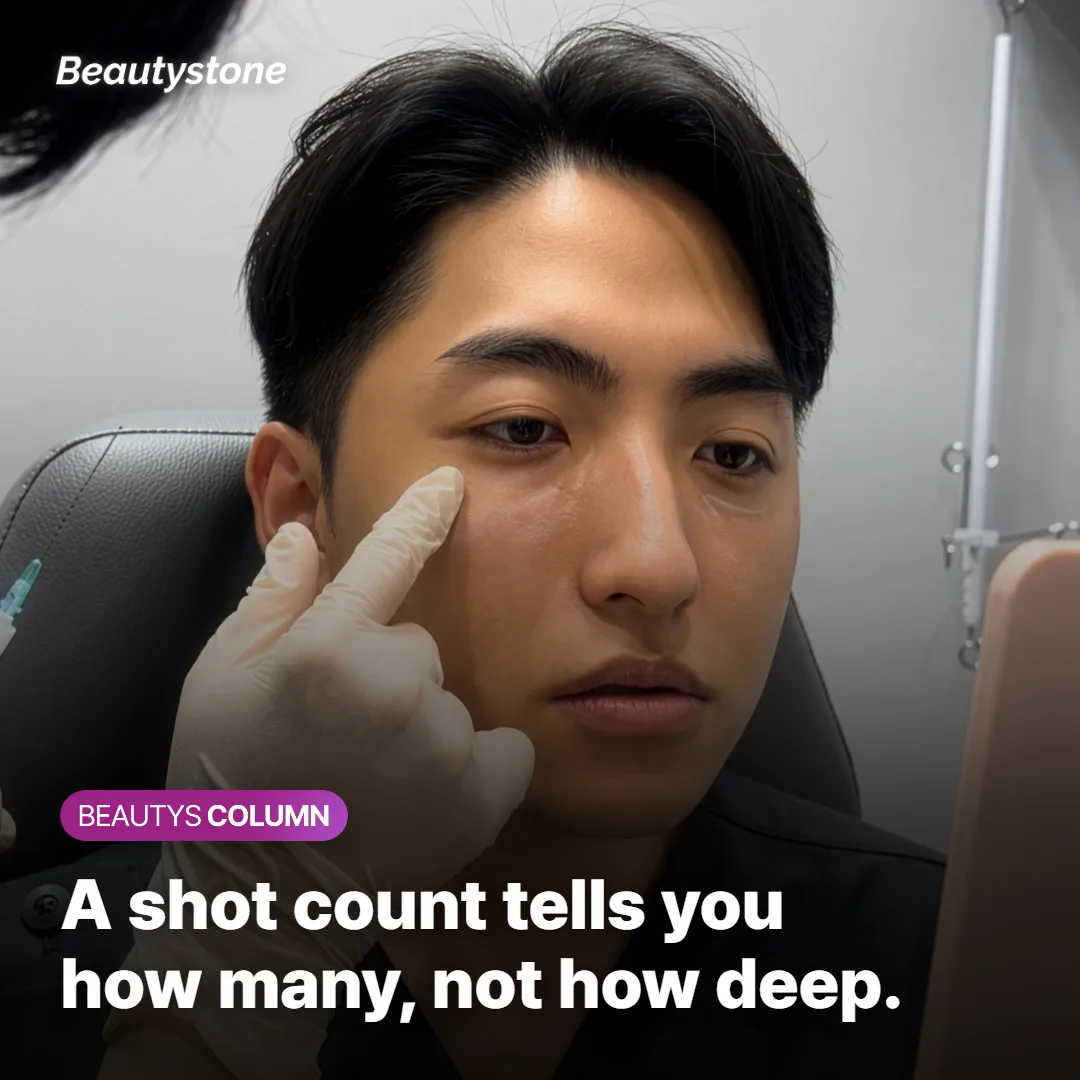
So when a quote reads simply "Shurink, 300 shots," it is an incomplete sentence. The missing half is which tip, or which combination of tips, delivered them. That missing half is also the part that moves both the result and the price, which is why the same headline number can sit at very different price points without anyone being dishonest about it.
Which Depth Does Your Concern Actually Need?
Sort your own concern by layer before you sort it by number. The lift people associate with Shurink comes from the SMAS, a fibromuscular layer sitting well below the surface. Contracting that layer is what pulls sagging along the jawline and cheeks back into place, and the 4.5mm tip is the one that reaches it.
| Tip depth | What it is aimed at | What it will not do |
|---|---|---|
| 1.5mm | Surface texture and fine lines | Move a sagging jaw contour |
| 3.0mm | The deeper dermis, without reaching the fascia | Meaningfully affect the SMAS at any shot count |
| 4.5mm | The SMAS support layer, which drives visible lifting | Refine surface texture on its own |
Two failure modes follow from that table. A session built entirely on shallower tips can feel underwhelming when what you wanted was jawline contouring, no matter how high the shot count climbs. Going straight to 4.5mm depth on someone with less facial fat to begin with tends to produce more discomfort without a proportional improvement in the result.
This is why providers usually mix depths rather than defaulting to one setting for everyone. Skin thickness and the pattern of sagging decide the mix, and those are things someone has to look at on your face rather than infer from your age or from what worked for a friend.
So Is 300 Enough? Match the Number to the Goal
With depth sorted, the shot count finally becomes meaningful. Here is a rough guide by goal. Actual planning varies by clinic and by what your provider sees, so treat this as a starting point rather than a quote.
| Your goal | Typical setup | Sessions | Rough cost per session |
|---|---|---|---|
| Texture and fine-line refinement | 1.5mm plus 3.0mm, around 300 shots | 1 session | KRW 200,000 to 250,000 |
| Early-stage sagging (30s to 40s) | 4.5mm plus 3.0mm, around 600 shots | 1 session | KRW 400,000 to 500,000 |
| Progressive sagging (40s to 50s) | 4.5mm plus 3.0mm, around 600 shots | About 3 sessions, roughly 3 weeks apart | KRW 400,000 and up per session |
Read the first row carefully, because it is the one people misread. The cheaper option on that list is not a weaker version of the same treatment. It is a different treatment aimed at a different goal, and it is a perfectly reasonable choice if texture is what bothers you. It only becomes a bad deal when someone books it hoping for a sharper jaw.
The practical rule: decide the goal, let the goal choose the depths, and let the depths set the number. Doing it in the opposite order, starting from a shot count you saw advertised, is how people end up paying for pulses that never reached the layer they cared about.
One Session or Three? What the First Month Tells You
Right after treatment you will likely notice some tightening. Providers estimate that this immediate effect accounts for roughly 30 percent of the total change, coming from the SMAS contracting in real time. The remaining share builds gradually as the body responds to the micro-injury with new collagen, typically becoming noticeable somewhere between four and twelve weeks afterward.

That timeline explains a common disappointment. Someone judges a session at the two-week mark, concludes it did nothing, and books something else. Most of the change had not arrived yet. It also explains why a single session on more significant sagging tends to underdeliver: one round of collagen remodeling can only do so much, which is why a series spaced several weeks apart is often suggested for more advanced cases.
- Book one properly matched session rather than committing to a package before anyone has seen how you respond.
- Photograph your jawline from the same angle and distance on the day of treatment, so the comparison later is not a memory.
- Check in around the one-month mark, when a fair share of the collagen response has had time to show.
- Decide on further sessions from that check-in, not from how you felt in the first week.
Results vary with skin thickness, age, and how well the tip depth matched the concern in the first place. A properly matched single session often does more than a mismatched three-session package, which is the least intuitive and most useful thing to know before paying upfront.
Pain, Downtime, and the Questions to Ask Before Booking
Discomfort is the concern people raise most often in consultations, ahead of cost, so it deserves a straight answer. Shurink is generally well tolerated and most people return to normal activities the same day. Some redness, mild swelling, and tenderness along the treated area are common and usually settle within a few days on their own.
Depth changes the sensation. Deeper 4.5mm shots near bone tend to feel more like a jolt than shallower ones, and a dull ache for a day or two afterward is not unusual. Numbing cream is typically applied beforehand to keep this manageable. If you notice fever, spreading redness, or swelling that worsens rather than improves, contact your provider promptly instead of waiting it out.
- Which tip depths are included in this quote, and in what combination?
- How many of the shots are at 4.5mm, if jawline contouring is my goal?
- What did you see on my face that led you to this mix?
- What would you expect at one month, and what would tell us to change the plan?
Beautystone is a dermatology clinic in the Hapjeong area, and a Shurink consultation there starts from the sagging pattern and skin thickness rather than from a shot number on a price list. Current offers are listed at /en/promotion, though the more useful thing to leave with is a written note of which depths your plan includes.
Frequently Asked Questions
A quote just says "300 shots." What should I ask before booking?
Ask which tip depths are included and how the shots are split between them. A 300-shot session on a single shallow tip and a 300-shot session that includes 4.5mm work are aimed at different layers, so the same number can describe quite different appointments. If contouring is your goal, ask specifically whether 4.5mm shots are part of the plan and roughly how many. A clinic that can answer that in one sentence has thought about your face.
When will I know whether one session actually worked?
Give it about a month before judging. Roughly 30 percent of the change shows up immediately as the SMAS contracts, and the rest builds as new collagen forms, generally becoming noticeable between four and twelve weeks. Judging at the one-week mark tends to produce a false negative. Take a photograph from a fixed angle on treatment day so the comparison at one month is a real one rather than a recollection.
Does a 600-shot session hurt more than a 300-shot one?
More pulses generally means more of the sensation, but the depth matters more than the count. The 4.5mm shots, especially near bone, are the ones described as a jolt, while shallower tips feel milder. So a 600-shot plan that includes 4.5mm work will usually feel more intense than 300 shallow shots. Numbing cream is applied beforehand, and telling your provider when something feels sharp is useful information rather than a complaint.
My concern is texture, not sagging. Is 300 shots worth it then?
That is exactly the case the lower-cost setup exists for. A combination of shallower tips at around 300 shots is aimed at surface texture and fine lines, and choosing it for that purpose is not settling for less. The mismatch only happens in the other direction, when someone books the texture-focused version while hoping to see a sharper jaw contour. Name the goal first and the setup follows from it.