
Nose Filler Cannot Fix These 5 Things: Check Before You Book
Most people compare nose filler and rhinoplasty by price and downtime. The more useful question is simpler: does your goal need something added, or something taken away? Filler can only do one of those.


What you'll learn

  · Filler adds volume; it cannot remove or narrow anything, and that single fact decides most of the comparison.
  · Five common goals sit outside filler's range: reducing a large nose, refining a bulbous tip, narrowing nostrils, truly straightening a crooked nose, and meaningfully lifting a droopy tip.
  · Filler works well for a flat bridge, a soft bump you want camouflaged, and small profile dips.
  · Sort your goal first, then compare recovery, reversibility, and cost. Doing it the other way around is how people book the wrong thing.
If you are trying to choose between nose filler and rhinoplasty, start somewhere earlier than price or downtime. Start with a yes-or-no question about your own nose: does the change you want require adding something, or removing something? Filler can only add. It builds volume under the skin, which means it can raise a flat bridge or fill a dip in the profile, and it can do nothing at all about a nose you feel is too big, too wide, or too round. Answer that question honestly and half the comparison resolves itself.
That framing is also why so many consultations end in disappointment. Someone books filler after reading that it is the quick, low-commitment option, then discovers at the chair that their actual concern, a rounded tip or wide nostrils, sits outside what an injection can reach. This article works through the five goals filler cannot deliver, the ones it handles well, and what changes if surgery turns out to be the honest answer. It is general information, not a diagnosis.
First: Is Your Nose Short on Volume, or Carrying Too Much?
A nose complaint almost never arrives sorted. People say "I don't like my nose" and mean five different things at once: the bridge sits low, there is a bump halfway down, the tip looks round in photos, the nostrils flare when they smile. Those are not one problem. They belong to different layers of the nose, and only one of those layers responds to an injection.
So before you weigh anything else, sort your goal into one of two piles. It is the same sorting an injector does in the first minute of a consultation, and you can do a rough version of it with a side-profile photo on your phone.
- Pile A, something is missing: the bridge is flat or low, there is a dip above the tip, the profile looks scooped, one side sits slightly lower than the other. These are volume questions, and volume is what filler adds.
- Pile B, something is in excess or in the wrong place: the nose reads as large overall, the tip is bulbous or droops downward, the nostrils are wide, the bone or cartilage is genuinely deviated. These are structural questions, and structure is what surgery changes.

The clinical framing behind this sorting is not subtle. A clinical overview from the National Library of Medicine describes injectable filler as suited to correcting minor nasal irregularities rather than as a substitute for the structural reduction surgery provides. That is the whole distinction in one sentence: filler is addition-only, while rhinoplasty can add and subtract because it works on the framework underneath.
There is a broader principle behind that sorting. Filler belongs where something has sunk or is missing, not where something needs to be reduced or repositioned. Chosen against that grain, it rarely fails dramatically; it simply does less than you hoped, which is a quieter and more expensive kind of disappointment.
The 5 Nose Goals Filler Cannot Deliver
If your goal sits in Pile B, an injection is not a smaller version of the surgery you actually need. Here are the five that come up most often in consultations, and why each one falls outside filler's range.
| What you want | Why filler cannot get you there |
|---|---|
| A smaller nose overall | Filler adds volume. Making a nose smaller requires taking tissue away, which only surgery can do. |
| A refined, less bulbous tip | A rounded tip is cartilage shape, not a missing volume. Adding product on top of it does not slim it. |
| Narrower nostrils | Nostril width is set by the base of the nose. There is nothing to fill there, only tissue to reposition. |
| A genuinely straight nose | If the bone or cartilage is deviated, filler can only camouflage the shadow on one side. The underlying line stays where it is. |
| A meaningfully lifted tip | Filler can support a tip slightly, but real rotation comes from reshaping the cartilage that holds it down. |
Notice the pattern down that column. Every row where filler drops out involves reduction, narrowing, or repositioning. Every row where it performs involves adding height or smoothing a contour. That is not a limitation a skilled injector can work around with more product or a better technique. It is what the material does.
Practically, this matters because adding more product to a nose that needs reduction tends to make it read as larger, not more refined. If a provider tells you a goal on this list sits outside what an injection can reach, that is a good sign about the provider.
Where Filler Does Work, and How Far It Goes
None of this makes filler a lesser option. It makes it a specific one. Inside its own lane it does something surgery cannot: it changes a profile in under half an hour, with essentially no downtime, and it can be undone.
- A flat or low bridge. Adding height along the bridge is the single thing filler does best, and it is also the change most visible in a side profile.
- A small bump you want softened. Filler cannot shave a bump down, but placing product above and below it can smooth the line so the bump reads less sharply.
- A dip or scoop in the profile. Small localized hollows are exactly the irregularity injectable product was described for.
- Modest asymmetry along the bridge. Filling the lower side can even out how light falls, within limits, without touching the underlying bone.
The appointment itself is short. An injector maps the area first, then places small amounts of hyaluronic acid filler just under the skin with a needle or a blunt-tip cannula and shapes it by hand. Most people are in and out of the chair in roughly 15 to 30 minutes, with mild swelling and possibly some bruising for the first day, settling over two to three days. The final shape is usually readable within about a week.
Two caveats deserve equal billing with the convenience. Hyaluronic acid filler typically lasts somewhere in the range of six to twelve months, varying with the product, the amount placed, and your own metabolism, so this is a result you maintain rather than a result you finish. And the nose has blood vessels running closer to the surface than most other areas that get injected, which is why experience with the nose specifically, not filler in general, is the thing worth asking about.
If Surgery Is the Honest Answer, Here Is What Changes
When your goal lands in Pile B, the comparison stops being about two versions of the same appointment. Rhinoplasty is structural work: through an incision at the base of the nose or hidden inside the nostrils, the surgeon lifts the skin, sculpts cartilage and bone, repositions the framework, then closes and places a splint. The procedure usually runs one to three hours under general or heavy local anesthesia.
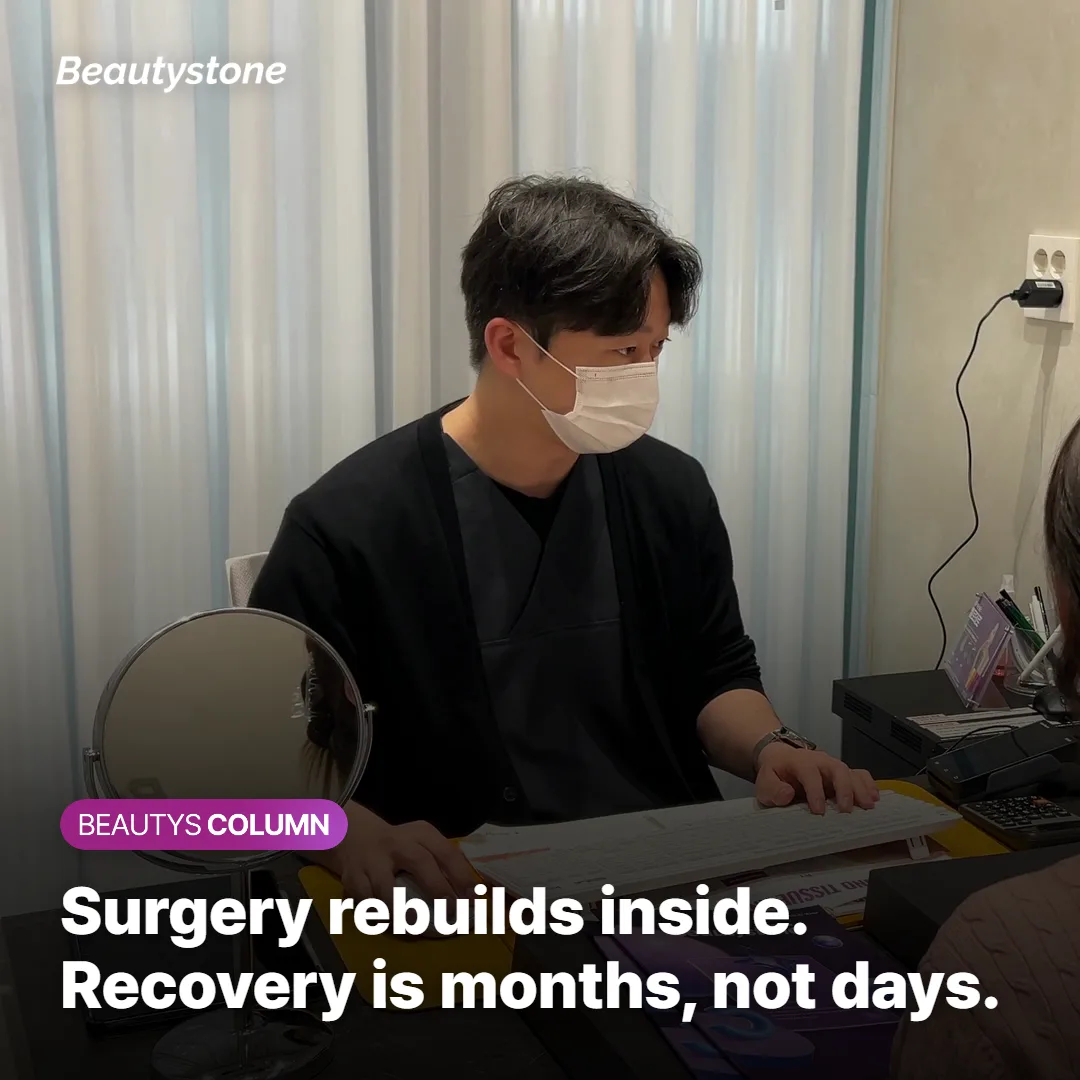
Recovery is the part people underestimate. The splint and any internal packing stay in place for roughly the first week, and once the splint comes off the visible bruising and major swelling begin to fade. The American Society of Plastic Surgeons notes that the nose can keep refining and settling for up to a year as deeper swelling resolves. Even after the first month, when most people are back to their routine, things like strenuous exercise, alcohol, and contact lenses may still be restricted for a while.
| Factor | Nose filler | Rhinoplasty |
|---|---|---|
| How long it lasts | Roughly 6 to 12 months, varying by product and individual | Long-lasting structural change, though normal aging continues |
| Can it be reversed? | Yes, dissolved with an enzyme | Only through revision surgery |
| Recovery | Days | Weeks, with subtle swelling settling over months |
| Cost pattern | Lower per visit, but repeats add up | Higher upfront, typically one time outside revisions |
Reversibility is the difference people think about last and regret ignoring first. Hyaluronic acid filler can usually be dissolved fairly quickly with an enzyme called hyaluronidase, which is a large part of why it feels like a low-commitment starting point. Surgery is a different kind of commitment: once the structure is changed, returning to your original shape is not really on the table, and revision tends to be more complex than the first operation because of scar tissue and altered anatomy.
On cost, treat any figure you find online as orientation rather than a quote, since pricing moves with the clinic, the amount of product or extent of surgery, and where you are. What holds is the shape of the spending: filler is a smaller recurring cost, surgery a larger single one.
What to Settle at the Consultation Before You Book Anything
A consultation is worth more when you arrive with your goal already sorted. Bring a side-profile photo, name the specific change you want in plain words rather than a procedure name, and let the provider tell you which pile it belongs in. If the answer is Pile B, the useful outcome of that visit is a clear referral, not a smaller treatment as a consolation.
- Ask how often this provider treats noses specifically. Nasal anatomy is not interchangeable with cheeks or lips.
- Ask what your goal would realistically look like at its best, and what it would look like if it only partly works.
- Ask what the plan is if you do not like the result, including whether and how quickly it can be dissolved.
- For surgery, ask about board certification and rhinoplasty-specific volume, which is one of the largest factors in how these results go.
Know the warning signs before you need them. Mild redness, swelling, and bruising at the injection site are common and usually settle within a few days. If swelling worsens, spreads, or has not improved after a week, contact your provider. Skin that turns pale, dusky, or unusually painful needs medical attention right away, because filler placed in the wrong plane can compress a vessel. Surgery carries its own list: bleeding, infection, anesthesia reactions, breathing changes, numbness, and asymmetry that may mean a revision later.
Beautystone is a dermatology clinic in the Hapjeong area, and injectable treatment of the nose is handled as a volume question rather than a shortcut around surgery. If your goal sits outside what an injection can reach, you should hear that during the consultation rather than after it. Current offers are listed at /en/promotion.
Frequently Asked Questions
How do I know if my bump is small enough for filler?
The rough test is whether smoothing the line around the bump would satisfy you, or whether you want the bump gone. Filler cannot shave anything down; it can place product above and below a bump so the profile reads as a straighter line. If the bump is prominent enough that camouflaging it would require a noticeably higher bridge overall, that trade is usually a poor one, and a provider examining you in person should say so.
Can nose filler make my nose look smaller?
Not in the sense of reducing it. Filler adds volume, so a nose treated with filler contains slightly more, not less. What some people perceive as a slimmer nose after treatment is really a straighter profile drawing attention along the bridge rather than to the width. If your core concern is size, that is a structural goal and belongs in a surgical consultation instead.
My nose looks crooked. Can filler straighten it?
Partly, and only visually. If the deviation is mild, filling the lower or shadowed side can even out how light falls across the bridge and make the line read straighter in photos. The underlying bone and cartilage stay exactly where they are, so the effect is camouflage rather than correction, and it fades as the product does. A significantly deviated nose, especially one that also affects breathing, is a surgical question.
What warning signs after nose filler mean I should call the clinic right away?
Ordinary redness, swelling, and light bruising in the first couple of days are expected. What is not ordinary is skin that turns pale, white, dusky, or mottled, pain that increases rather than fades, or swelling that spreads and keeps worsening past the first week. Those need to be seen promptly rather than watched at home, because they can indicate a vessel problem. Save the clinic's contact details before your appointment.