

Why Does Skin Sag So Fast During Menopause?
If your skin feels different lately — less lift, less bounce, moisturizer that just sits on top — menopause-related collagen loss is probably part of the story. Here's what's actually happening underneath, and what's worth doing about it.

If you've noticed your skin looking different lately — cheeks that seem to have lost their lift, a jawline that's softer than it used to be, or moisturizer that just sits on top instead of sinking in — you're not imagining it. For a lot of women, skin changes hit hardest right around perimenopause and the years just after, and it can be hard to tell whether it's simple aging or something more specific to this stage of life.
Short answer: menopause triggers a steep drop in collagen, and that drop is the biggest driver behind the sagging, thinning, and dullness so many women notice around this time. The good news is you don't need to jump straight to the most expensive treatment on the menu. Getting the basics right first, then adding targeted support if you need it, tends to work better than chasing a single fix. In this article, we'll cover why collagen drops so quickly during menopause, what to prioritize before you spend money on treatments, and how collagen-boosting options compare to each other.
Why Does Skin Sag So Fast During Menopause?
The short answer comes down to one hormone: estrogen. Estrogen supports the fibroblast activity that keeps your skin producing new collagen, and it also helps your skin hold onto moisture in its deeper layers. When estrogen drops around perimenopause and menopause, collagen production slows down at the same time older collagen starts breaking down faster than usual — a double hit that shows up as thinner, less springy skin.
The timeline can be surprisingly steep. According to a study on postmenopausal skin collagen changes, women can lose roughly 30% of their type I and type III collagen within the first five years after menopause. That's not a slow fade — it's a fairly compressed window where a lot of the visible change happens.
This is part of why so many women feel like their skin changed almost overnight, even though nothing about their routine changed. It's not just aging in the abstract — it's a specific hormonal shift with a fairly predictable pattern, and understanding that pattern makes it easier to figure out what actually helps.
How Deep Does Collagen Loss Go?
Collagen lives in the dermis, the structural layer underneath the surface of your skin. Think of it as scaffolding: it's what keeps skin thick, resilient, and able to bounce back after you smile or squint. When that scaffolding thins out, the layers above it have less support, and that's when you start noticing sagging along the jawline, hollowing in the cheeks, and lines that look more etched-in than they used to.
Because this change happens below the surface, topical products alone typically can't fully reverse it — moisturizer sits on top of skin, it doesn't rebuild the dermis. That doesn't mean skincare doesn't matter (it does, and we'll get to that), but it does explain why some women feel like their usual products stopped working around this stage. The products didn't change. What's underneath them did.
What to Prioritize Before Any Treatment
Before you look at any in-office treatment, the basics matter more than usual during menopause, because whatever collagen you have left is disappearing faster than it used to.
Sun protection: UV exposure breaks down collagen directly, so daily sunscreen isn't optional at this stage. It's arguably the single highest-leverage thing you can do to slow the loss you're already dealing with.
Barrier support: thinner skin tends to lose moisture faster, so a richer moisturizer or one built around ceramides can help your skin hold onto what it has a harder time keeping in on its own.
Collagen-supporting actives: ingredients like retinoids and vitamin C are typically the entry point here. They won't replace lost collagen overnight, but they can support your skin's own production over time.
Here's the practical reason order matters: if the basics aren't in place, even a treatment designed to stimulate collagen has more ground to make up. Getting sun protection and barrier support solid first means any treatment you add later has a better baseline to build on.
Collagen-Boosting Treatments: Boosters vs. Energy-Based Lifting
Once the basics are in place, if sagging or volume loss is still bothering you, it may be worth talking to a provider about treatments that stimulate collagen more directly. Broadly, these fall into two camps: collagen boosters, which are injectables designed to trigger new collagen production, and energy-based lifting, which uses heat — ultrasound or radiofrequency — to reach deeper layers of skin and prompt a similar response.
Research backs up the mechanism, at least on the energy-based side. A study on high-intensity focused ultrasound found that heat delivered to deeper skin layers increased collagen synthesis, which lines up with why treatments like Ultherapy or Thermage are positioned as collagen stimulators rather than instant fixes.
| Category | Collagen Booster | Energy-Based Lifting |
|---|---|---|
| How it works | Injected ingredients trigger new collagen production | Heat (ultrasound or RF) reaches deeper layers to stimulate collagen |
| What it targets | Volume and texture within the skin | Sagging and overall firmness |
| When you'll notice it | Typically a few weeks to a few months | Typically a few weeks to a few months |
Options in the booster category include things like Rejuran, a polynucleotide-based booster, or Sculptra, a PLLA collagen stimulator, while the energy-based side includes treatments like Ultherapy, Thermage, or Oligio. None of these work on day one — they're designed to encourage your skin to rebuild collagen gradually, so results tend to build over weeks rather than show up the day of your appointment.
Which one makes more sense for you really depends on your skin thickness, how much sagging versus volume loss you're dealing with, and how your basic skincare routine is already holding up. That's a conversation worth having with a provider rather than guessing on your own.
Side Effects and Risks to Know
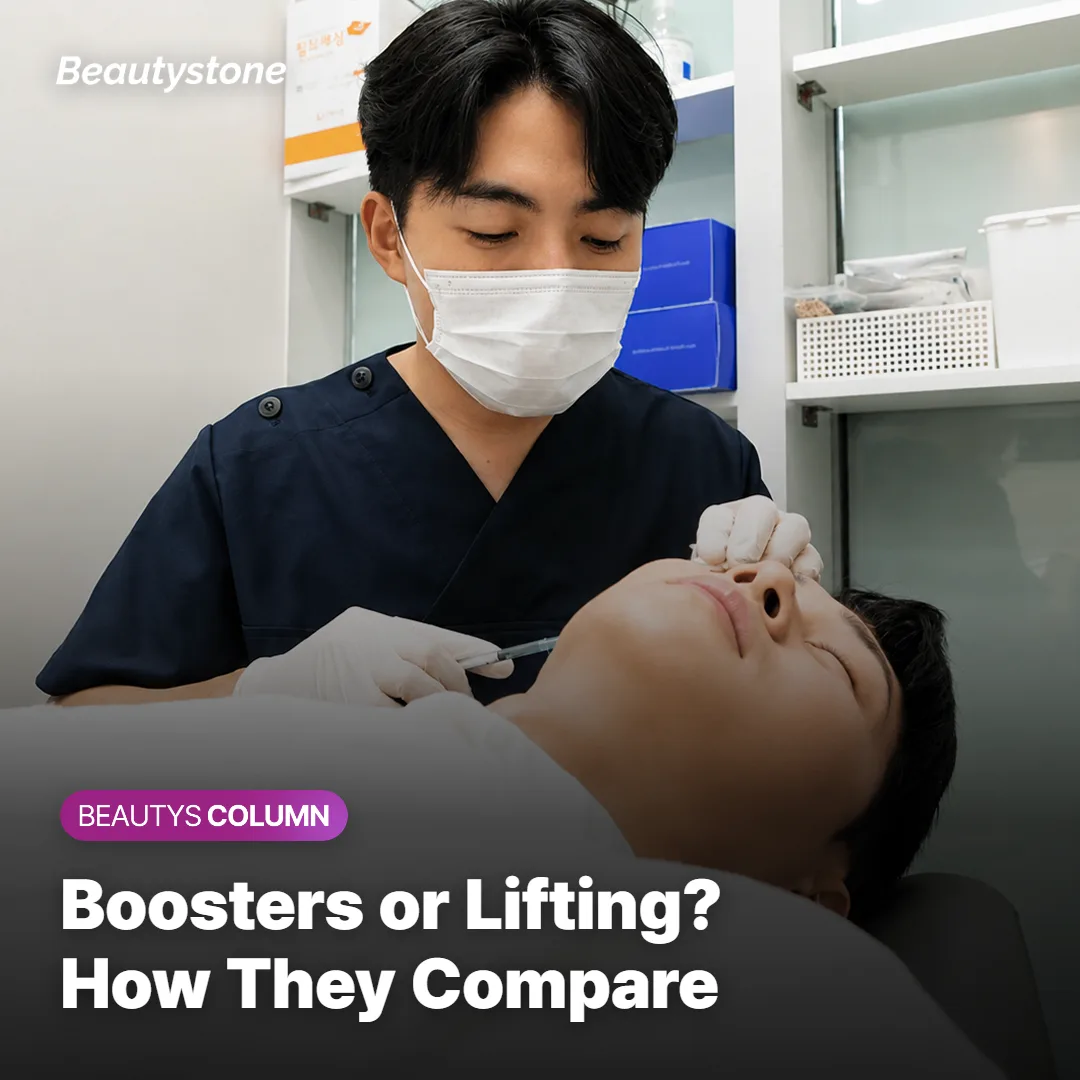
Like any procedure, collagen-stimulating treatments come with trade-offs, and it's worth going in with realistic expectations. Redness and mild swelling are common after energy-based treatments and usually settle within a few days. Injectable boosters can cause temporary bruising or small bumps at the injection site, which typically resolve on their own.
If redness worsens, spreads, or comes with fever, contact your provider right away rather than waiting it out. Individual results vary quite a bit from person to person, depending on skin thickness, how much collagen loss has already happened, and how consistent you are with the basics in between sessions.
It's also worth knowing that these treatments work gradually, not on day one, and none of them are a substitute for sun protection — skipping sunscreen while getting treatments is a bit like bailing out a boat without patching the leak.
Who's a Good Candidate for Treatment?
Not everyone needs to jump into a treatment plan right away. For some women, tightening up the basics is enough for a while. A few things are worth checking before you decide what's next:
- Sun protection habit: if you're not wearing sunscreen daily, that's the fix to make before anything else — it protects whatever collagen you have left.
- Current skin stage: figure out whether thinning, sagging, or dryness is the most noticeable issue for you, since that points toward different priorities.
- Baseline routine: if barrier support and daily protection aren't solid yet, treatments have less to build on.
- Timeline expectations: collagen rebuilding is gradual — expect changes over weeks to months, not overnight.
- Underlying conditions or medications: if you're on hormone therapy or have another condition that affects healing, mention it during a consultation.
Because menopause-related changes move on their own hormonal timeline, a provider who takes the time to look at your specific stage, rather than defaulting straight to the most expensive option, tends to be a better starting point. Beautystone, a dermatology clinic in Seoul's Hapjeong area, is transparent about being a Korean clinic and typically starts by assessing your current skin stage and skincare basics before recommending any treatment, so the plan matches where your skin actually is rather than a one-size-fits-all package.
The Bottom Line
Menopause triggers a real, measurable drop in collagen — not just aging in general — and that drop is steepest in the years right around menopause itself. A few things worth carrying forward:
- Estrogen decline drives collagen loss, with research suggesting up to 30% can disappear within five years of menopause.
- Sun protection and barrier support come first — treatments tend to work better once those basics are solid.
- Collagen boosters and energy-based lifting both stimulate collagen, but through different mechanisms, and results build gradually rather than overnight.
- Side effects like redness and swelling are common and usually settle within days, but worsening symptoms are worth a call to your provider.
Like any procedure, collagen-stimulating treatments come with trade-offs, and no single option works for everyone. Ultimately, the choice depends on your skin, your goals, and your budget. If you're thinking about treatment options for menopause-related skin changes, a consultation is the best way to find out what actually fits your skin. Beautystone is a dermatology clinic in Seoul's Hapjeong area — you can see current offers at /en/promotion.
Frequently Asked Questions
Q1. Do I need a treatment right away, or can skincare alone help?
For a lot of women, skincare basics alone can carry you for a while, especially early on. Sun protection and barrier support are what actually slow the loss, so if you haven't nailed those down yet, that's the place to start before spending money on a treatment. Whether you need more than that depends on how much sagging or volume loss is already showing.
Q2. How much collagen do you actually lose after menopause?
Research suggests it can be substantial and fairly fast — one study found roughly a 30% drop in type I and type III collagen within the first five years after menopause. That's why skin can feel like it changed quickly around this stage, rather than gradually over many years.
Q3. Should I try a collagen booster or a lifting treatment first?
It depends on what's bothering you most. If sagging and firmness are the main issue, energy-based lifting tends to be the starting point. If volume and texture within the skin are the bigger concern, a collagen booster may make more sense. A provider can help you sort out which fits your skin better.
Q4. Can hormone therapy improve my skin, too?
Hormone therapy is a decision made around your overall health, not just your skin, so it's a conversation for your OB-GYN or primary care provider rather than a dermatology clinic. It may have some effect on skin, but it shouldn't be decided on skin appearance alone.