Why Cheeks Sag Years After Cheekbone Reduction
If your cheeks look like they've dropped a year or more after cheekbone (zygoma) reduction surgery, the cause is rarely extra fat. It's more often a support problem — and it has a fairly specific fix.

You had cheekbone reduction surgery. Your face looks narrower, the angles are softer, and for a while everything looked exactly the way you wanted. Then, somewhere around the one-year mark, something shifts. The lower half of your cheeks starts to look heavier. Your nasolabial folds seem deeper in photos, even though you haven't gained weight. If you've searched "sagging after zygoma reduction" more than once, you're not alone — it's one of the more common follow-up questions patients bring to consultations. In this article, we'll cover why this kind of sagging happens, why it's usually not about weight, and what a targeted filler approach (sometimes called the "MD Code" technique) can and can't do about it.
What Is Post-Zygoma Reduction Sagging?
Post-zygoma reduction sagging is the drooping or heaviness that shows up in the mid-face, usually six months to two years after cheekbone (zygomatic) reduction surgery. It's not the same thing as normal facial aging, and it's rarely caused by weight gain, even though that's the first thing most people suspect.
Here's the short version: cheekbone reduction removes or repositions bone, which narrows the face. But the skin, fat, ligaments, and connective tissue that used to sit on top of that bone don't shrink at the same rate. They're left with less structure underneath them, and over time, gravity does the rest.
So the face gets narrower — which is usually the goal — but the soft tissue can end up looking like it's "pooling" lower on the face, especially around the nasolabial folds and lower cheeks.
Why Does Your Face Sag a Year (or More) After Cheekbone Reduction Surgery?
The tissue involved here is more than skin. Providers usually think about it in three layers: the skin itself, the subcutaneous fat underneath it, and a thin fibrous layer called the SMAS (superficial musculoaponeurotic system) that connects your facial muscles to your skin. Ligaments — including the zygomatic ligament and the masseteric cutaneous ligament — anchor all of that to the bone at specific points.
When the cheekbone is reduced, the outer wall those ligaments were anchored to gets lower. The soft tissue doesn't disappear — it just loses part of its scaffolding. Over months, the mid-face tissue tends to drift down and inward, toward the nasolabial folds, because that's the path of least resistance once the lateral support is gone.
That's why patients often say the same thing: their face looks smaller from the front, but heavier from a three-quarter angle, especially in photos. It's not new fat and it's not sudden aging — it's tissue settling into the space that used to be held up by bone and ligament.
A useful way to think about it: don't just ask where the tissue looks like it dropped. Ask where the support disappeared from. Those are often two different spots — usually the temple and the posterior cheek (the area just in front of the ear and above the jaw), rather than the front of the cheek where the sagging is most visible.

How Support-Point Filler (the "MD Code" Approach) Restores Structure
The instinct is usually to fill in the fold or the area that looks sunken. In a lot of post-zygoma-reduction cases, that's actually the wrong starting point, and it can make the mid-face look heavier instead of lifted. If the front of the cheek is where tissue has already migrated to, adding more volume there just adds to what's already sitting low.
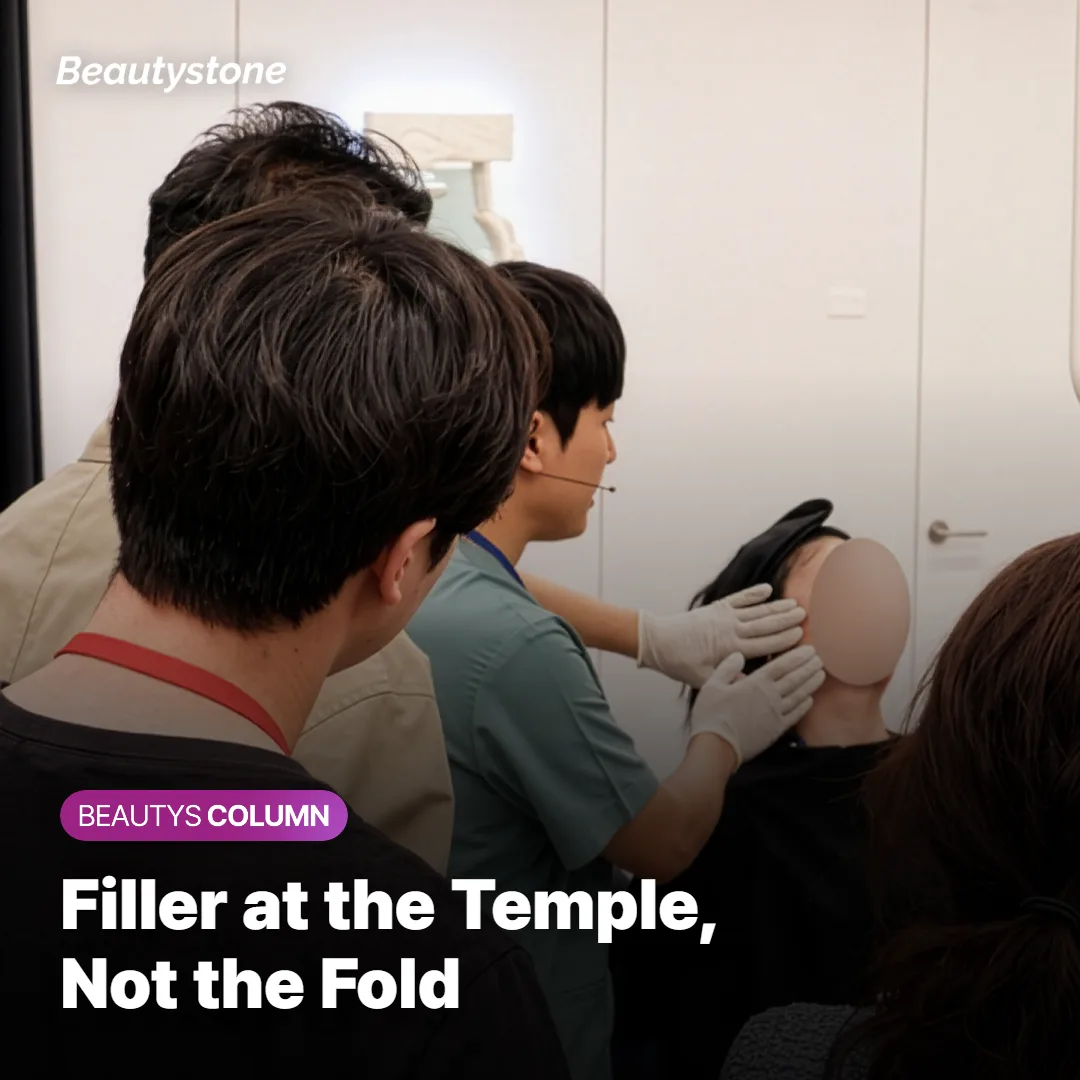
A structural, or "support-point," filler approach — sometimes labeled the MD Code technique in Korean aesthetic medicine — works differently. Instead of filling the visible hollow or fold directly, it places filler at specific anchor points along the temple and posterior cheek, rebuilding the lateral support the bone used to provide. When those points are re-established, the sagging mid-face tissue has something to rest against again, and the pull toward the nasolabial fold softens.
This is also why providers who focus on this technique tend to talk about placement more than volume. Injecting a large amount into the front of the cheek can make the face look wider again, which is often the opposite of what patients want after having reduction surgery in the first place. Rebuilding the support points first, then reassessing, tends to produce a result that reads as "lifted" rather than "filled."
What to Expect: Timeline and Number of Sessions
Here's a general timeline for support-point filler after cheekbone reduction, though your provider will adjust it based on how much lateral support you've lost and how much skin laxity is involved.
- Day of treatment: Mild swelling and pinpoint bruising at injection sites are common and usually settle within a few days.
- First 1–2 weeks: Initial swelling resolves and the filler starts to settle into place. The lifted effect at this stage is usually more visible than the final result.
- 4–6 weeks: Most of the swelling is gone and the support effect is easier to judge accurately — this is typically when a provider will check whether additional filler is needed.
- Ongoing: Results from hyaluronic acid filler in this area commonly last around 9–18 months, though this varies by product, metabolism, and how much structural support was needed to begin with.
Providers who use this approach often start conservatively — establishing the support points first — rather than correcting everything in one session. Going in heavy on the first visit can make the face look wider again, which tends to work against the reason patients chose reduction surgery.
Filler vs. Lifting vs. Surgical Revision: Choosing the Right Fix
Not every case of post-zygoma-reduction sagging responds the same way, and the right first step usually depends on what's actually causing the look, not just where it shows up.
| What You See | Likely Cause | Where to Start |
|---|---|---|
| Hollow temples and flat posterior cheeks | Loss of lateral support points | Support-point (MD Code) filler |
| Heaviness above the nasolabial folds | Soft tissue that has already migrated downward | Support-point filler, plus a lifting device (like Ultherapy or Shurink) if skin tone is also loose |
| Visible skin folding or excess | Reduced skin elasticity, not just volume loss | Consultation for lifting or surgical revision |
| One side noticeably lower than the other | Asymmetric bone or tissue changes after surgery | In-person asymmetry evaluation before any correction |
HIFU devices like Ultherapy or Shurink are sometimes brought up as a first option, since they're associated with lifting. They're not a bad idea in the right case, but depth matters here. These devices commonly target the SMAS layer at a depth of around 4.5mm, which tends to be most effective where subcutaneous fat is roughly 3mm or so. Cheek tissue after zygoma reduction doesn't always fit that profile evenly, so going straight to a lifting device without addressing lost support points first can be underwhelming. Sequencing — what gets treated first — tends to matter more than which single device or product is used.

Side Effects and Risks of Support-Point Filler
Support-point filler in the temple and posterior cheek is a fairly established technique, but it isn't risk-free, and it isn't the right fit for every case.
- Bruising and swelling: Common at injection sites and usually resolves within a few days to a week.
- Temporary asymmetry: Some unevenness right after treatment is normal while swelling settles; it typically balances out within 1–2 weeks.
- Under- or over-correction: Because placement matters more than volume here, an inexperienced injector can add filler in the wrong spot and make the face look wider instead of lifted.
- Vascular risk: The temple has notable blood vessels nearby, so this area should only be treated by a provider familiar with facial vascular anatomy. Sudden, severe pain, skin blanching, or a dusky/purple discoloration after injection needs medical attention right away.
- Limited effect on lax skin: If the sagging is mostly from stretched-out skin rather than lost support, filler alone won't fully resolve it — a provider may recommend lifting or surgical options instead.
A thorough consultation, including a hands-on assessment of where support is actually missing, is what separates a good outcome here from a disappointing one.
How Much Does It Cost?
Cost for support-point filler after cheekbone reduction varies quite a bit depending on how many anchor points need to be treated, the type and amount of filler used, and whether a lifting device is added to the plan. Clinics in Seoul, including Beautystone in the Hapjeong area, typically price this by syringe count and treatment plan rather than a single flat fee, since every case starts from a different amount of lost support.
Because pricing depends so much on individual anatomy — and on whether a combination approach is recommended — a consultation is really the best way to get an accurate number for your case. Current offers and pricing details are usually listed at /en/promotion.
The Bottom Line
If your face looks like it's sagging a year or more after cheekbone reduction, the instinct to fill the visible hollow or fold is understandable — but it's often not where the actual problem is. In a lot of these cases, the issue is a lost support point at the temple or posterior cheek, not extra volume or extra weight up front.
- Sagging after zygoma reduction usually comes from lost ligament and bone support, not weight gain.
- Filling the front of the cheek directly can make the mid-face look heavier rather than lifted.
- Support-point (MD Code) filler at the temple and posterior cheek often restores a more natural lift by rebuilding structure, not just volume.
- Lax skin or clear asymmetry may need lifting devices or a surgical consultation in addition to filler.
Like any procedure, this comes with trade-offs, and results vary from person to person depending on skin quality and how much support was lost. Ultimately, the right approach depends on your anatomy, your goals, and your budget. If you're considering treatment for sagging after cheekbone reduction, a consultation is the best way to find out what fits you — Beautystone is a dermatology clinic in Seoul's Hapjeong area, and you can see current offers at /en/promotion.
Frequently Asked Questions
Q1. Can filler alone fix sagging after cheekbone reduction?
In many cases, yes — if the sagging is mainly from lost support at the temple and posterior cheek rather than excess, lax skin. If the skin itself has stretched out and is folding, filler alone usually isn't enough, and a provider may suggest adding a lifting device or discussing surgical revision.
Q2. How many sessions does support-point filler usually take?
Most providers start with one session to establish the support points, then reassess after the swelling fully settles, usually around 4–6 weeks later. Going heavy in a single session can make the face look wider again, so a more conservative, staged approach is common.
Q3. Can this be combined with Ultherapy or Shurink?
Yes, and it's a common combination when skin tone is also loose. That said, sequencing matters — rebuilding lost support points first tends to give a lifting device like Ultherapy or Shurink something more solid to work with.
Q4. Is it safe to inject filler in this area again after surgery?
It can be, but the temple in particular has notable blood vessels nearby, so this should only be done by a provider experienced with post-surgical facial anatomy. A proper consultation and hands-on assessment beforehand is essential for safety.