Why Won't a Double Chin Shrink With Diet?
Losing weight but your double chin isn't budging? An enlarged submandibular gland, not fat, might be the real cause, and it calls for a different approach altogether.

Last updated: July 2026
If you've been eating clean and hitting the gym for months, but that stubborn pocket under your chin hasn't budged an inch, you're not imagining things. Fat isn't always the full story. In some people, a healthy but oversized submandibular gland — one of the salivary glands tucked under the jaw — is doing most of the work, and no diet plan touches gland tissue.
The short answer? Weight loss shrinks fat cells. It doesn't shrink glands. If a gland is driving the look, you need a different game plan altogether.
In this article, we'll cover what the submandibular gland actually does, how it can make a double chin look worse than it is, how to tell whether fat or gland is behind yours, and what submandibular gland Botox can (and can't) do about it.
What's Really Under That Double Chin?
There's more going on under your jaw than most people realize. Three things typically build volume there: fat, muscle (mainly the digastric and mylohyoid), and the submandibular gland itself.
The submandibular gland is one of your major salivary glands — it's part of the system that produces saliva, working quietly behind the scenes every time you eat. It's not something you'd normally think about, until it starts affecting how your jawline looks.
Here's the detail that matters: this gland doesn't sit in the center of your neck. It sits off to the side, tucked along the inner edge of the jawbone, one on each side. That positioning is exactly why it can throw off an otherwise slim jawline.
How the Submandibular Gland Makes It Worse
Because the gland sits laterally rather than centrally, an enlarged one doesn't just add a little fullness underneath — it pushes outward along the sides of the jaw. Looked at head-on, that reads as a wider, more sagging chin line, even if the center of your chin is perfectly lean.
This is exactly why fat alone doesn't explain every double chin. You can lose the fat and still be left with that side-heavy fullness, because the gland tissue never went anywhere. Diet, cardio, and even fat-dissolving injections work on adipose tissue — they don't touch glandular tissue.
We see this pattern often: someone has already tried liposuction or a fat-dissolving injection elsewhere, the center looks flatter, but the sides look exactly the same. That's usually a sign the gland was the bigger piece of the puzzle all along.
Fat or Gland? How to Tell the Difference
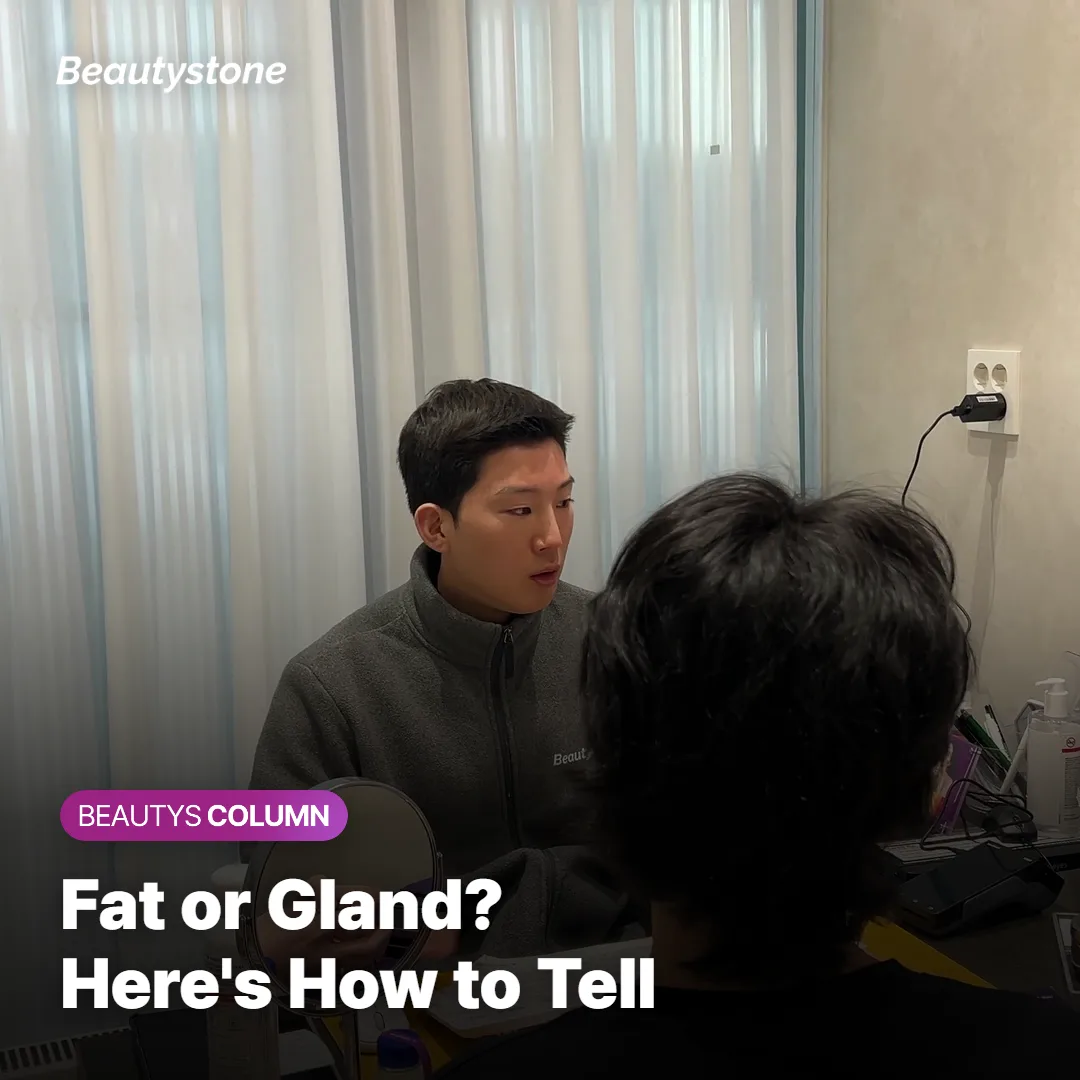
Honestly, telling the two apart just by looking is hard, and plenty of people have some of both. That said, there's a simple, low-tech way to get a sense of what you're dealing with before you ever book a consultation.
Press two fingers gently along the underside of your jaw, toward the sides rather than dead center. If it feels soft and easy to compress, you're likely feeling mostly fat. If you find a firmer, more defined lump that doesn't give much, that's more consistent with gland tissue.
A hands-on exam, and sometimes an ultrasound, is still the only way to know for certain, but the at-home check is a reasonable starting point.
| Sign | Fat-Based Double Chin | Gland-Based Double Chin |
|---|---|---|
| Feel | Soft, compressible | Firm, lump-like |
| Location | Spread evenly under the chin | Concentrated along the sides of the jaw |
| Response to weight loss | Usually shrinks somewhat | Rarely changes |
| Response to fat-dissolving injections | Often effective | Limited |
| Typical approach | Fat-dissolving injections, liposuction | Submandibular gland Botox, sometimes surgery |
If that table sounds like you have a bit of both — a soft center and a firmer side — that's common too. Providers often treat fat and gland issues together rather than picking just one.
How Submandibular Gland Botox Works
If a gland turns out to be the main issue, surgery isn't automatically the answer. Injecting Botox directly into the submandibular gland can shrink it temporarily by dialing down the amount of saliva it produces.
Botox is FDA-approved for a range of medical and cosmetic uses, but using it specifically to shrink the submandibular gland for a slimmer jawline is considered an off-label application, so it's worth having a thorough conversation with your provider before moving forward.
Here's what it doesn't do: it doesn't touch your ability to chew. Chewing is a job for the masseter muscle, a completely separate structure from the salivary gland. What it can affect, at least temporarily, is saliva output, which is where the trade-offs come in (more on that below).
Because the gland gradually returns toward its original size, results aren't permanent. Most providers plan for periodic repeat sessions rather than a one-and-done fix. For people with real gland volume who haven't responded to other approaches, though, it's still a legitimate, non-surgical option worth considering. In many cases, a provider will treat fat and gland issues at the same visit if both are contributing.
Side Effects and Risks to Know About
- Dry mouth: A temporary drop in saliva production is the most talked-about side effect. It doesn't affect everyone, and when it happens, it tends to ease up on its own.
- Chewing and eating: Since the masseter muscle isn't involved, most people notice zero difference in how they chew.
- Repeat treatment: Because the gland regenerates, effects fade over time, and touch-ups are part of the plan, not a sign anything went wrong.
- When to seek care: Sudden swelling on just one side, fever, or real pain after treatment isn't typical — if that happens, seek medical care right away, since it could point to an unrelated issue like a blocked duct or infection rather than a treatment side effect.
As with any procedure, individual results vary, and your provider is the best judge of whether this approach fits your anatomy and health history.

How Much Does It Cost, and Is It Worth It?
Pricing for submandibular gland Botox varies quite a bit depending on the clinic, how much gland tissue needs treating, and whether fat is being addressed in the same session. There isn't a single flat number that applies to everyone.
Whether it's worth it really comes down to what's driving your double chin in the first place. If fat is the main issue, gland Botox on its own won't get you the change you're picturing. If the gland is genuinely the bigger contributor, and you've already tried fat-focused options without much luck, this is one of the few non-surgical paths left to explore.
A consultation is really the only way to get a plan (and a price) that's actually about your face rather than a generic estimate. You can see current offers at /en/promotion for a starting point on cost.
The Bottom Line
Here's the short version:
- A double chin isn't always about fat. The submandibular gland, positioned along the sides of the jaw, can be a major contributor.
- Pressing gently along your jawline gives you a rough sense of fat versus gland, though a proper exam is more reliable.
- Submandibular gland Botox can shrink an oversized gland temporarily, without surgery, though it comes with trade-offs like occasional dry mouth and the need for repeat sessions.
- Like any procedure, it comes with trade-offs, and it isn't the right fit for every double chin.
Ultimately, the choice depends on what's actually happening under your jaw, and figuring that out starts with an honest assessment rather than guesswork. If you're considering submandibular gland Botox, a consultation is the best way to find out what fits you. Beautystone is a dermatology clinic in Seoul's Hapjeong area — see current offers at /en/promotion.
Frequently Asked Questions
Q1. Is an enlarged submandibular gland a health problem?
In most cases, no. The gland typically still functions normally, and its size on its own isn't a medical concern. That said, if you notice sudden, one-sided swelling, pain, or fever, that's a different situation, and it's worth seeing a doctor to rule out a blocked duct or infection rather than assuming it's just cosmetic.
Q2. Does submandibular gland Botox affect chewing or eating?
No. Chewing depends on the masseter muscle, which is a completely separate structure from the submandibular gland. Some people notice temporary dry mouth after treatment, but chewing function itself typically isn't affected.
Q3. How can I tell if my double chin is fat, not gland?
Press gently along the sides of your jaw. Soft, easily compressible tissue usually points to fat, while a firmer, more defined lump is more consistent with gland tissue. It's a useful starting point, but a hands-on exam, sometimes with ultrasound, gives a clearer answer.
Q4. How long do submandibular gland Botox results last?
Results aren't permanent. The gland gradually returns toward its original size over time, so most providers plan for periodic repeat sessions rather than a single treatment. Individual results vary, so your provider can give you a more specific timeline based on your anatomy.