Restylane vs Juvederm: Same Ingredient?

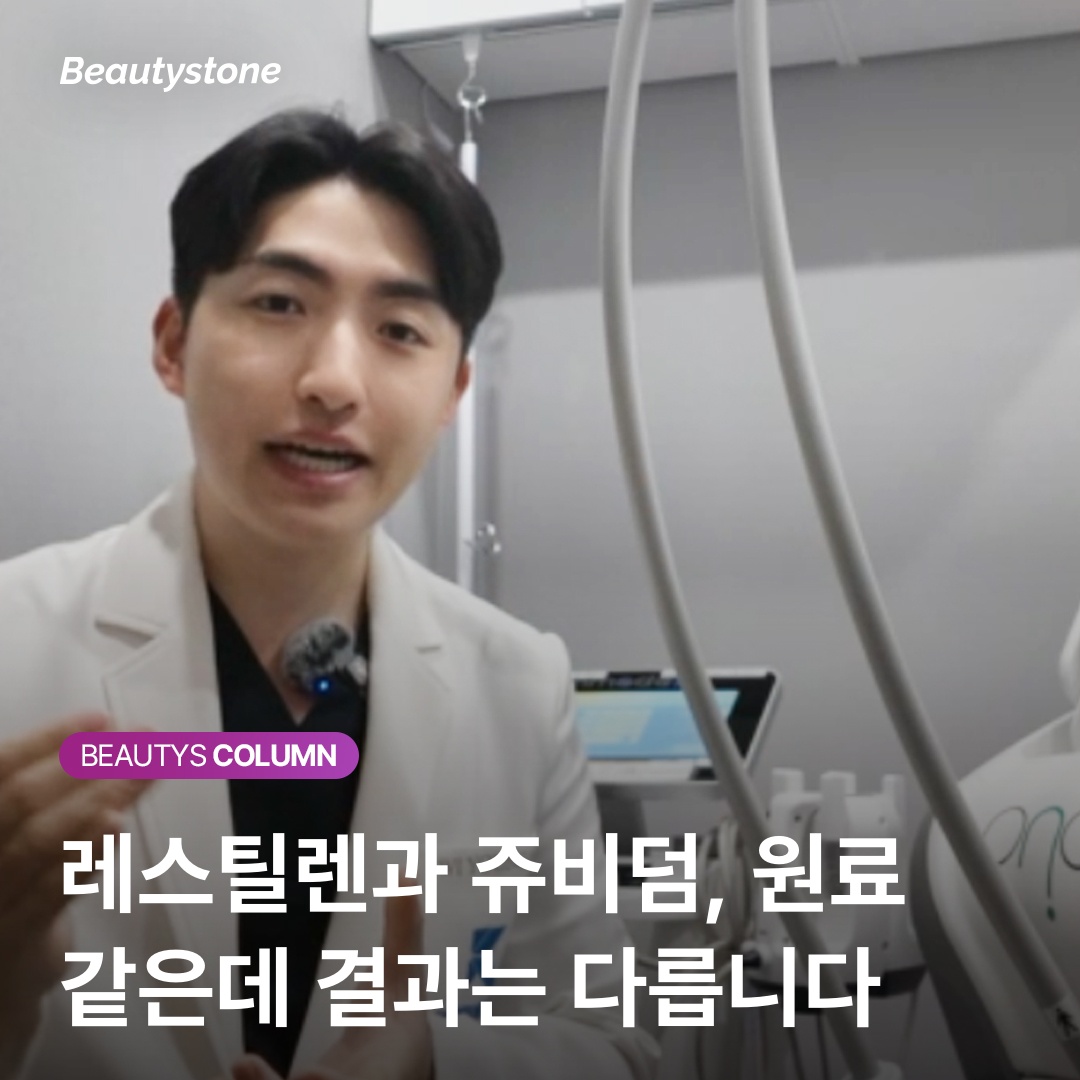
Restylane vs. Juvederm: Same Ingredient, Different Results
Last Thursday, a woman in her early 40s came to my clinic.
She had received filler for her nasolabial folds at another clinic and asked,
"They told me Juvederm was the more expensive option,
so why did my friend get more natural results with Restylane?"
This is quite a common misconception - many patients think
that the more expensive option is automatically better.

Here's what makes them different
Restylane is a hyaluronic acid-based filler
manufactured by Galderma in Sweden.
Juvederm is produced by Allergan (now AbbVie) in the United States.
Both use the same core ingredient: hyaluronic acid.
But here's the crucial difference:
While the base ingredient is identical, the 'cross-linking technology' differs.
Restylane uses NASHA and OBT technologies,
while Juvederm employs VYCROSS and HYLACROSS techniques.
This difference affects how the product spreads in tissue,
duration of results, and firmness - even with the same volume injected.
Understanding this difference makes choosing easier
"Restylane is Galderma's hyaluronic acid filler.
While it shares the same base ingredient as Juvederm, the manufacturing process differs, resulting in variations in tissue compatibility and longevity.
The optimal product choice depends on the treatment area.
"
— Dr. Wi Young-jin (Beautystone Clinic, Hongdae)
Restylane is Galderma's hyaluronic acid filler.
While it shares the same base ingredient as Juvederm,
the manufacturing process differs, resulting in variations in
tissue compatibility and longevity.
The optimal product choice depends on the treatment area.
Looking at that patient I mentioned earlier,
I noticed she had thin skin and very expressive facial movements.
For someone like her, injecting a product like Juvederm Voluma
deep into the nasolabial folds
can easily create clumping or a lumpy appearance when smiling.
In contrast, her friend received Restylane Lyft,
which uses NASHA technology
with firmer particles that spread less into surrounding tissue.
This provides excellent support without interfering with natural facial expressions.
To put this in numbers,
NASHA products have approximately 1% cross-linking ratio
with relatively firm gel particles.
OBT (XpresHAn) products are enhanced for flexibility,
making them ideal for areas with frequent movement.
Juvederm VYCROSS offers high concentration and high elasticity,
providing superior volumizing power.
Honestly speaking, neither is inherently 'better' -
the answer depends on the treatment area and individual skin characteristics.

Dr. Wi Young-jin's Key Summary
It's not about Restylane being
better or worse than Juvederm.
For delicate areas like under-eyes,
high-movement areas like around the mouth,
or areas requiring structural support like the chin.
Each area has its ideal product match.
Here's how I categorize in my practice
While each case varies,
this is generally how I approach consultations.
However, there are some considerations.
One important point I must mention:
Restylane NASHA series, due to its firmness,
may feel slightly palpable during the first 1-2 weeks after treatment.
For patients with thin skin, this might appear as slight irregularities.
However, this can be well-controlled
through proper injection depth and volume adjustment.

Three most common questions from my clinic
Q1. Can I exercise immediately after Restylane treatment?
A. I recommend avoiding exercise on the treatment day and the following day.
Increased blood flow can prolong swelling,
and excessive movement before the filler settles
may cause it to shift to unexpected positions.
Light walking is generally fine.
Q2. How long do the results last?
A. Duration varies by area and product type,
but typically Restylane Lyft and Volyme last 12-18 months,
while Refyne and Defyne last 9-12 months.
In thin-skinned areas like under the eyes,
results often last even longer
due to minimal movement in these areas.
Q3. I'm concerned about side effects - is it safe?
A. A major advantage of hyaluronic acid fillers is that
if problems occur, they can be dissolved
using an enzyme called hyaluronidase.
However, if accidentally injected into blood vessels,
serious complications like skin necrosis can occur,
so it's crucial to choose a physician well-versed in facial anatomy.
If you experience excessive pain or color changes after treatment,
you should return to the clinic immediately.
I hope today's post was helpful. This was Dr. Wi Young-jin.